2025 Honors College Dean’s Prize recipients named
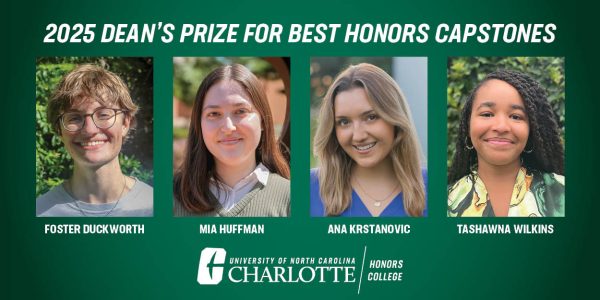
Foster Duckworth, Mia Huffman, Ana Krstanovic and Tashawna Wilkins received the 2025 Dean’s Prize for outstanding honors capstone theses/projects at a virtual ceremony held this summer. They were nominated by their honors program directors for outstanding research, and each received a $500 prize.
To qualify for the Dean’s Prize, candidates must be in good standing with their honors program, maintain a minimum 3.5 overall GPA and embody the Honors College core value of mutual investment.
“The Dean’s Prize highlights the depth of thought and commitment our honors students bring to their projects,” said Malin Pereira, dean of the Honors College. “This year’s recipients are true models of academic excellence for the Honors College and the University.”
Foster Duckworth analyzed how 19th-century Western notions of indigeneity and the role of alcohol contributed to constructing the image of the Ainu of Japan in the eyes of American employees of the Hokkaido Development Commission.
“It means a lot to me for my research to be recognized by professors and academics who I look up to and aspire to be,” said Duckworth. “This project has shown me that I’m capable of producing high-quality historical research that addresses research gaps and I’m honored to be a recipient.”
“This thesis belongs among the best 10 percent of honors theses submitted in our program in the last four years because of the originality and ambition of its research question and strong primary source analysis,” said Maren Ehlers, associate professor of history and honors program director.
Duckworth, a history major who is expected to graduate in spring 2026, is applying to graduate schools to further his education in Japanese history and colonial and indigenous studies.
“I don’t think I’d feel as capable as a researcher or that my goals in academia were realistic if it weren’t for all the encouragement and reassurance my professors have given me, and the faith in my success they have shown me in the last three years I’ve spent at UNC Charlotte,” said Duckworth.
Mia Huffman examined the relationship between social support, emerging adulthood and prisoner reentry outcomes to analyze factors that predict successful reentry to inform criminal justice policies and practices.
“Receiving the Dean’s Prize is an incredible honor and validates that my research is meaningful and impactful,” said Huffman. “In continuing my work within criminology, this award gives me confidence that I can make a difference in my field through research.”
“Mia’s ability to explain research in front of a group was not only better than most graduate students, but she even outperformed some applicants that we’ve had for faculty lines,” said John Stogner, professor of criminal justice and criminology and honors program director.
Huffman is attending the University of Maryland College Park this fall to earn a Ph.D. in criminology and criminal justice.
“My time at UNC Charlotte has been so pivotal in my development as a student, community member and individual,” said Huffman. “The freedom to explore my interests, combined with comprehensive education and innovative opportunities, has prepared me for further education and a successful career within research.”
Ana Krstanovic examined the educational, societal and informational gaps that news media coverage has created following the overturning of Roe v. Wade.
“Receiving the Dean’s Prize is an unbelievable honor, one that I cannot express enough gratitude for,” said Krstanovic. “UNC Charlotte has provided me with endless assistance, encouragement and strength. I feel unbelievably blessed to have been a part of this phenomenal school, furthering my education and meeting incredibly talented people.”
“The amount of work Ana has performed and her demonstration of competency in the area of statistical research easily rises to the level I would expect from our top graduating master’s students,” said Tiffany Gallicano, associate professor of communication studies and honors program director.
This summer, Krystanovic was an intern with UNC Charlotte’s Office of Emergency Management and is now attending graduate school and working as a graduate teaching assistant with UNC Charlotte’s Department of Political Science and Public Administration.
“All of these amazing experiences would not have been possible without the foundation that UNC Charlotte provided me,” said Krstanovic. “I am indebted to the Department of Communication Studies for all of its guidance on this project.”
Tashawna Wilkins explored how participation in arts-based programs influences the future outlooks for youth of color.
“It is an incredible honor to receive the Dean’s Prize and to know that my work was well-received by the Honors Faculty Committee,” said Wilkins, a Levine Scholar. “The students I interviewed and observed impacted me greatly, and I’m glad to know I did their stories justice.”
“Some of the distinguishing strengths of Tashawna’s thesis are the degree to which she invested time in the field to build rapport with the mentor-artists and the students at her research sites,” said Victoria Rankin, associate teaching professor of sociology and honors program director. “I am not aware of another undergraduate honors thesis that has engaged in this many hours of field work and made such extensive use of field notes to produce interesting findings.”
Wilkins completed a summer internship with Wake County Community Services and is now pursuing a master’s degree at UNC Charlotte in public administration and will be a graduate assistant.
“My time at UNC Charlotte has instilled in me the confidence and skills I need to pursue my goals,” said Wilkins. “I met so many great people who have led me to where I am now. My professors introduced me to new experiences and opportunities that have allowed me to practice new skills that apply to various professional and personal settings.”
The Dean’s Prize is possible through the generosity of three friends of the Honors College, Harry Creemers, Delbridge Narron and Murray Webster. Creemers was the University Advancement Division administrator who helped launch the Honors College Advisory Board and has supported fundraising initiatives in the college for many years. Webster and Narron have taught courses in the Honors College. In addition, Narron supports two scholarships in the college and served as inaugural chair of the advisory board; and Webster chaired the Honors Council. Additional support for these prizes came from gifts during the Niner Nation Gives campaign.