Breaking the ice: A rare dive into the Arctic’s secrets
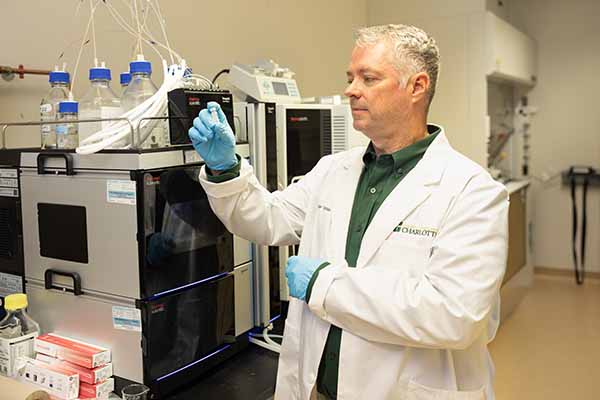
In a first-of-its-kind project to study one of the planet’s last unexplored environments, Roger Tipton, UNC Charlotte research associate professor of mechanical engineering and engineering science, is leading a team of researchers from multiple universities that will investigate contaminants in the Arctic’s pristine waters. This rare opportunity has become possible with the recent weakening and melting of the Arctic ice field. The research of Tipton and his team will provide a first-ever, critical baseline on water pollutants such as perfluoroalkyl and polyfluoroalkyl substances or PFAS.
Tipton explains the implications of this work:
What is this significance of this new research opportunity?
The central Arctic has very limited studies for pollution, mostly concentrating on the surrounding regions like Canada, northern Europe, Alaska and Greenland. This expedition lets us fill that gap. With support from the National Science Foundation, a member of the team is joining a rare voyage through the Arctic to collect and analyze data that will help us understand the region’s environmental health.
What will your team test in the water?
Our main focus is to test for PFAS chemicals in the Arctic, but we’ll also measure other characteristics of seawater like salinity, which can tell us where the water originated. Different depths in the Arctic hold water from different sources, like northern Europe or North America, and each has its own salinity signature. By tracking these differences, we can map the hidden flows within the ocean.
What are PFAS chemicals and why are they dangerous?
PFAS are synthetic chemicals that are used in a variety of products and released into the environment. They’re often referred to as “forever chemicals” because they don’t break down in the environment or human body. Over time, these chemicals can accumulate in humans and lead to long-term health risks.
Are any students working with you on this project?
Absolutely. Our graduate students at UNC Charlotte will be deeply involved. They’ll analyze and interpret rare seawater samples and take ownership of real-world science. The students will get to publish articles on their research and present at conferences to share this data. Our students also will work with a local school, Hough High School in Cornelius, to give live Zoom presentations of research aboard the ship to science and engineering classes to drive teen interest in STEM. It’s an incredible way to train the next generation of scientists.
Why would a baseline measurement of possible contamination in the Arctic matter to the global community?
All the world’s oceans are connected. Pollution in one place can eventually reach another through ocean currents. We already see small amounts of PFAS at the edges of the Arctic, and I expect we’ll find them in the central Arctic, too. This is a rare, once-in-history chance to gather baseline data before increased external factors change the region. What we collect now will be the reference point for understanding how the Arctic evolves over the next century and longer.
What will be the legacy of this project?
I hope the legacy is that we use this data to keep the Arctic environment a wonderful, pristine and beautiful place. In an effort to protect the environment, nations across the globe can use this data to guide responsible use as the region opens to shipping and mining.