Charlotte researcher unlocking breakthroughs in autoimmune disease treatment
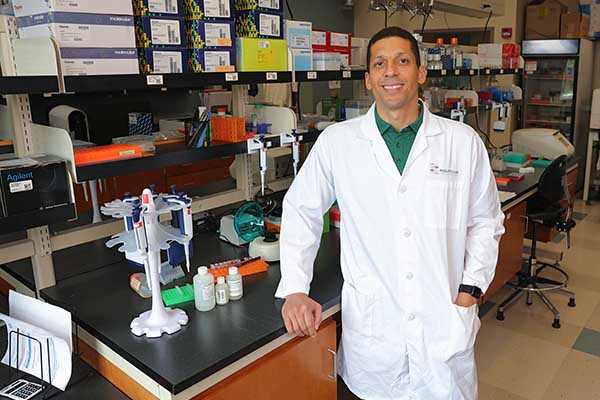
UNC Charlotte researcher Danillo Augusto, Ph.D., was recently awarded a $3.7 million dollar grant from the National Institutes of Health for an immunomics project that is using a new approach to study human immune response and autoimmune diseases.
Augusto and his research team are employing a novel method using long-read sequencing technology, a first-of-its-kind of research design to examine an extremely complex portion of the human genome to map how it interacts with pathogens, eliciting autoimmune response.
Understanding the host-pathogen interaction could unlock more discoveries for mitigating autoimmune diseases.
“The genomic region that we are studying is like a hot spot for disease association,” said Augusto. “In this very large region, there are approximately 170 genes and about 50 percent of them are directly related to the immune system. The research could have a large impact on how we understand human immune response and multiple diseases.”
This type of research, called immunomics, studies how differences in the genes of an individual’s immune system affects the way we respond to pathogens, like viruses and bacteria. These genetic differences can influence whether our body fights off an infection effectively or, in some cases, reacts in a harmful way that causes disease.
The research uses advanced gene sequencing techniques and laboratory analysis, and requires enormous computing power to analyze the large, complex datasets.
The Augusto lab in the Klein College of Science is home to the world’s largest repository of samples from patients with Pemphigus Foliaceus, an autoimmune condition that causes painful blisters in the skin.
“It’s like a puzzle, and we have to align all of the gene sequences to find where they overlap to create the whole picture,” said Augusto, assistant professor of biological sciences. “We sequence the entire region, and we can compare individuals or groups of individuals to find commonalities in their gene expression.”
The grant application scored in the top two percentile for all the grants under consideration from the National Institute of Allergy and Infectious Diseases within the NIH and is currently the largest active NIH grant at UNC Charlotte.
Read the full story on the Klein College of Science website at https://science.charlotte.edu/2025/09/03/charlotte-research-aims-to-unlock-breakthroughs-in-autoimmune-disease-treatment-with-3-7m-grant/.