Vote in this year’s Mecklenburg County local elections
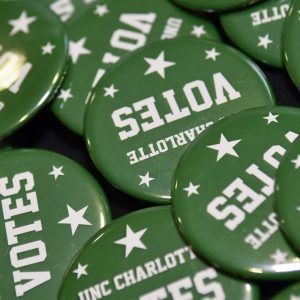
Are you ready to vote in this year’s local elections? In Mecklenburg County, polls are open for early voting. You can get involved in this election season by researching candidate platforms, discussing the issues, volunteering to support get-out-the-vote efforts or voting.
Key dates for the upcoming election
- Thursday, Oct. 16, through Saturday, Nov. 1: Early Voting
- Tuesday, Oct. 21: Deadline to request an absentee ballot
- Tuesday, Nov. 4: Election Day
Early voting has started for this year’s local elections
If you live in Mecklenburg County but are not yet registered to vote, you can register during the in-person early voting period. After registering, you can immediately vote at that same site. This process is called “same-day registration.”
You may register and vote in person at any early voting site in your county. Here is a list of early voting locations in Mecklenburg County. The University City Regional Library is the closest early voting site to UNC Charlotte’s main campus. To register and vote at the same time in local elections, you must prove that you live in Mecklenburg County. If you live on campus, you can use your housing.charlotte.edu account as your proof of address. If you live off campus, you must use any of the following documents that includes your current address:
- North Carolina driver’s license.
- Other photo identification issued by a government agency, provided that the card includes your current name and address.
- A copy of a current utility bill, bank statement, government check, paycheck, or other government document showing your name and address.
On Election Day, you must vote in your designated precinct. You are not able to register AND vote on Election Day. You must already be registered to vote on Election Day.
You will need to bring a valid photo ID to vote. For students, the physical UNC Charlotte student ID card is a valid photo ID. Other valid IDs include your North Carolina driver’s license, a passport, a military ID or other state-issued photo ID.
Check your voter registration information and view your sample ballot
To check your registration status or view your sample ballot, use the N.C. Voter Lookup Tool. Please research all of the candidates and ballot measures before you get to the polls. This will allow you to cast an informed vote and save time in the process.
What’s on your ballot this local election?
In this election cycle, voters will elect the mayor, city and town council representatives and school board members. The Mecklenburg County Public Transportation Systems Local Sales and Use Tax Referendum also is on the ballot.
In June 2025, the North Carolina General Assembly passed the PAVE (Projects for Advancing Vehicle-Infrastructure Enhancements) Act, which authorizes Mecklenburg County to hold a one-cent transit sales tax referendum in November. The bill also establishes a 27-member transit authority to oversee regional transit. In July, advocates succeeded in requiring that each appointing body to this authority designate one seat to someone who relies on public transit. The Mecklenburg County Board of Commissioners authorized the placement of this referendum on the ballot in August 2025.
If approved, the tax is projected to generate $25B over the next 30 years, with revenue allocated as follows:
- 40% toward local and state-funded roads
- 40% for rail development
- 20% for bus and microtransit services
| Supporters Say… | Detractors Say… |
| The tax will improve the transit network across the region and increase performance on existing infrastructure. | CATS has been spotlighted recently for its mismanagement and lack of reliability — giving this much money to such an organization is irresponsible. |
| New transit infrastructure funded by the tax will spur economic development, including transit-oriented development along rail lines. | Suburban and rural constituents, particularly in Matthews, are concerned that urban projects will receive priority funding and have raised issues related to representation. On the other hand, some Charlotte residents believe that they would be unfairly taxed when the rail service primarily benefits suburbanites and non-county residents. |
| The tax will support the construction of multimodal transit and, in the process, reduce traffic congestion and GHGs while promoting equitable access. | The tax raises equity concerns – it is a regressive tax and could also spur gentrification along rail lines. |
For more information on the local transportation sales tax referendum debate, listen to the conversation that aired on the Tuesday, Oct. 14, episode of WFAE’s Charlotte Talks.
For more local election, visit the 49er Democracy Experience website.