Data Science Ph.D. program: Tackling research with societal impact
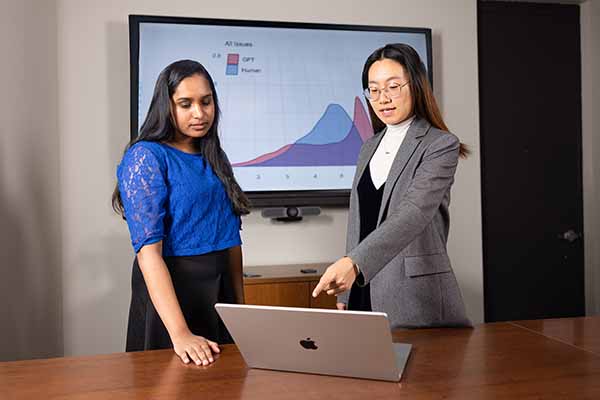
Sijia Qian, new this fall to UNC Charlotte’s School of Data Science, is blazing trails – in the classroom and her lab.
For the University’s inaugural cohort of students pursuing a Ph.D. in data science, Qian is teaching a research design course that is eliciting “aha moments” over the connection of quality design to meaningful insights from data. Her research on the social implications of artificial intelligence and information integrity reinforces the fundamental interdisciplinary nature of data science.
“One focus of my research is to create media literacy interventions, such as educational materials or training modules, to equip people to better navigate an increasingly complex multimodal information landscape,” said Qian, an assistant professor in the School of Data Science at UNC Charlotte. “On social media, all kinds of information, including that generated by AI, adds another layer. How do users distinguish trustworthy information?”
For Qian, who joined SDS from the University of California at Davis, where she completed a Ph.D. in Communication and Computational Social Science, this question exemplifies a societal problem whose solution will require a variety of perspectives.
Aptly, Charlotte’s initial 11 data science doctoral candidates possess varied backgrounds — some with years of industry experience, others coming directly from master’s programs.
“We are embarking upon this journey together,” Qian said. “My goal is to provide students with a firm foundation in terms of conducting research and what it entails, and on the importance of being able to replicate results. Ultimately, I want them to know that as researchers, our work should be interesting, rigorous and impactful.”
A passion for applying data science to bolster public health
Anusha Reddy ’21 ’22 M.S. grew up in Bengaluru, India, a city considered synonymous with America’s Silicon Valley.
“Dr. Qian emphasizes the importance of setting up our hypotheses,” Reddy said. “It reinforces how data science is dependent upon our research designs, which, in turn, influence our hypotheses.”
As she starts doctoral study, Reddy, a first-generation student who chose UNC Charlotte initially as an undergrad, is leaning toward analyzing the factors influencing crash fatalities and emergency response outcomes with a goal to develop recommendations for reducing fatal automobile accidents.
The Centers for Disease Control define motor vehicle crashes as a global health concern. In fact, more than 120 people die from them every day in the United States. Reddy is wasting no time to determine a dissertation topic with her advisor and gather data from the National Highway Traffic Safety Administration..
“If we can examine predictors that contribute to car accidents, then data-backed, preventive measures could reduce their occurrence,” Reddy explained. “This is a great example of data science and technology producing a long-term impact to improve public health.”
A central role in research
Sparking lively classroom discussion for Qian and the Ph.D. candidates is the question: What is data science?
“If you were to use a Venn diagram, data science would be in the middle. But skills and knowledge from computer science, mathematics, statistics and the social sciences contribute to the equation,” explained Qian. “Researchers tackle complex questions related to individuals and society. No single discipline can solve these problems. A more connected effort is necessary, which illuminates the unique strength of Charlotte’s School of Data Science.”
The combined expertise of several academic colleges — the College of Computing and Informatics where SDS resides as well as in business, engineering and health – supports the exploration of applied research by SDS-affiliated faculty in five major focus areas: innovation and application of data science and AI; integrated urban infrastructure and development; online fraud and misinformation; health and medical analytics; and public policy and social analytics. These align with fields where data science thrives.
“Students seeking to advance their career prospects benefit from UNC Charlotte’s robust connections in the city,” said Qian. “The University’s record of regional partnerships across multiple industries, businesses and other organizations reveals a locational advantage that few other institutions offer.”
Photo: Sijia Qian, right, with Ph.D. student Anusha Reddy