UNC Charlotte community explores AI’s expanding role in higher education
“What do you imagine for AI in higher education at UNC Charlotte?”
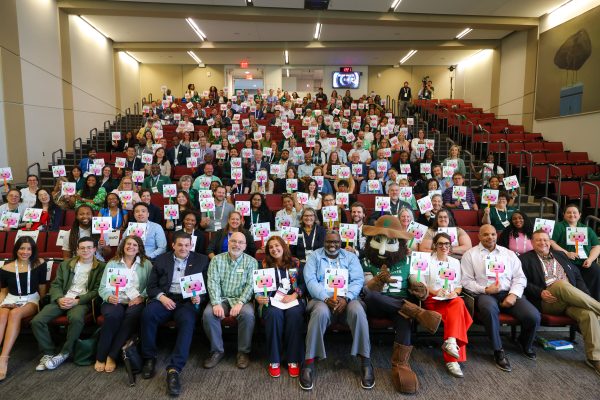
UNC Charlotte faculty, staff and students explored that question and others at the fourth annual AI Summit for Smarter Learning, held Wednesday, May 14, at The Dubois Center at UNC Charlotte Center City.
Hosted by the Center for Teaching and Learning, the summit featured the theme “Accelerating Imagination with AI in Higher Education” and provided a full day of presentations, workshops and hands-on learning opportunities for faculty and staff — regardless of their experience with AI.
Registration totaled more than 400, including more than 200 faculty, more than 100 staff and nearly 50 students. Participants represented all academic colleges and 131 departments across the University.
The summit reflected UNC Charlotte’s continued investment in AI to support teaching, learning, research and workforce readiness across disciplines.
“This year’s theme of imagination was intentional,” said Kiran Budhrani, director of teaching and learning innovation in the Center for Teaching and Learning. “It’s about imagining new experiences, new forms of creativity, new models of leadership and new futures for our students and institutions.”
Among key highlights were panel discussions that offered a variety of perspectives on AI from campus and industry leaders:
- During the workforce panel, industry experts from Microsoft, NASCAR, Under Armour, First Citizens Bank and Arizona State University shared insights about the importance of preparing graduates to work alongside AI technologies.
- The featured student panel, moderated by Premkumar Pugalenthi, clinical assistant professor in the Cato College of Education, highlighted how UNC Charlotte students are already using AI in their coursework, research and career preparation.
“AI absolutely needs guardrails. We need ethics, transparency, thoughtful governance and responsible practices,” said Asher Haines, associate provost for digital and professional learning and chief online learning officer. “Once we understand those boundaries, there is enormous room for imagination, experimentation and creativity.”
The featured addresses, delivered by Beth Rugg, chief workplace AI officer for OneIT, and keynote speaker Kyle Bowen, deputy chief information officer for Arizona State University, provided an overview of the skills necessary for a 2030 workforce and how AI may reshape the future of learning:
- Rugg’s “Workforce 2030: The AI Skills Imperative” outlined how artificial intelligence is reshaping the workplace and emphasized the importance of preparing students and employees for a future defined by human-AI collaboration. Her talk also highlighted UNC Charlotte’s efforts to integrate AI across teaching, learning and operations.
- “Charting the AI Journey Into the Future of Learning,” presented by Bowen, explored how AI can support more personalized learning experiences, expand access and help students and faculty solve increasingly complex problems.
“At ASU, we describe our approach as ‘one size fits one,’” said Bowen. “We want to make a large institution feel small by creating hyper-personalized learning experiences tailored to each student’s goals and aspirations.”
Returning this year were lightning talks, panel discussions and workshops highlighting practical uses of AI across teaching, learning, research and administration. Attendees chose from more than 25 sessions covering topics ranging from AI literacy and instructional design to ethics, student engagement and research applications. The AI Exploration Zone was a new addition, offering seven engagement booths hosted by faculty, as well as summit sponsors Adobe and McGraw Hill and vendor Pencil Spaces.
The summit also continued its focus on storytelling and lived experiences with AI integration. During the AI Use Case Story Segment, faculty and staff shared personal examples of how AI tools have changed their workflows, teaching strategies and approaches to problem-solving.
Marie Vrablic, a data systems analyst in OneIT, described how AI helped her analyze student retention and experiential learning data while emphasizing the importance of human oversight.
“AI will make mistakes, just like our students make mistakes,” Vrablic said. “We correct them and we hope they learn from them. That’s how you train AI models.”
Debbie Baker, senior lecturer in communication studies, spoke about how she redesigned her classroom approach after initially resisting generative AI tools in student assignments. Her session, “Resigning from the AI Police Force: Embracing Instructional Growth,” encouraged faculty to embrace AI tools with curiosity rather than fear.
“I knew I was onto something during the fall semester when a student said to me, ‘I’ve never had a teacher allow ChatGPT. What is happening here?’” Baker said. “What once felt like a battle shifted into feeling empowered, renewed and a little ahead of the curve.”
View more photos from the AI Summit for Smarter Learning.
Written by: Bernie Petit