2026 Dean’s Prize recipients honored for outstanding research
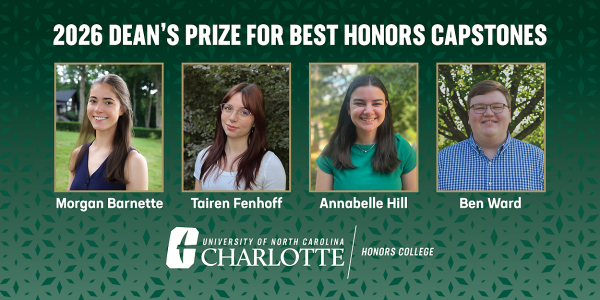
The UNC Charlotte Honors College recently recognized honors students Morgan Barnette, Tairen Fenhoff, Annabelle Hill and Benjamin Ward as the 2026 Dean’s Prize recipients for outstanding honors capstone theses and projects.
To be eligible for nomination for the Dean’s Prize, candidates must be in good standing with their honors program, maintain a minimum 3.5 GPA and embody the Honors College core value of mutual investment. The four recipients, who each received a $500 award, were nominated by their honors program directors.
“These Dean’s Prize recipients demonstrate the curiosity, rigor and sense of purpose that distinguish honors scholarship at UNC Charlotte,” said Malin Pereira, dean of the Honors College. “Their projects take on complex questions within their respective disciplines, and each reflects a commitment not only to deepening knowledge but also to understanding how research can make a difference in the world around us.”
Morgan Barnette: Building toward more accessible vaccines
Barnette, who graduated with honors in both the University Honors and Biology Honors programs, investigated a potential approach to simplifying the purification of bacterial polysaccharides used in vaccine production. Her research examined a process that could make polysaccharide purification more efficient and vaccines more accessible.
“Receiving the 2026 Dean’s Prize means so much to me personally, and I am so grateful that I got the opportunity to once again speak about my research at the Dean’s Prize Ceremony,” Barnette said. “It is a true honor and I am so thankful that the long days and weekends spent in the lab paid off.”
Richard Chi, director of the Biology Honors Program, said Barnette’s thesis combined scientific significance, technical sophistication and strong scientific communication.
“She demonstrates strong independence and scientific maturity through thoughtful troubleshooting and careful interpretation of both successful and inconclusive results,” Chi said. “Overall, her thesis reflects a high level of intellectual engagement, disciplinary understanding and scientific communication.”
Barnette plans to take a gap year before applying to physician assistant programs.
“My experience at UNC Charlotte has prepared me for my future goals in so many ways,” Barnette said. “From being a member of the UNC Charlotte dance team, co-president of the Pre-Dental Club, service chair of Alpha Epsilon Delta, working as a teaching assistant in lecture and lab, and working in the Troutman lab, I got a true sense of what my passions are in life. More than that, the people I met helped shape me into the person I want to be and I am so grateful for them. UNC Charlotte aided in defining my future goals and set the groundwork for me to achieve my goals.”
Tairen Fenhoff: Examining the rhetoric of enemyship
Fenhoff, who completed the Communication Studies Honors Program, examined how perceived enemies were constructed through presidential campaign rally rhetoric during the closing stages of the 2024 election. Analyzing transcripts of campaign rally speeches, Fenhoff explored how different groups were framed as antagonists during political rallies, why those rhetorical choices were made and how that framing can shape the way audiences understand others and the world around them.
“It has been really encouraging for me to receive the Dean’s Prize for my work,” Fenhoff said. “At times, it was exhausting to deal with the heavier topics that I explored in my thesis and it’s nice to know that my efforts were not in vain.”
Jason Black, Fenhoff’s thesis advisor, said her focus on political rallies contributes to an area of rhetoric that has often received less scholarly attention.
“This is a unique project, particularly in the exploration of a political genre often left unexamined: the political rally,” Black said. “Tairen was smart to consider how these more ‘internal’ rhetorics to one’s political base intensify enemyship as a construct and lead to dangerous populist movements.”
Fenhoff plans to continue at UNC Charlotte in the Master of Arts in Communication Studies program, where she hopes to expand her research into the social sciences and further explore how rhetoric shapes how people understand the world around them.
“During my years at UNC Charlotte, I was generously given close mentorship within my thesis programs and assistantships, which prepared me to do research that I am truly proud of within the Department of Communication Studies,” Fenhoff said. “I am immensely grateful for the guidance I received during my undergraduate years and I look forward to continuing this journey in my graduate program.”
Annabelle Hill: Putting people at the center of migration research
Hill, who was a member of the Honors College and triple majored in political science, French and international studies, examined how people deported from the United States affect social and economic conditions in their countries of origin in Latin America upon their return. Her research combined data on U.S. removals and socioeconomic conditions across Latin America with fieldwork in Mexico City, where she interviewed people who help returnees reintegrate into Mexican society.
“Receiving the 2026 Dean’s Prize is a true full circle moment,” Hill said. “I completed my thesis under the mentorship of Beth Whitaker, who was the first person to introduce me to migration research and has consistently expanded my concept of what I am capable of in research and beyond. My other committee members, Hania al-Shamat and David Dalton, further encouraged me to think, research and advocate in new ways that will shape my approach to complex human questions for many years to come.”
Hill’s field research was supported by a Scholarly Undergraduate Research Grant through the Office of Undergraduate Research.
“Her honors thesis stands out both for the timely relevance of the topic and for the amount of research she did, including a period of field research, which is exceedingly rare for an undergraduate thesis,” said Whitaker, Hill’s thesis advisor for Political Science Honors.
Hill, who was also a Levine Scholar, has received a Fulbright grant and will spend a year teaching English and serving as a cultural ambassador in Malta. While there, she plans to explore the country’s role in global migration.
“The mentorship and support I have received at UNC Charlotte have been key to my work now and as I move forward,” she said. “From the grant that allowed me to conduct research in Mexico, to the network my mentors have connected me with, to the constant encouragement toward difficult things, I have been tremendously blessed by the opportunities and lessons Niner Nation has allowed me to access.”
Benjamin Ward: Preserving culture through a Native American lens
Ward, who completed the History Honors Program, explored how the Longhouse religion, created by Haudenosaunee chief Handsome Lake, served as a means of cultural preservation and communal revitalization amid U.S. expansion.
Receiving the Dean’s Prize “motivates me to keep going and keep pursuing this kind of topic and this kind of work,” Ward said. “It really reminded me that I love what I’m doing. And to have that award, it shows that the effort I put in was worth it and it will continue to be worth it if I can put in this level of effort.”
That effort, Ward said, spanned two semesters.
“You put so much heart and soul into that work,” he said. “So far, that has been my biggest piece of work academically that I’ve done in my life, I’d say. And I was proud of it.”
Jill Massino, interim director of the History Honors Program, highlighted Ward’s focus on the agency and resilience of Indigenous communities.
“Through a close textual analysis of a wide range of primary sources, including the Iroquois Constitution and the Code of Handsome Lake, Ward illuminates Indigenous communities’ resilience and active role in reshaping traditions to sustain their identity, land and social cohesion during a period of profound disruption,” Massino said.
Ward plans to enter UNC Charlotte’s early entry master’s program in history and eventually pursue a doctoral degree. His goal is to teach history at the university level while continuing to write and conduct research.
“I love Charlotte, I really do,” Ward said. “I’ll be honest, I initially came to this school because I thought a lot of my friends were going to come here. And it became so much more than that. The history department has been so good to me. I’ve had the chance to grow. It’s a wonderful campus. It’s a wonderful school. I think everyone at the school was great. So, I’m very appreciative of the school.”
The Dean’s Prize is made possible by the generosity of three friends of the Honors College, Harry Creemers, Delbridge Narron and Murray Webster. Creemers was an administrator in the Division of University Advancement who helped launch the Honors College Advisory Board and has supported fundraising initiatives in the college for many years. Webster and Narron have taught courses in the Honors College. Narron also supports two scholarships in the college and served as inaugural chair of the advisory board. Webster chaired the Honors Council. Additional support for these prizes came from contributors to the Honors College Endowed Fund through Niner Nation Gives.