UNC Charlotte expert explains recovery challenges after Nepal’s catastrophic flooding
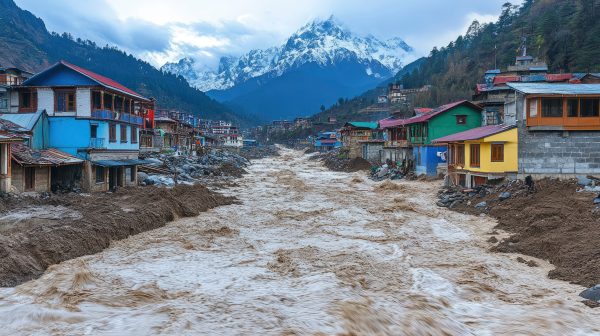
Catastrophic flooding on the Nepal-China border in August claimed hundreds of lives, decimated entire communities and damaged critical infrastructure. While the immediate damage is clear, it will take time before the devastation is completely understood. The individuals and communities affected have a long road of recovery ahead.
Stephanie Pilkington, UNC Charlotte teaching assistant professor within the Albert School of Construction, and expert on natural hazards, recovery modeling and community resilience, explains the long-term challenges communities face after major flooding events, why mountainous regions are especially vulnerable and how AI and data science may help other countries around the world better prepare for natural disasters.
Beyond the immediate loss of life, what are the biggest long-term challenges communities face after catastrophic flooding?
Rebuilding. This flooding event was also a landslide and mudslide event and brought debris and soil into places it was not originally. Not only will communities have to rebuild structures, but before they can do that, they will have to move a significant amount of earth and debris.
What makes flash floods in mountainous regions especially dangerous?
One cubic foot box of water weighs a little over 60 pounds. Rivers carry more water than just one cubic foot and in mountainous regions, steep slopes cause that water to move very quickly, which, in turn, results in a very high force (or pressure) that can be exerted on the riverbanks and any nearby infrastructure. This moving water can be so powerful that it could alter a river’s course once the water recedes.
On the human development aspect of hazards, we have historically built communities in valleys and along rivers for the ease of access to water and for establishing trade routes. This is a very common practice worldwide and as we continue to develop and learn about our environment and climate, these communities will require additional work to mitigate impacts.
Why are roads, bridges and utility systems often among the first critical services to fail during disasters?
In short, their exposure lends them to being in the most vulnerable position. Bridges are how we cross waterways. Roads, and underground utilities, are dependent on the subsurface (soil) remaining intact, which, in flooding conditions, can become questionable. Aboveground utilities are very exposed to the elements and these often long thin members (e.g., poles, cables) are naturally less stable than a short, wide, box of a building when exposed to fluid forces (e.g., water, wind).
What are the economic consequences of large-scale flooding for a region?
I do not know that we can comprehend the scale of the economic impact just yet. Given that this event also occurred along the border of two countries, this will have local and international economic impacts that will take time to appear.
How can advances in data science, artificial intelligence and hazard modeling improve disaster preparedness?
In all honesty, in this specific event, I am at a loss for words. However, in considering overall, worldwide improvements to disaster preparedness, advancements in data science allow us to leverage information we have been gathering for years regarding the formation of hazards and their impacts. That is to say that advanced computing power, data storage, and yes, artificial intelligence, if used properly, could aid experts in meteorology, hazard mitigation, infrastructure, and emergency management, in discovering new patterns and solutions to help us move forward in our understanding and preparedness practices. Sometimes these data sets are so large that the use of AI can help experts “see the forest through the trees.” It is another tool now available to us and many agencies are already using it.
Written by: Stephanie Pilkington and Jason Vaughan