UNC Charlotte’s Truman Lab awarded $2.1 million grant from the National Institutes of Health
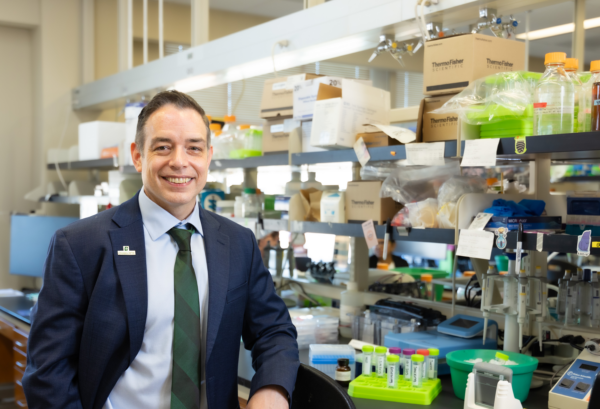
UNC Charlotte’s Truman Lab has secured a new $2.1 million grant from the National Institutes of Health to advance fundamental research on how cells maintain protein health, a process central to diseases ranging from cancer to neurodegenerative disorders. The five-year Maximizing Investigators’ Research Award from the National Institute of General Medical Sciences will support the project “Deciphering the Hsp70 chaperone code,” bringing the lab’s active research funding to $6.05 million.
“This NIH award reflects both the scientific significance of Andrew Truman’s research with the team in the Truman Lab and his leadership in building a leading proteostasis research community at UNC Charlotte,” said Bernadette Donovan-Merkert, dean of the Klein College of Science. “By supporting long-term, curiosity-driven discovery, this grant will provide new insights into how cells maintain protein health and create opportunities for breakthroughs that could ultimately inform future therapies for devastating diseases. We are proud to see UNC Charlotte continue to lead in this important area of research.”
Founded in 2015, the Truman Lab investigates how cells regulate proteostasis, the systems that keep proteins properly folded and functional. Truman is principal investigator, professor and associate chair for research in the Department of Biological Sciences, and affiliate faculty in the School of Data Science. He also leads the Charlotte Group for Proteostasis Research, which recently received sponsorship from the NCBiotech.
The lab focuses on Heat Shock Protein 70, or Hsp70, one of the cell’s most abundant and essential molecular chaperones. Hsp70 binds and folds most cellular proteins, and its activity influences diseases linked to protein misfolding. The lab studies the “chaperone code,” a set of small chemical switches on Hsp70 that guide which tasks it performs, when it performs them and which proteins it interacts with.
“This five-year MIRA award is a major step forward for my group, giving us the long-term support and flexibility to decode and ultimately manipulate these signals,” Truman said. “We hope this work will reveal new ways to understand and treat diseases linked to damaged or misfolded proteins, including cancer and ALS.”
Deciphering the chaperone code
For decades, scientists have studied how Hsp70’s specificity is shaped by its expression levels, its family of isoforms and the co-chaperone proteins that bind to it. Recent advances in proteomics have revealed a far more complex regulatory landscape. More than a hundred post-translational modifications have been identified on Hsp70, a collection Truman’s team calls the Hsp70 chaperone code.
“The Hsp70 protein acts as a custodian of the cell, helping proteins to fold correctly, restoring those damaged by stress and removing proteins that cannot be fixed,” said Truman. “My group studies the chaperone code, a set of small chemical switches on Hsp70 that tell it which jobs to perform, when to perform them and which proteins to work with.”
Over the past decade, the lab has shown that these modifications play key roles in heat stress response, cell cycle progression and genome integrity. Similar regulatory patterns have been found on other chaperones, including Hsp90, but many Hsp70 modification sites remain unexplored.
Funding for the next five years
Over the next five years, this new R35 grant will allow the Truman Lab to map the stresses and enzymes that regulate most of these modifications in budding yeast and mammalian cells and determine how they are activated. Researchers will test how each modification affects Hsp70’s function both in vitro and inside cells. The team will also investigate how modifications on Hsp70’s client proteins, described as the client code, influence chaperone interactions and protein behavior.
Check out more news from the Truman Lab
- UNC Charlotte Truman Lab publishes new insights into cellular heat shock response in Nature Communications
- The path to pathology: Celebrating Klein College of Science graduate Erica Flores
- Truman Lab awarded new R01 grant from the National Institutes of Health
- Ashley Choi found her collaborative community at Charlotte
Written by: Emily Hamm
Lab photos by: Amy Hart
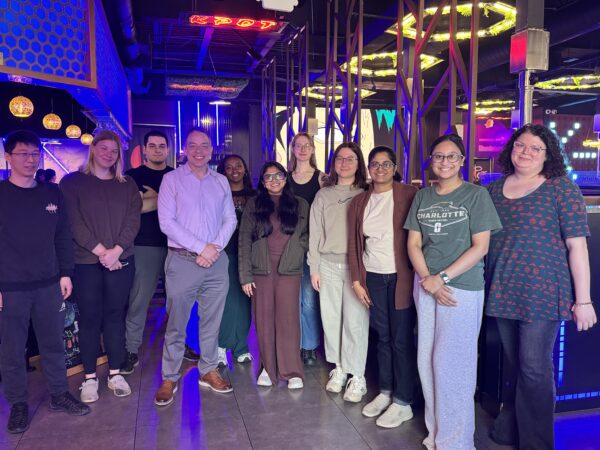
Team photo provided by: Andrew Truman