Q&A: Bats, busted myths and the science behind their superpowers
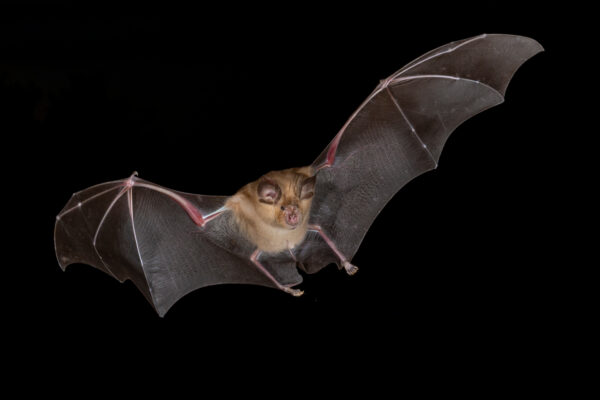
Bats are a familiar sight around Halloween, often portrayed as spooky creatures to be feared. Like spiders, they’re frequently misunderstood, despite their important role in the ecosystem. Bats help control insect populations, pollinate plants and disperse seeds, making them valuable to ecosystems around the world.
In this Q&A, UNC Charlotte bat researcher Laurel Yohe discusses what makes these animals so fascinating, clears up common misconceptions and shares highlights from her research in the field and the lab.
What first drew you to studying bats, and what has kept you interested in them throughout your career?
Believe it or not, my original research was on birds — specifically, songbirds in Vietnam during a Fulbright fellowship, where I worked on conservation-related projects. This is where I discovered how much I loved working directly with animals and developed a passion for evolution. However, I always had an interest in neuroscience, and when I started my Ph.D., my adviser had a lab studying bat evolution and a project on bat sensory systems. It felt like the perfect way to bring those two interests together.
What has kept me hooked is that bats are kind of the ultimate evolutionary experiment. There are over 1,400 species, and they do everything: They echolocate, and they eat fruit, nectar, insects, fish, frogs and even blood. Every time I think I have a handle on them, they surprise me again. Plus their nocturnal nature aligned with my tendency to be more of a night owl than an early bird.
Why are bats often able to coexist with viruses that can make other animals sick?
There are a lot of hypotheses, but nothing that we know for sure. It remains an open question. Some ideas relate to their ability to fly, which results in a much higher metabolic rate and body temperature. Another reason may be the gregarious nature of bats and how their roosting behavior may facilitate viral circulation.
What we do know for sure is that bats have a low level of inflammation, which is the response the body has when it first detects a virus. For a long time, we thought they might have evolved exceptionally low levels of inflammation, but it turns out that some genes involved in these immune responses are simply missing from their genomes.
What are some of the biggest misconceptions the public has about bats?
Probably the biggest one is that bats are dirty, scary or out to get you. Bats are actually very clean animals that spend a lot of time grooming, and they have zero interest in flying into your hair.
Another misconception is that bats are basically flying mice. They are not rodents at all and, as mammals, they are actually more closely related to horses, cats and whales than to mice. I like to call them flying horse-dogs.
People often don’t realize how much we depend on them. Insect-eating bats eat enormous numbers of crop pests and mosquitoes every night, and tropical bats pollinate plants and disperse seeds. If you like tequila, thank a bat, since agave is pollinated by nectar-feeding bats.
What are the biggest unanswered questions in bat research right now?
In addition to figuring out why bats are so good at harboring lethal viruses without getting sick, researchers are trying to understand why bats live so long for their body size. The oldest bat ever recorded was a Brandt’s bat that lived to 41 years old. For their body size, they should live fewer than five years.
Figuring out how they pull that off, and whether it is connected to how their immune systems work, could teach us a lot about aging and disease in humans.
Do any common Halloween bat myths have a basis in reality?
Probably the spookiest bat-Halloween association is with vampires. While I’m not sure about actual vampires, there are certainly vampire bats! Of the more than 1,400 species of bats, there are three species of vampire bats, and they are found only in South and Central America — so none here in North Carolina.
What is amazing about vampire bats is they are the only vertebrate animals that exclusively feed on blood. They are very good at it, too. Vampire bats have the sharpest teeth in the animal kingdom and specialized saliva with both anesthetic and anticoagulant properties, allowing them to bite without being detected by their prey and to keep the blood flowing. Spooky!
Are bats really blind?
Good question! My favorite bat cartoon shows bats playing “pin-the-tail-on-the-donkey” at a party, wearing corks in their ears instead of blindfolds.
However, this is a very common misconception and quite untrue. While most bats rely on echolocation, many bats see quite well. Fruit bats, in particular, often have big eyes and use vision to find food and navigate, and some bats can even see ultraviolet light.
Even bats that echolocate still have working eyes. They just use whichever sense is best for the job, a lot like how we use both our eyes and ears.
What’s the most memorable bat encounter you’ve had in the field?
One of my all-time favorites happened in Trinidad. We pulled a Jamaican fruit bat out of the net and realized she wasn’t alone. She had a baby still clinging to her, holding on tight to her nipple.
Bat moms often fly with their babies attached in the first days after birth, and the size of those babies is wild. A newborn bat can weigh 20% to 30% of its mother’s body weight. For a person, that would be like giving birth to a 30- or 40-pound baby and then going out to find dinner with it strapped to your chest.
Bats invest a huge amount of energy in each baby. Most species have only one pup a year, and moms nurse them until they are nearly adult-sized and ready to fly on their own. Holding that little family in my hand was a pretty special reminder of how much these animals put into raising the next generation.
What are the key takeaways from your most recent research?
I was part of a huge study just published in Nature by Bat1K, an international consortium of 137 researchers from 64 countries working to sequence the genome of every living bat species. We combined 103 bat genomes, covering all 21 bat families, with 44 fossils to build the most complete bat family tree yet and even reconstruct the genome of the ancestor of all living bats.
We found that bats originated in Europe around 65 million years ago before spreading across the globe, and that echolocation evolved much earlier than we thought, right alongside flight. It really takes a global effort to capture the true diversity of bats.
My lab also recently published a paper in Evolution comparing the skulls of domestic dogs and Neotropical leaf-nosed bats. Dog breeding has created extreme skull variety very quickly, but mostly along one path: longer or shorter snouts. Bats, over millions of years, branched out in many different directions and evolved skull shapes dogs simply can’t reach.
That global spirit is something I try to pass on to students. This past May, I took our first group of students to Vietnam through an NSF International Research Experiences for Students program, where they sampled bats in national parks and used portable “backpack lab” tools to sequence DNA and monitor pathogens right in the field.
Coming full circle back to Vietnam, where I first fell in love with fieldwork, has been one of the highlights of my career.
Written by: Laurel Yohe and Jason Vaughan