From Navy nurse to home health pioneer: Eileen Klimkowski’s journey of service and innovation
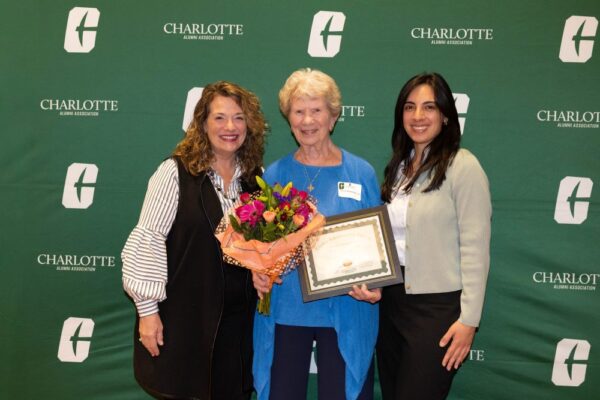
A small-town girl from New Jersey never imagined that a chance decision to join the Navy would lead her to Charlotte, a degree from UNC Charlotte’s School of Nursing, and a pioneering career that would transform home health care across the region. But for Eileen Klimkowski ’79, following opportunity and trusting her instincts became a lifelong pattern.
“I enjoy life,” she said. “I have always worked hard and played hard.”
That spirit guided her from a naval hospital in Naples, Italy, where she met her husband, to Charlotte, where the couple settled and raised their family. With young children at home, Klimkowski worked as a nurse while searching for ways to advance her education. Using GI Bill benefits she had earned through military service, she enrolled at Central Piedmont Community College before continuing her studies in the RN-to-BSN program in UNC Charlotte’s School of Nursing.
At UNC Charlotte, she discovered a broader vision of nursing that extended beyond hospital walls. Students were taught to think independently, assess patients holistically and meet people where they were. Those lessons would shape the course of her career. The University’s emphasis on physical assessment and community-based care later became foundational to the services she developed and integrated into her own organization. The School of Nursing would also become a valued partner, sending nursing students to train alongside her staff for years to come.
In 1979, a Certificate of Need was granted for what would become Home Health Care of Gaston County, Inc., and the nonprofit agency opened its doors later that year. Eighty-eight patients were served in the first year, but Klimkowski envisioned something much larger. At a time when most advanced medical care took place in hospitals, she believed many patients could receive high-quality treatment in the comfort of their own homes.
Starting with a small team, she built the agency into one of North Carolina’s most innovative home health providers. It became one of only six agencies in the state offering a comprehensive range of services, including nursing, physical therapy, speech therapy, occupational therapy, home health aides, nutrition services and respiratory therapy. The agency eventually served patients throughout Gaston, Lincoln, Cleveland and Mecklenburg counties, providing care 24 hours a day, seven days a week.
Klimkowski’s guiding principle was simple: do what was best for the patient.
That philosophy led her to challenge conventional thinking and push the boundaries of what home health care could accomplish. Long before such services became common, her agency provided intravenous therapies, including chemotherapy and blood transfusions, in patients’ homes. Specialized wound and ostomy care, psychiatric nursing, diabetes education and respiratory services allowed patients with complex medical needs to avoid unnecessary institutionalization. For jaundiced newborns, the agency offered bili-light therapy so mothers and babies could remain together at home. Before pulse oximeters became commonplace, respiratory therapists even traveled to patients’ homes to draw arterial blood gases.
Innovation alone was not enough. In the early years of Medicare and Medicaid home health reimbursement, changing regulations frequently threatened access to care. In 1984, payment disruptions nearly forced the agency to close. Klimkowski exhausted her savings, sought legal assistance, took business courses at Gaston College and rallied support from churches and community leaders who recognized the organization’s value. Their support helped the agency survive, and ultimately thrive.
As the organization grew, so did its impact. Contractors became full-time employees. The staff expanded to more than 140 people. Community support groups, educational programs and outreach initiatives extended the agency’s reach beyond direct patient care. Yet Klimkowski remained committed to teaching. Nursing students accompanied staff on home visits, gaining firsthand experience in community health and patient-centered care.
She was equally dedicated to helping her employees grow. Nurses were encouraged to pursue bachelor’s and master’s degrees, specialty certifications and advanced clinical training. Home health aides became nurses, and nurses became experts in their fields.
“I never viewed education as an expense.
Eileen Klimkowski
Education is an investment in patients and the profession.”
In 1990, the organization evolved into Emerald Care, transitioning from a nonprofit to a proprietary agency. Even then, its mission of service continued. Funds from the nonprofit were directed to the School of Nursing to support scholarships, creating opportunities for future generations of nurses. The agency’s culture continued to reflect Klimkowski’s personality: hardworking, welcoming and deeply connected to the community.
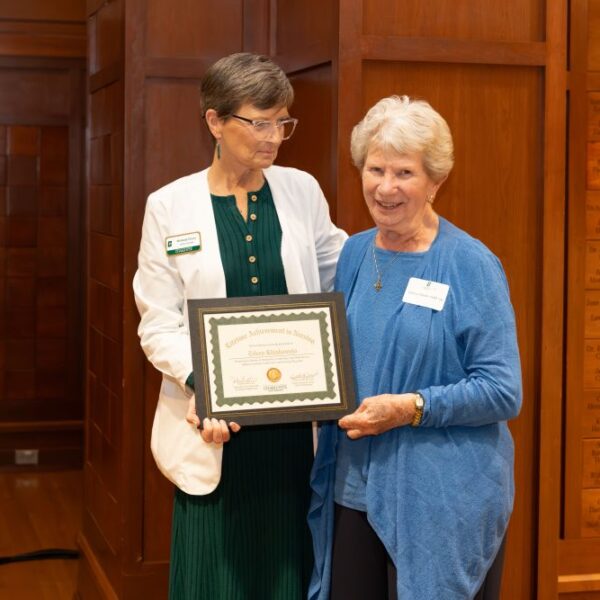
After 25 years of service, Klimkowski sold the agency and retired in 2005. By then, thousands of patients and families had benefited from the care she helped make possible. Yet retirement marked another transition rather than an ending. Drawn toward a ministry of healing and spiritual support, she helped establish The Christian Prayer and Healing Center, continuing a lifelong commitment to caring for others.
Today, Klimkowski’s legacy can be found throughout the communities she served, in the nurses she mentored, in the students she helped train and in the patients who were able to receive advanced care at home when few believed it was possible.
The School of Nursing recently honored Klimkowski with the LIfetime Achievement in Nursing Award, a well deserved honor.
Her story is one of persistence, innovation and service. From a New Jersey to a Navy hospital in Italy, from the classrooms of UNC Charlotte School of Nursing to the homes of patients across the Charlotte region, she spent her life asking a simple question whenever someone said something couldn’t be done:
“Why not?”