Q&A: Solar cell expert explains the science behind cheaper, efficient solar energy
When UNC Charlotte envisioned its Energy Production and Infrastructure Center (EPIC) in 2011, the goal was to recruit the energy sector’s leading experts. For solar energy, one name stood out: Abafriske Ebong.
Ebong, a global leader in solar cells whose life’s work is in pursuit of making the most efficient solar cell at the lowest price point possible, was recruited to Charlotte from Georgia Tech where he ran a renowned DOE University Center of Excellence for photovoltaic lab with Ajeet Rohatgi. Earlier he was a postdoctoral fellow at Samsung in South Korea, having earned a Ph.D. at University of New South Wales in Australia, where he researched alongside the “godfather” of solar cells, Martin Green.
For over a decade, Ebong, a professor of electrical and computer engineering, has conducted research at EPIC into solar cell materials, tested materials and screen printed solar cells for industry partners. Several of those partners have donated industry-grade equipment to his Photovoltaic (PV) Technology Research Laboratory.
“One hour of one hour of sunlight is more than enough to power the whole world for one year — if we can harness it,”
– Abafriske Ebong
In this Q&A, Ebong explains how solar cells work, the key to creating a cheap and efficient solar cell, and more.
What is a solar cell and how does it work?
A solar cell is a semiconductor device that converts sunlight to electricity without any polluting byproduct. When the energy in sunlight is absorbed in the silicon material on top of the solar cell, electrons (negative charges) and holes (positive charges) are created. Whenever positive and negative charges are brought together (the P-N junction) you create an electric field. So the electrons will flow to the purely electron side and then holes will flow to the purely positive side. When you put a wire connecting it to a bulb, for example, it lights up.
The function of a solar cell is simply the absorption of photons from the sun, generation of electrons and holes and then creating the electricity. That’s basically how it works.
What makes a solar cell efficient?
A solar cell is an opto-electrical device, so we have to marry those two — optics and electrical — and compromise between those two to get high efficiency.
The key to high efficiency for a solar cell is to reduce the reflection of the sunlight (optics) and reduce the recombination — an electrical process that destroys the carriers of electrical charges. You want every electron that is being generated to be collected. If that happens, then we have high efficiency.
What is a solar cell made of?
It starts with a silicone wafer. Silicon is a semiconductor and the second most abundant element on earth. However, silicon is also 30% reflective so you need a layer of anti-reflective coating, which is where a solar panel’s blue color comes from. We discovered a material called silicon nitride, which reduces both reflection and recombination.
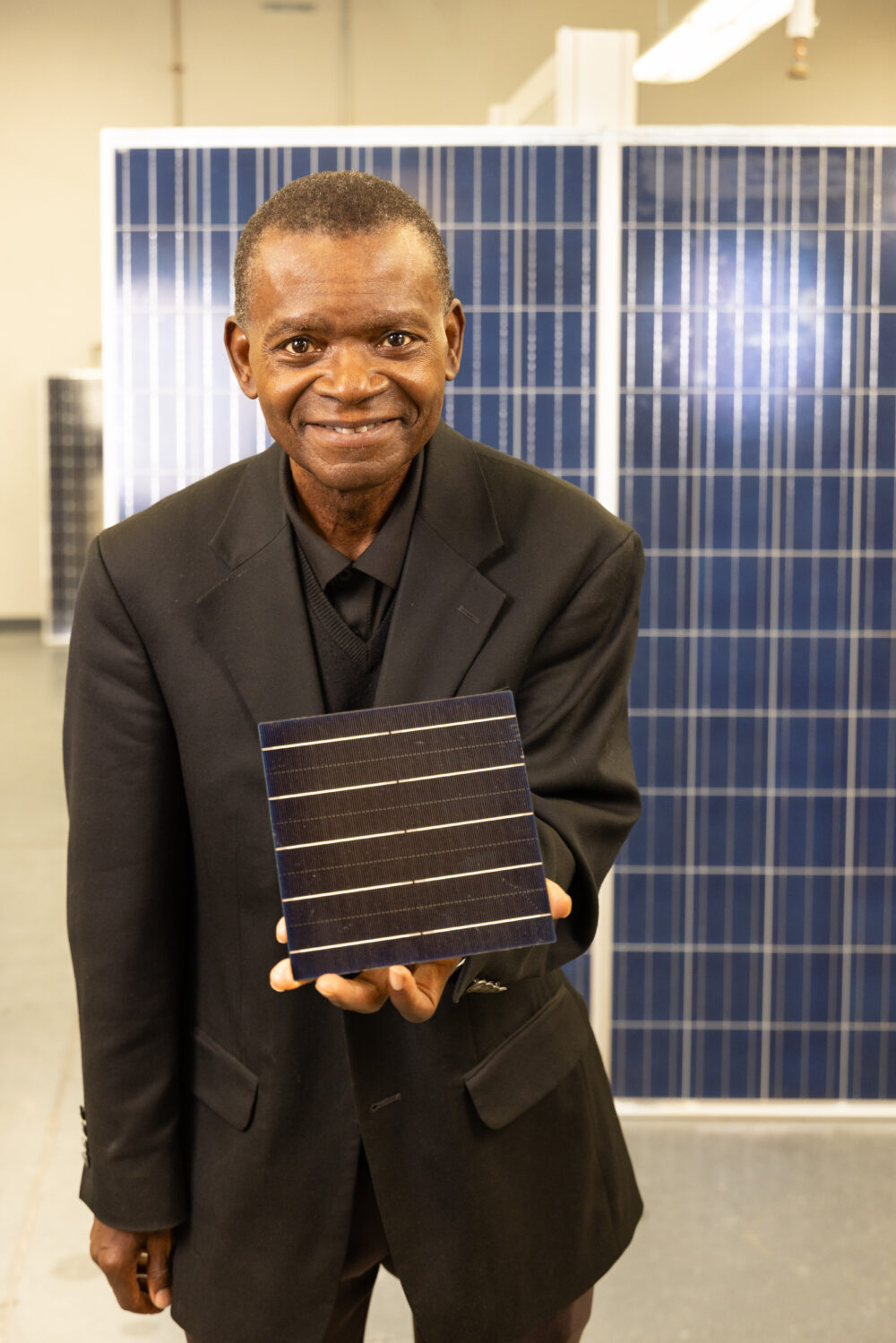
The next component are the “fingers” or grid lines printed with conductive material that conduct the carriers from the semiconductor. When I first started screen printing solar cells, the grid lines were 200 microns wide. Today we can print fingers that are less than 50 microns wide, and the target gridline width is 25 microns wide, and would lead to higher short circuit current and open circuit voltage, and higher efficiency.
The fingers feed the energy from the sunlight to the busbar, thin but visible grid lines commonly made of silver. That feeds electrons to a connected cell or to the solar panel inverter to turn it into usable electricity.
What is the difference between a solar cell and a solar panel?
A solar cell, like the ones we print in the lab, are typically a six inch by six inch square. They give you around 10-10.5 amperes (current) at 0.65 volts (voltage), but that’s not enough to power anything.
To power anything with solar energy, you need a solar panel, which essentially is 60-72 cells connected in series to give high voltage. The trick is that the current has to be consistent across the cells, because if the current is not the same, the lower current controls.
Voltage X Current = Power (Watts) so when you hear about 300 watt panels or 450 watt panels, it is a function of that multiplication. And depending on what you want to power, say it’s a house or utility, you will see what we call an array of panels, multiple panels reconnected together.
We hear that solar technology is becoming more affordable. What is the science behind that decreasing cost?
When I was pursuing my PhD, a solar cell cost $250 per watt to produce — you couldn’t imagine then that the technology could be viable for commercial purposes. But over the years, through research into materials, physics and all the technologies around it, we have come to a point whereby it is a commodity.
The biggest factor in decreasing the cost of solar is to increase efficiency. The higher the efficiency, and the longer you can generate electricity from a cell, the lower the cost.
Another factor is the footprint of the material. Silver is a common conductor used in solar cells. Back in 2019, I started working with a company that was looking into copper — a conductor that is 100 times cheaper than silver. We started testing cells with copper knowing that if we could use copper in place of silver, we can bring down the cost to next to nothing.
In 2007, the Department of Energy released a plan to see solar cells cost 3 cents per kilowatt hour by 2030. That’s exactly what we have been working towards, and we’re close. Today, we can produce solar cells at about 5 cents per kilowatt hour.
So the science behind reducing the cost is understanding how to reduce recombination to improve the efficiency because efficiency is the key. If we can get the efficiency, at lower material cost the final factor is longevity — which we are looking into with another industry partner.
Why does efficiency matter?
Efficiency matters because when you look at solar electricity, it is a function of area and real estate. If I have very efficient cells, I need fewer panels. If the cells are not efficient, I will need a larger area to produce the same power. So that’s why it is very, very critical that the cell be efficient.