UNC Charlotte researchers receive NCInnovation grant to advance treatment for drug-resistant wound infections
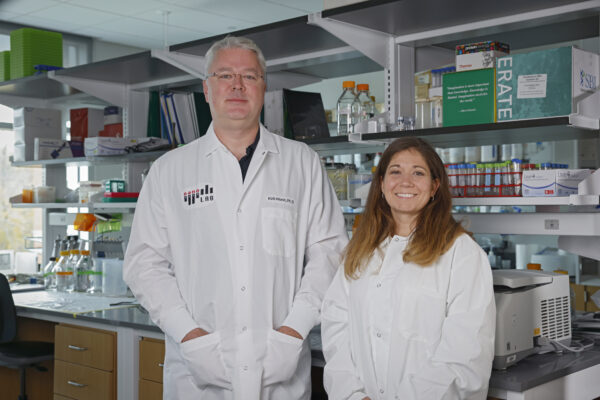
UNC Charlotte researchers from the Klein College of Science have received a new major grant from NCInnovation to advance a promising technology that could transform treatments for chronic wounds and drug-resistant infections.
The award is part of NCInnovation’s latest funding round, which approved $6.8 million for eight university research projects across North Carolina. The grants support technologies with strong commercial potential and help researchers move innovations from the laboratory toward real-world use.
The project, “Silver Nanoclusters: Scalable Broad-Spectrum Antimicrobials for Clinical Translation and Commercialization,” focuses on treating chronic infected wounds that often contain bacteria that have developed resistance to antibiotics.
The technology’s first applications are expected to be topical gels, sprays and wound dressings that could improve outcomes for patients facing prolonged treatment for antibiotic resistant wounds such as diabetic foot ulcers.
NCInnovation’s grant could help bring a new class of antimicrobial treatment to market from Charlotte. According to the American Diabetes Association, approximately 1,154,000 adults in North Carolina, or 11.5% of the adult population, have diabetes, with an estimated 74,000 more adults diagnosed annually in the state.
The principal investigator of this project, Kirill Afonin, professor of chemistry, and co-principal investigator M. Brittany Johnson, assistant professor of biological sciences, work collaboratively with a research team. They have developed DNA-guided silver nanoclusters, which are tiny clusters of silver consisting of just a few atoms and stabilized by short strands of synthetic DNA. In laboratory testing, the silver nanoclusters demonstrated the ability to kill drug-resistant wound bacteria more effectively than conventional silver-based treatments and standard antibiotics while causing minimal harm to human cells.
“Drug-resistant wound infections lead to too many amputations, especially in rural communities, and Dr. Afonin’s silver nanocluster technology could give doctors a new class of treatment that works where antibiotics no longer do,” said NCInnovation CEO Michelle Bolas. “Getting a technology to work in the lab is one milestone. Getting it ready for the market is another. NCInnovation helps de-risk promising technologies from North Carolina’s public universities by funding the testing and validation that gives companies and investors the confidence to move them closer to market.”
The NCInnovation funding will support the next stage of development, including additional laboratory and animal testing, regulatory planning and preparation for licensing the technology to a wound-care company.
The award represents an important milestone for UNC Charlotte’s growing research and innovation enterprise, demonstrating how interdisciplinary collaborations between chemistry, biology, and translational science can generate technologies with significant clinical and commercial potential.
This latest grant marks UNC Charlotte’s seventh NCInnovation research award, in addition to two pilot grants the university received during the organization’s first year of funding.
NCInnovation is a public-private partnership focused on accelerating the commercialization of university research across North Carolina. The organization’s newest cohort of eight projects spans biohealth, computing, energy and climate resilience and includes researchers from seven universities across the state.
Read more about silver nanoclusters for wound treatment.
Learn more about UNC Charlotte’s NCInnovation grantees:
- June 2026: North Carolina advances Charlotte engineering solutions for next-gen challenges
(Shen-en Chen and Tiefu Zhao) - Dec. 2025: UNC Charlotte captures NCInnovation grants for research expected to drive economic growth through commercialization (Babak Parkhideh and Rosario Porras-Aguilar)
- Nov. 2025: Poler team passes industry-standard filtration certifications, allowing commercial production on water filters
- May 2025: Pinku Mukherjee and Susan Trammell awarded NCInnovation research grants
- May 2024: NCInnovation awards pilot grants to two Charlotte researchers
(Sukumar Kamalasadan and Jordan Poler)
Written by: Jenn Conway
Photo by: Kat Lawrence