UNC Charlotte’s Violence Prevention Center turns research into real-world solutions
By Pam Davis
Photos by Kat Lawrence
KEY TAKEAWAYS:
- UNC Charlotte’s Violence Prevention Center turns research into practical solutions for safer communities
- Data partnerships with agencies and health systems strengthen violence-intervention outcomes
- A multidisciplinary approach targets the root causes of violence to support community well-being
Do you feel safe? The majority of people will say ‘no.’ Worry about crime and violence persist in almost every community. Nearly everywhere.
Research shows that most of the population either has been affected by violence or know someone who has, directly or indirectly. The World Health Organization and other major institutions declared violence to be a major public health issue.
The key to making all of us feel safer is preventing violent acts so they don’t take place at all.
It sounds easy. But myriad challenges stand in the way. Factors from a lack of funding to limited broad, cross-sector collaboration make it hard to curb gun violence, sexual violence, suicide, human trafficking and other violent acts.
According to the Council on Criminal Justice, greater investment in rigorous research is critical to shed more light on the changing crime landscape and to craft effective crime control approaches for the future.
One of our most important roles is developing community partnerships to explore how to get things done, reduce harm and ensure fewer victims.”
Apryl Alexander, executive director
Violence Prevention Center
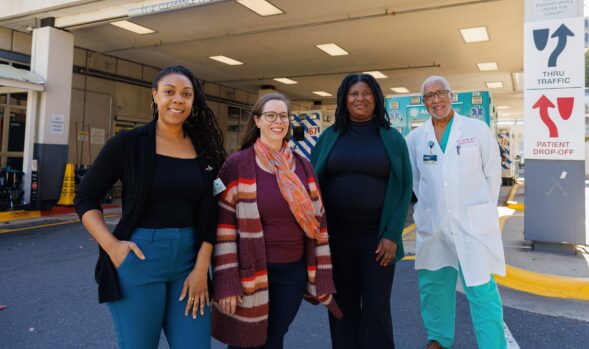
Britney Brown, Annelise Mennicke, Apryl Alexander, David Jacobs
“These problems can be solved,” said Apryl Alexander, Psy.D. “From a research perspective, there’s a lot we know in terms of what can be done to address violence.”
Alexander is the Metrolina Distinguished Professor of Health and Policy and executive director of the UNC Charlotte Violence Prevention Center, which is housed in the University’s College of Health and Human Services. She created the center two years ago as a resource for violence prevention research, training and technical assistance for communities, policymakers and the public.
“We want to be more than a traditional basic or applied research center. We intend to invest in and find ways to get our work into the community,” Alexander said.
It takes a village
The Violence Prevention Center seeks not only to study violence but also actively find and create solutions with community partners and decision-makers. To that end, the center has worked with the City of Charlotte, the Mecklenburg County Office of Violence Prevention and the North Carolina Department of Adult Corrections.
“One of our most important roles is developing community partnerships to explore how to get things done, reduce harm, and ensure fewer victims,” Alexander said.
Currently, the center is partnering with Atrium Health, now part of Charlotte-based Advocate Health, and its Project BOOST (Building Optimal Outcomes for Survivors of Trauma) violence intervention program.
Based at Atrium Health Carolinas Medical Center, Project BOOST provides support to individuals between the ages of 15 and 24 who’ve been admitted to the hospital for treatment of violent injuries such as gunshot wounds, stabbings and serious assaults.
Our collaboration with UNC Charlotte will strengthen and widen our lens.”
Britney Brown, program director, Project BOOST
The project’s goal is to prevent hospital readmissions caused by repeated violence and to address the nonmedical factors, known as social determinants of health, that contribute to the problem. These include — but are not limited to — education, income, housing and access to nutritious food.
“It sounds cliché, but it does take a village to do this work,” said David Jacobs, M.D., FACS, the director of Project BOOST and a surgery professor at Wake Forest University School of Medicine and vice chair of Atrium Health Carolinas Medical Center’s surgery department. “Eighty percent of health care outcomes are not related to the quality of the medicine you practice but to the social drivers.”
To understand the extent of Project BOOST’s effectiveness, the Violence Prevention Center is collaborating with the Charlotte Regional Data Trust, which is part of the UNC Charlotte Urban Institute, for access to key administrative and cross-sector data that can evaluate and interpret intervention outcomes.

“There are so many end points to look at — law enforcement data, school data, and similar information,” Jacobs said. “UNC Charlotte’s Violence Prevention Center can provide that data to us, which will make for a more robust evaluation of our program’s effectiveness.”
The impact analysis will give Project BOOST the full picture it’s been missing. “Our collaboration with UNC Charlotte will strengthen and widen our lens,” said Project BOOST program manager Britney Brown. “It will show us on a bigger scale how we are trying to help the community at large.”
Currently, Project BOOST is able to provide services on weekdays from 9 a.m. to 5 p.m. The Violence Prevention Center is planning to help launch an initiative to reach the estimated 60% of violent injury patients who arrive at the hospital on nights and weekends.
In addition, Atrium Health and the Violence Prevention Center are looking to develop a program for the hospital’s surgery department. The program would give surgical residents one or two years to research violence-prevention projects.
“This not only would advance the science at Atrium Health, but enhance our attractiveness as a surgical training program,” Jacobs said. “We know folks are interested in this work. It has a direct impact in the community we serve and, with a new medical school here, we could bring in residents and medical students, and build a research infrastructure focused on violence and injury prevention.”
Interconnections
During its first two years of operation, the Violence Prevention Center has focused on building community partnerships, training components, and a strong team of subject matter experts and research methodologists.
“The center’s experts on substance abuse, homelessness and other social drivers are helping us better understand how those connect to violence prevention,” said Annelise Mennicke, Ph.D., an associate professor of social work and an executive committee member of the center. “We're not looking just at violence, but also what underlies it.”
A multidisciplinary approach that integrates public health, social work, psychology, criminal justice and other areas of study guides the Violence Prevention Center’s work from a social-ecological perspective.
“By addressing a community holistically, we expect to see positive movement across forms of violence in these other spaces,” Mennicke said. “Our commitment is to creating environments where everybody can thrive.”