Charlotte Biometrics Pioneer Fights Identity Crime With AI Hacker Know-How
By Schaefer Edwards
Photos by Kat Lawrence
KEY TAKEAWAYS:
- UNC Charlotte’s Center for Identification Technology Research – CITeR – is beating hackers at their own game with advanced AI (deepfakes and face morphing) to create and detect biometric identity hacks.
- Algorithms that measure biometric “liveness” distinguish a living person from a physical spoof or digital deepfake.
- Access to one of the world’s largest databases of biometric spoofs provides students hands-on experience that prepares them for careers in advanced identity security.
If the head financial executive of a company hops on a video call with an employee and demands they make a transaction, that’s about as legit as it gets, right? Wrong — just as it was in 2024 for a finance worker in Hong Kong who was tricked into sending $25 million to a scammer digitally disguised as the company’s chief finance officer.
That bamboozled businessman is not alone. The power of advanced AI has exploded, and cyber thieves are making hay. Trillions of dollars and some of the world’s most important data are protected by identity tech like face recognition, eye scans and fingerprint readers. In a world where criminals can use AI tools to fake all that and more — and traditional digital security is obsolete — what are the alternatives?
UNC Charlotte’s biometrics pioneer is on the case. Stephanie Schuckers, Bank of America Distinguished Professor in Computing and Informatics and co-director of the UNC Charlotte Artificial Intelligence Institute, brings decades of expertise in biometric security to the College of Computing and Informatics, home since 2024 for her globally recognized research.
At the Center for Identification Technology Research — CITeR for short — Schuckers leads a team of local and international tech wizards to beat the bad guys at their own game. By conducting their own mock biometric hack attacks with state-of-the-art AI technology, they determine how to prevent those advanced attacks from happening in the future.
“We need to become an attacker – to understand what real attackers might do – and be the good guys,” Schuckers said.
Beating the Bad Guys
Schuckers’ unique approach to biometric security convenes experts from a number of disciplines to invest in innovative solutions to big, thorny problems. The center, sponsored by the National Science Foundation, is an Industry/University Cooperative Research Center, one-of-a-kind in the identity security world, which works directly with government and industry partners to protect data that desperately needs to be kept safe.
“We’re interested in how people might try to attack a biometric recognition system,” Schuckers said. “We have been very focused on physical attacks, like masks and printed photographs.” Many of her early projects involved helping the FBI analyze fingerprint data. The CITeR lab space is full of surprisingly lifelike face masks, many created at Charlotte in the CCI Makerspace and the Super Fab Lab, based on complex digital face scans to attempt to thwart face scanning technology.
CITeR now focuses on advanced AI-assisted attack techniques, like video deepfake tech that can swap one face for another in real-time, or digital face-morphing where multiple digital faces are combined so that a single fake face could successfully beat face detection for either face.
When it comes to staying three steps ahead of digital ne’er-do-wells, Schuckers is the one to call. Her colleagues from the world-leading IEEE elected her president of the organization’s global IEEE Biometrics Council in January 2025, and she currently serves on the board of the international Biometrics Institute. Two decades prior, she founded NexID Biometrics, a startup that commercialized innovative biometric testing methods and was sold in 2017 to industry leader Precise Biometrics.
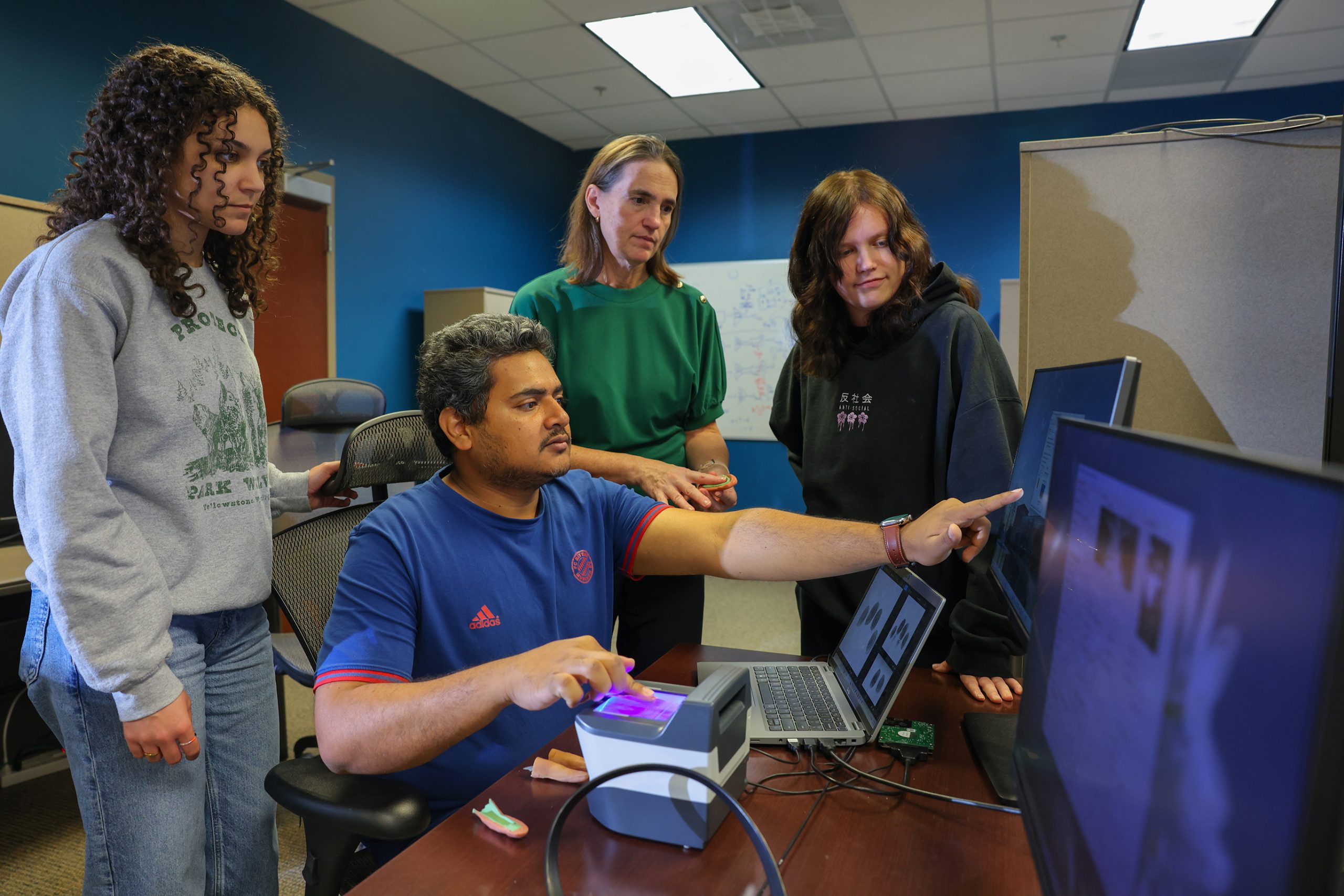
Schuckers collaborates with students during a hands-on demonstration, analyzing biometric and facial data.
Partners In Crime Prevention
A key concern for Schuckers and her team is “presentation attack detection,” which devises new methods to defend against sophisticated attempts to break into a system with highly advanced “spoofs” of biometric data, both physical (like masks) and digital (like deepfakes).
“What’s special about biometrics over a password is that you have the ability to measure factors like liveness,” which Schuckers explains as the idea of whether biometric information is tied to a living, breathing person. It is the underlying thread of much of her work. “Our research is all about building liveness algorithms and testing them.”
With firsthand knowledge from actively playing the role of ethical hackers, Schuckers and her team learn how to design advanced computer algorithms, harnessing the power of artificial intelligence to train computers to better detect all types of spoofs.
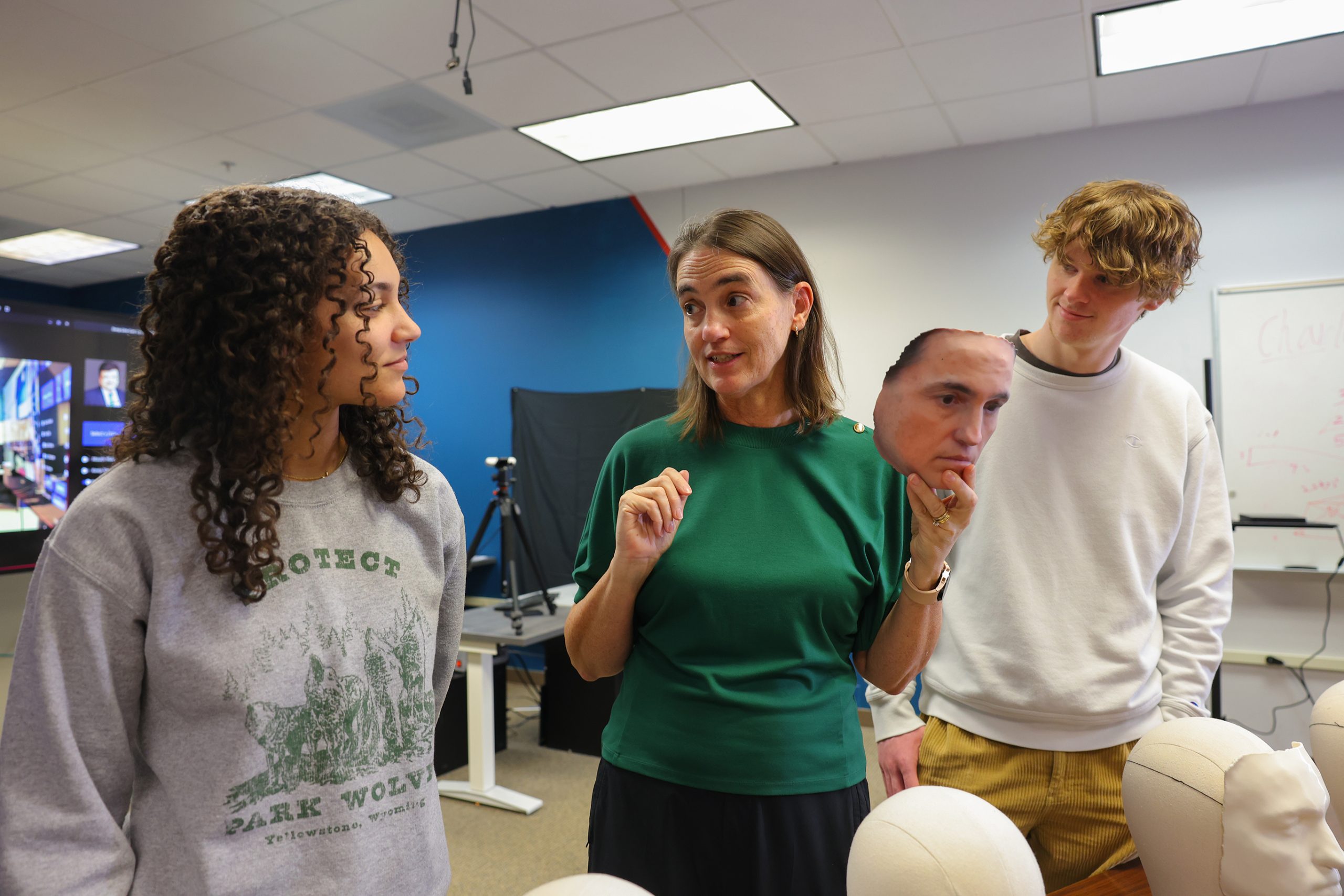
Schuckers instructs students on biometric research, demonstrating deepfake detection techniques with facial models.
“We have one of the largest databases in the world around spoofs. We have spoofs for faces, fingerprints and irises; and we’ve done work with voice,” Schuckers said. Since CITeR’s founding in 2002 at West Virginia University, through its expansion to Clarkson University along with Schuckers and the ultimate move to Charlotte, over 400 organizations from 40 countries have requested its data to aid in their biometric protection efforts. In addition to UNC Charlotte and Clarkson University, other CITeR university sites and academic partners include West Virginia University, the University at Buffalo, Michigan State University and the Idiap Research Institute.
CITeR’s research is made possible through the financial support of organizations worldwide, including U.S. government agencies, national and international research organizations with purviews ranging from computer security to military defense as well as massive corporations tasked with protecting an untold amount of sensitive personal information.
While these groups often bring research ideas to the table, CITeR partner organizations receive the results of every one of the center’s research projects. It's a wide-ranging level of insight gained that explains why CITeR partners report an over-20-times return on their investments.
Niner Nation Sparks Student Cyber Success
It’s not just the partners that benefit from these investments; central to Schuckers’ approach is providing student researchers with unparalleled career development opportunities gained from working directly on the most pressing problems employers face. “Our students are deep into the projects,” Schuckers said. “When they’re done, they’re ready to be hired.”
Schuckers’ mentorship provides her students with the type of collaborative, hands-on-learning experience regarded as a hallmark of Charlotte’s commitment to student success.
“Dr. Schuckers' work is a big part of why I’m focused on biometrics,” said Weston Bondurant, one of Schuckers’ Ph.D. students. A Greensboro native, Bondurant earned a CCI bachelor’s degree and now studies deepfake technology. “I’ve learned more in the past year than at any other point in my life.”
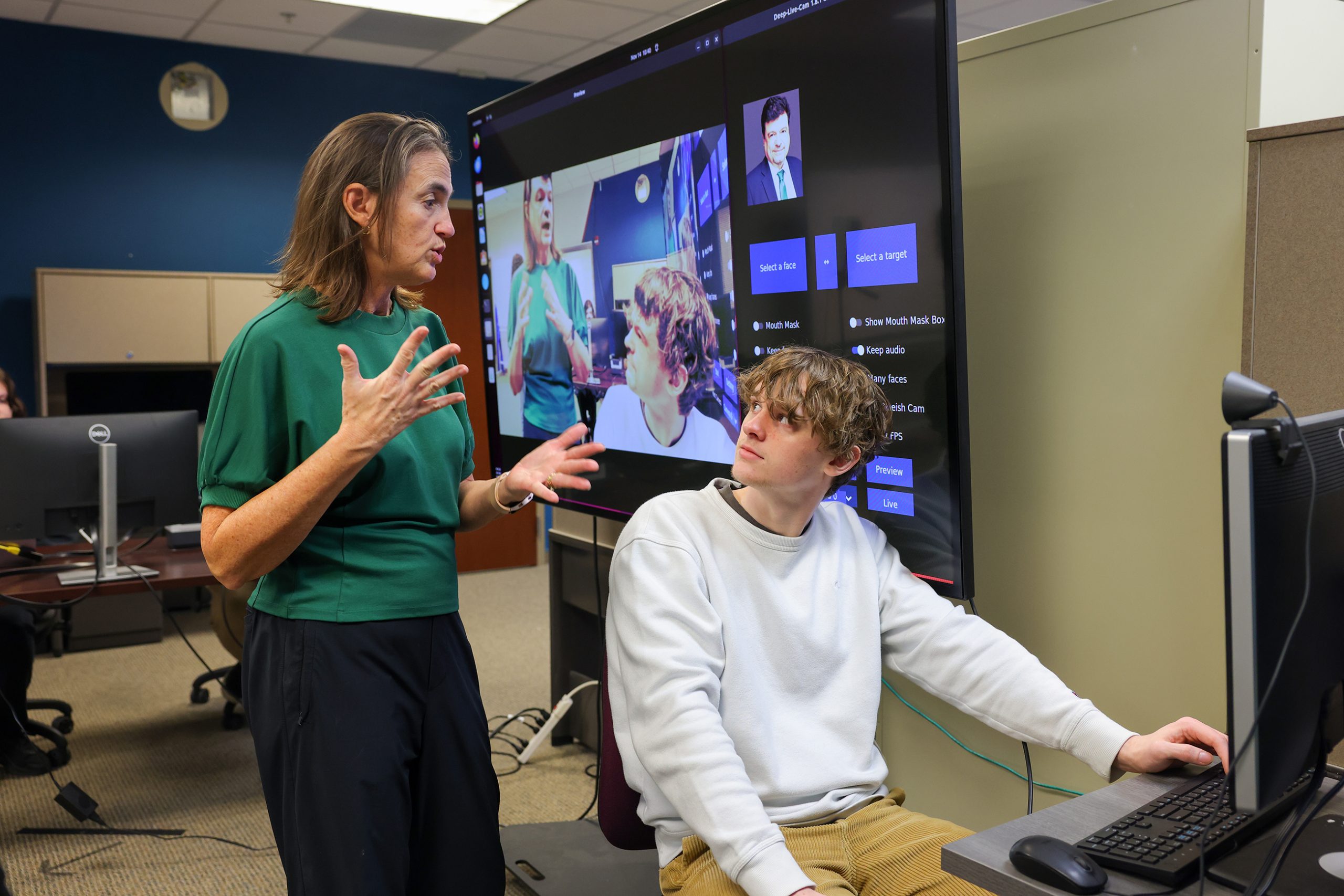
Schuckers guides Ph.D. student Weston Bondurant, whose studies in deepfake technology is inspired by Schuckers' research.
One of his research partners, Ph.D. student Jahangir Khondkar, accompanied Schuckers from Clarkson to Charlotte in 2024. Khondkar earned a master’s degree in Electrical and Computer Engineering and previously worked as a network and systems engineer with a nonprofit organization in his home country of Bangladesh, where the government provides a stipend to disabled individuals. In that role, he witnessed cases in which government stipends meant to support individuals with disabilities were illegally withdrawn by others, scamming them out of essential financial support.
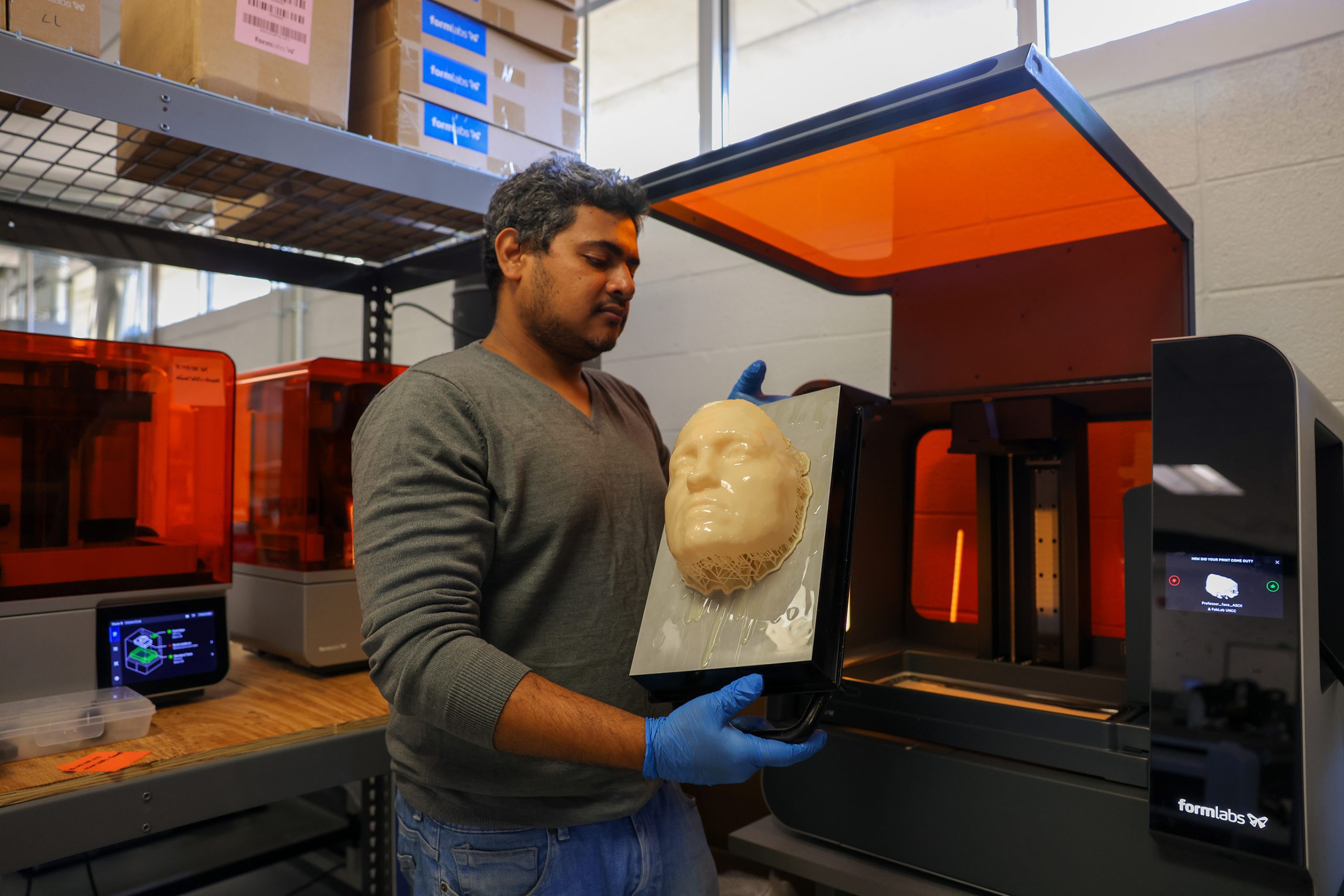
Ph.D. student Jahangir Khondkar examines a 3D-printed facial model.
“That made me so sad,” he said “I kept thinking, ‘How could we prevent that?’”
That question was the key that led him to biometric security. Now, Khondkar’s research with Schuckers focuses on strengthening facial recognition technology through developing attacks with both physical masks as well as digital faces that are either morphed or merged with one another through advanced AI.
Pragya Pandya, a first-generation undergraduate student who transferred to Charlotte from Central Piedmont Community College to study computer science, was sold on biometrics in an introductory course taught by Schuckers. Schuckers regaled Pandya and her classmates with documented cases of how inaccurate facial recognition in camera surveillance systems had led people to be falsely accused of crimes. Students then created masks based on their faces to better understand how smartphone face detection systems work and how they may fail. Pandya credits the project along with Schuckers’ skill and passion in the classroom with opening her eyes to the potential of a career in biometrics.
“Dr. Schuckers doesn’t teach dry theory,” Pandya said. “She always talked about the practical implications of these biometric technologies. Everyone in class was constantly talking and sharing ideas.”
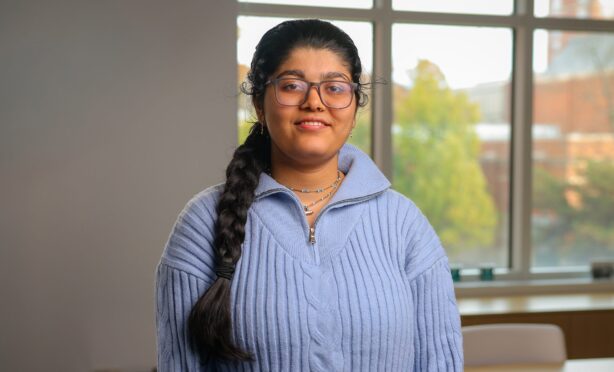
Student Pragya Pandya explores biometrics after a hands-on course with Schuckers, examining facial recognition accuracy and ethical technology.
Charlotte Makes The Difference
A scholar like Schuckers can anchor her research endeavors anywhere. She chose Charlotte. Now firmly planted in the Queen City, Schuckers is eager to expand CITeR’s work with new partners who are innovating in North Carolina’s fastest-growing city.
“With UNC Charlotte’s world-class faculty in foundational artificial intelligence, computer vision, biometrics and cybersecurity research, the deepfakes that seem so realistic and dangerous today won’t be effective due to the advancements we’re developing to protect against them,” Schuckers said. “That’s thanks to the work we’re doing at — and in — Charlotte.”