Introducing... the Classroom Experience!
How Charlotte Researchers are Improving Teacher Retention through Intentional Design
By Caroline Freeman
Photos by Kat Lawrence, Video by Ozzie Hernandez, and Animation by Nora Nota ’28
KEY TAKEAWAYS:
- A Charlotte research team wants to help alleviate the teacher shortage affecting one in eight classrooms by improving retention in teacher education programs.
- Their more thoughtful clinical experience, developed with a strong community partner, will help students feel more confident in their career choice.
- Early results show a 20% improvement in the number of students who want to continue pursuing classroom teaching.
Cover photo: Bailey Taylor '23, left, serves as a mentor teacher for Charlotte education students.
Picture yourself stepping into the role of a teacher.
It’s a daunting prospect, especially if teaching wasn’t part of your plan. Many believe that teaching demands a special kind of person, yet every year, students of all kinds take this leap. It’s a good thing they do: America is grappling with a critical teacher shortage, impacting one in eight classrooms.
Now, envision yourself in their shoes. You’d crave every opportunity to dive into the classroom experience, to get comfortable in front of students and to refine your teaching skills – without the pressure of managing a full class on your own.
Fortunately, that's exactly what educator preparation programs are designed to do. From early on, you enter classrooms to observe, and later assist, through clinical experiences. Clinicals are a midway point between theory and practice: an opportunity to be a supervising adult in a classroom without the full responsibility of being the teacher on duty.
But not all clinicals are created equal.
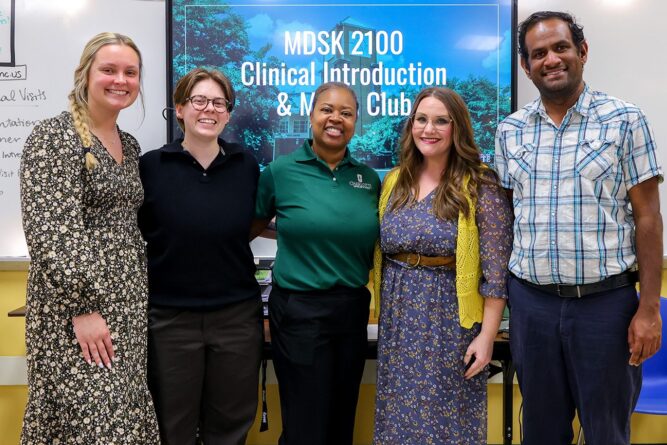
The Charlotte research team working to develop a more thoughtful clinical: Bailey Wilcox '24, Bailey Taylor '23, Danyeal Morrison, Kate Gilbert, and Premkumar Pugalenthi.
Multiple Perspectives, One Question
Clinical Assistant Professor Premkumar Pugalenthi and University supervisors Kate Gilbert and Danyeal Morrison each began noticing a troubling pattern in their work as teacher educators in the Cato College of Education.
Upon arriving at Charlotte in 2022, Pugalenthi recognized a lack of engagement in his students, even at the start of their journeys. “Their experiences felt very siloed, and they weren’t able to reflect with one another because their experiences varied too greatly,” he said.
Gilbert and Morrison’s work focuses on the final semester: Student teaching, a culmination of everything a student has worked toward. Too often, students were withdrawing or changing majors, unable to complete that last hurdle — a costly and emotionally difficult decision. Faculty across the college often felt they were losing a battle against factors out of their control. So Gilbert asked a specific question: “What part of this equation can we control?”
Considering a New Approach
The hypothesis formed as the team came together in 2024: Focus on retention. If adjustments could be made to the program to help students feel confident they belonged in the classroom, Charlotte could produce more teachers without adjusting recruitment strategy. That would mean taking a hard look at the teacher preparation process to understand where and why so many potential teachers were changing their minds.
Clinicals are designed to give students an abundance of flexibility and autonomy. Historically, students have selected their own placements. They take responsibility for contacting the school and choosing their mentor as well as for coordinating visits and fulfilling assignments within a timeframe that spans several weeks.
However, this raises an important question: Is there such a thing as too much autonomy, where it gives way to stress and overwhelm from lack of direction? If we shift the balance toward clear structure and intentional design, could education programs improve retention and thus create more qualified teachers?
Shaped by Student Experience
Enter Bailey Taylor ’23, a former advisee of Gilbert, now an English teacher at Mallard Creek High School in Charlotte. Taylor (they/them) had struggled at the finish line, nearly quitting during student teaching because they felt they didn’t fit the mold — confusing discomfort with a particular school for being uncomfortable as a teacher.
In Taylor’s senior year, before the research team had formed, Gilbert had already begun personalizing her teacher candidates’ experiences and invited Taylor on a “field trip” to a school separate from their student teaching placement. “The difference was night and day,” Gilbert said. “I got to watch them find their comfort zone.”
“She connected me to people she trusted,” Taylor said. “I knew she was going above and beyond, because friends with different supervisors had never heard of a field trip. It made me feel valued — like she saw me and wanted me to succeed.”
It’s about making sure teacher candidates feel like they belong there, like they can do this. It gives them a reason to push through all the testing and paperwork that we have to do to serve students… if I had seen people doing research to keep me in education, it would have meant the world.”
Bailey Taylor ’23
The outcome of that experience pushed Gilbert, and later the team, to interrogate the connection between belonging at the front of the classroom and longevity in the teaching profession. Taylor’s questions were about process — how student teachers are placed and what more could be done to find classrooms that really fit a teacher candidate — while Gilbert saw how those could affect a student’s perception of the profession. “The process wasn’t intentional,” Taylor lamented, looking back. “The clinical experience was not designed to keep me pursuing education.”
In fall 2024, the team began trialing changes to the clinical experience in Pugalenthi’s class. One of these changes was a video from an alum sharing a few brief words about their own clinical experience; after Taylor filmed their story, the team invited them in. Even though alumni are not traditionally on research teams as investigators, Taylor had already impacted the team’s direction. Gilbert added, “We thought a former student’s perspective would make the new model that much more effective.”
A New Approach to Clinicals
As the research team built the new model, they looked for a community partner: A school with a history of partnering with Cato College, a high alumni population on staff and an administration that would facilitate their presence.
Mallard Creek principal Jared Thompson’s strong belief in Charlotte’s work made his school an easy choice. Thompson said, “Research and practice both tell us that sustained, high‑quality clinical experiences lead to stronger first‑year teachers. This model honors that by treating clinical experiences as core work, not a checkbox. By working closely with UNC Charlotte, we’re helping identify and develop educators who understand our students, our standards and our community before they ever have a classroom of their own.”
The new model inserts the human element into the clinical experience, designing with intention to reduce isolation and increase confidence and belonging.
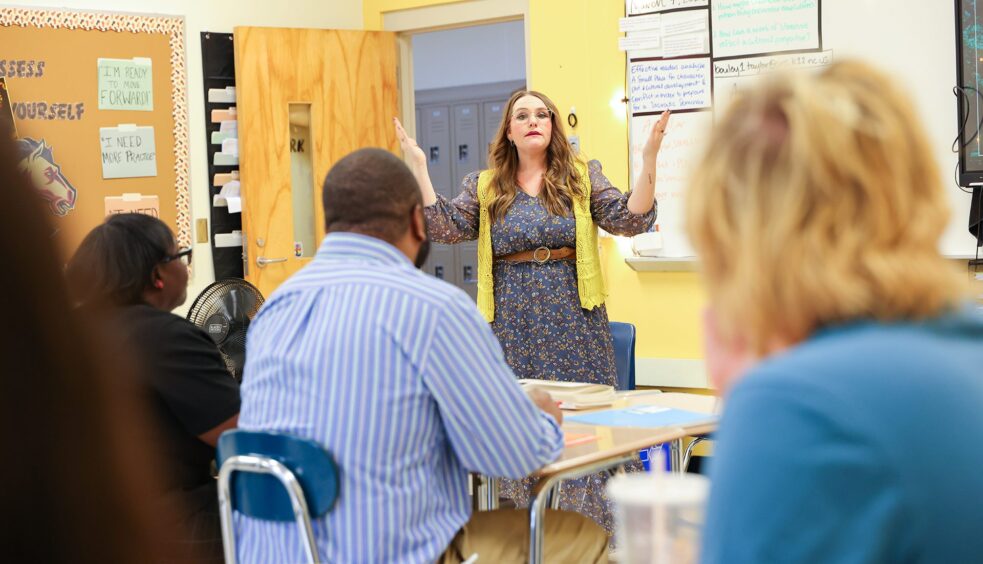
The research team carefully designs each experience and shares with the pre-service teachers. Students learn about Mallard Creek well in advance, knowing care has been taken to set them up for success.
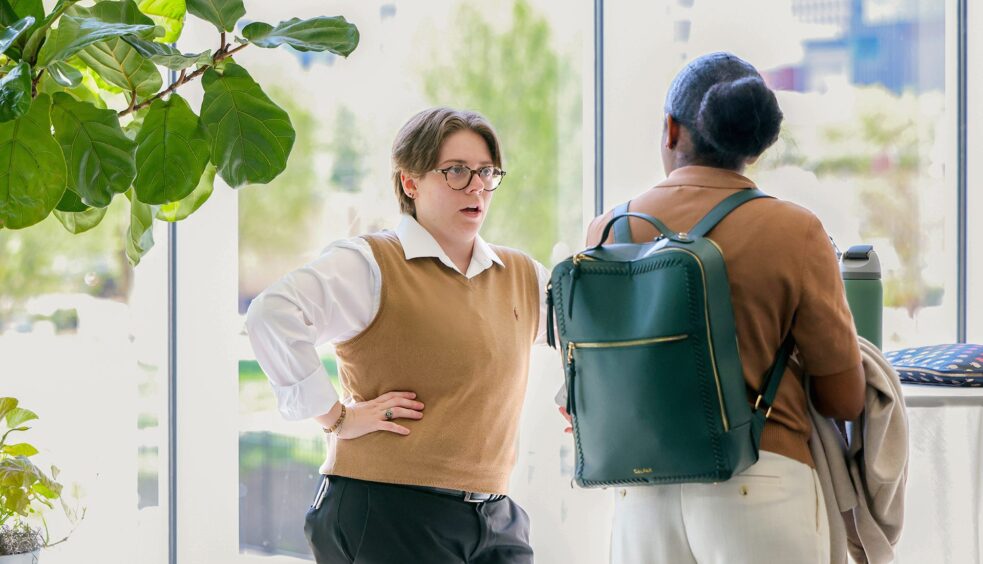
Meanwhile at Mallard Creek, Taylor, left, approaches colleagues to become mentor teachers, keeping in mind individual personalities and chosen subject areas, choosing educators who are bought into the process.
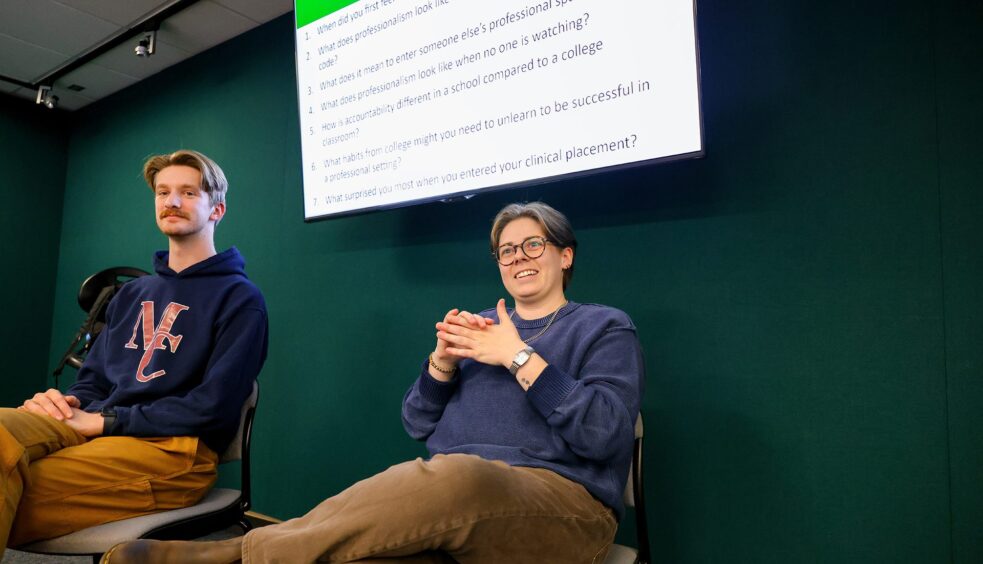
A few weeks before clinicals, Taylor and fellow alum Jacob Majure ’25 enter the classroom at Charlotte for an alumni panel where Gilbert positions them as mentors her students can approach when they’re onsite. They focus on how to handle the transition from, “I was a high schooler just two years ago” to “Now I'm a professional in the room.”
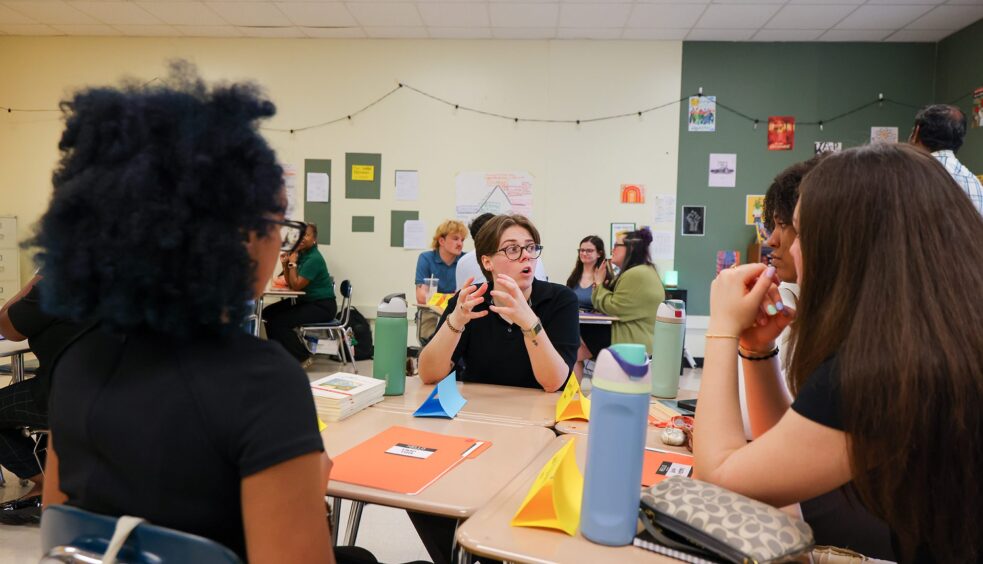
A week before clinicals begin, the research team arranges a site visit to Mallard Creek. They spend a few hours after the school day ends with the supervising teachers Taylor has hand-selected, removed from the pressure of having high school students around or the timing of a bell schedule.
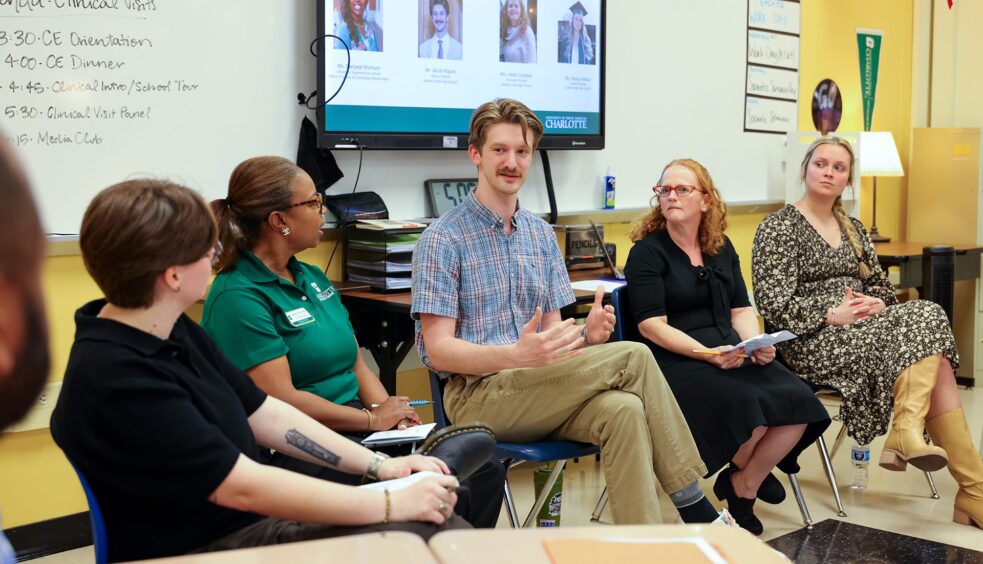
While on site, education students familiarize themselves with school logistics and ask questions of their mentors, a school administrator, and an alum who student taught at Mallard Creek. They can get comfortable in the space before they ever meet any high schoolers and establish a rapport with their supervising teacher.
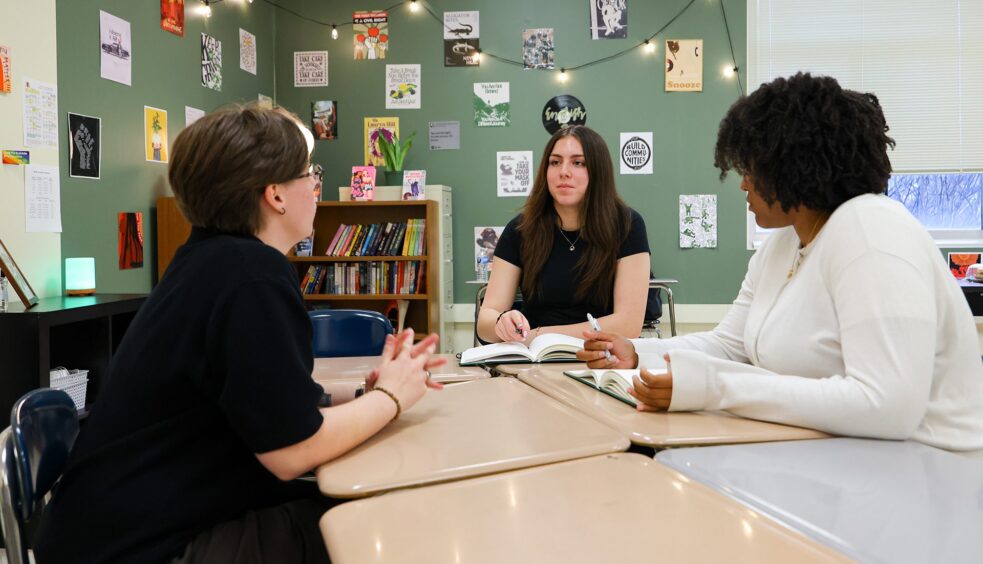
During clinicals, students are divided by content area and encouraged to pair up for more opportunities to reflect. With their mentors, they run the full gamut of a school day, including lunch, bus duty or planning period — not just instructional time — making for a more complete learning experience.
THE POWER OF INTENTIONAL DESIGN
1,200 More
Teachers Means:
- More classrooms fully staffed
- More students supported
- More communities strengthened
When clinicals are complete, students return to campus to reflect on their experience. At the end of the reflection class, Gilbert asks, “How many of you still want to be a teacher?” Pugalenthi shared, “I’ve asked that question at least once a semester since well before we started implementing this model. The unraised hands averaged five or six in a class of 20. Last semester, with this model in place? Only two. A 20% improvement.”
These early results are especially promising: Increasing the number of students who want to be teachers is the goal of the research. The world needs more teachers, especially those who want to be teachers.
The team hopes to share this approach across the college. Anticipating replicability, they believe it's a model that can be applied at peer institutions nationwide. If the early numbers hold, it would mean 20 more teachers in every class of 100. With over 6,000 students enrolled in a teacher education bachelor’s degree programs in North Carolina in 2024, that could produce 1,200 new teachers for the state in a four-year cycle.
Like many Cato College students, Taylor recognized their calling early and chose Charlotte to hone it into a profession. “I remember sitting in observations thinking, ‘I can’t wait to do this.’”
Now, there’s an added bonus — the work they do every day with their students has been worth every mountain to climb, and they get to help EduNiners like them. “Now I get to help the next generation of educators find confidence and clarity in the profession they’ve been dreaming of.”