Redefining Military Student Recruitment
How one alumna built connection and momentum across Military and Veterans Services — without a military background
By Alex Reynolds
Photos by Amy Hart and Alex Reynolds
KEY TAKEAWAYS:
- Since Elizabeth Beattie ’20 joined Military and Veteran Services, unique student certifications have surged — putting UNC Charlotte on a path to lead the UNC System.
- Beattie spends much of her time on the road, recruiting at military bases across eastern North Carolina and building relationships with military‑affiliated organizations.
- Despite having no military background, Beattie naturally connects with veterans and continues to strengthen Charlotte’s reputation as a military‑friendly institution.
In 2023, the Military Veteran Services office had a budget for a new position. Vice Chancellor for Student Affairs Kevin Bailey asked Chris Brasel ’18, director of MVS, what he needed. Brasel’s answer was a program director for Outreach and Engagement, someone who could support military-affiliated students from recruitment to job placement.
A nationally competitive search began. Of the 85 applicants, the committee selected Elizabeth Beattie ’20, a recent alumna with no military background.
Beattie’s impact was instant and fundamentally shifted the trajectory of the program.
The outreach approach fueling record certifications
Beattie recruits prospective students at military bases and community events, regularly visiting Camp Lejeune, Fort Bragg and Seymour Johnson Air Force Base in North Carolina, with expansion planned into Virginia and South Carolina. She also develops partnerships for events like the Camo Classic and MVS Job Fair and meets one‑on‑one with military‑affiliated students to connect them with admissions.
Beattie’s lack of military experience is her superpower. Instead of swapping “war-stories” with prospective veteran students, she centers their story with genuine curiosity.
From there, Beattie acts as a “mini resource person,” highlighting the different programs and advantages of attending UNC Charlotte.
“I highlight what I call the ‘Charlotte ecosystem,’” Beattie said. “The different businesses we have, the community and the support available to veterans. Many of the University’s corporate partners have military talent recruitment teams so it’s a very natural connection.”
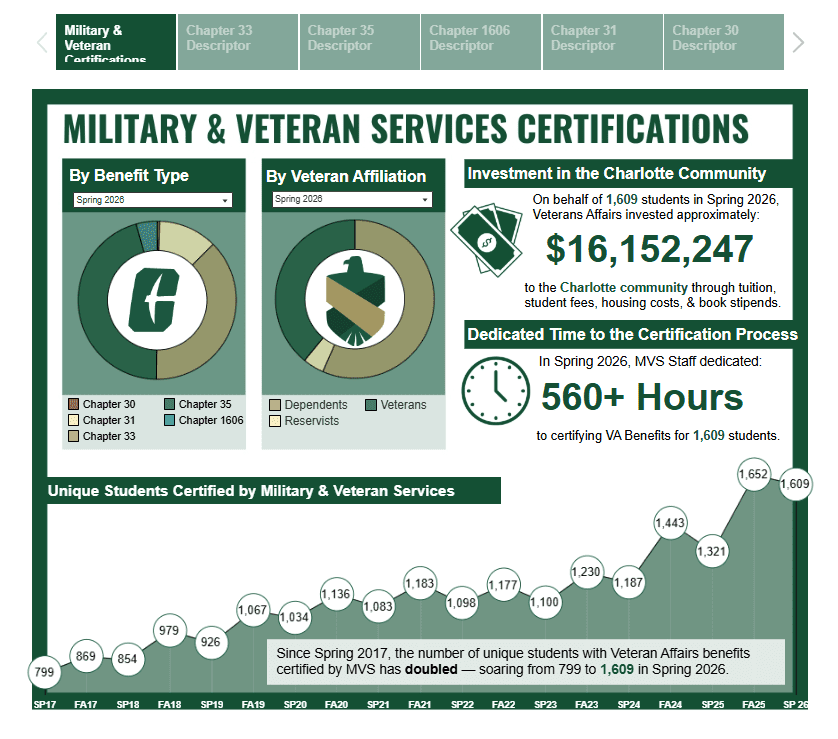
MVS measures success through the number of unique students certified each semester. Prior to Beattie’s arrival, the office grew about 10% year over year. In her first semester, fall 2024, certifications jumped 17% to 1,443. In fall 2025, certifications reached 1,652 — a nearly 15% increase.
This puts Charlotte ahead of sister schools NC State and UNC Wilmington, which benefit from proximity to military bases in eastern North Carolina. As Brasel projects future growth, he wonders how close the University is to crossing 2,000 unique fall certifications, a milestone that would put Charlotte neck‑and‑neck with state leader ECU.
“I love our underdog story — a scrappy 80-year-old university,” Brasel said. “But we’re strapped in, we're killing it with the student population and our ratio is insane.”
Beyond enrollment, Beattie finds new ways to elevate MVS. Once, she suggested she and Brasel present military education benefits to a high school class. Brasel questioned the ROI, but as he monitored the Zoom chat, he was stunned by the engagement.
“This wasn’t a recruitment event, but we were unintentionally recruiting people,” he said. “Even if they end up going somewhere else, they’re going to remember UNC Charlotte.”
How a Charlotte alumna became the perfect fit
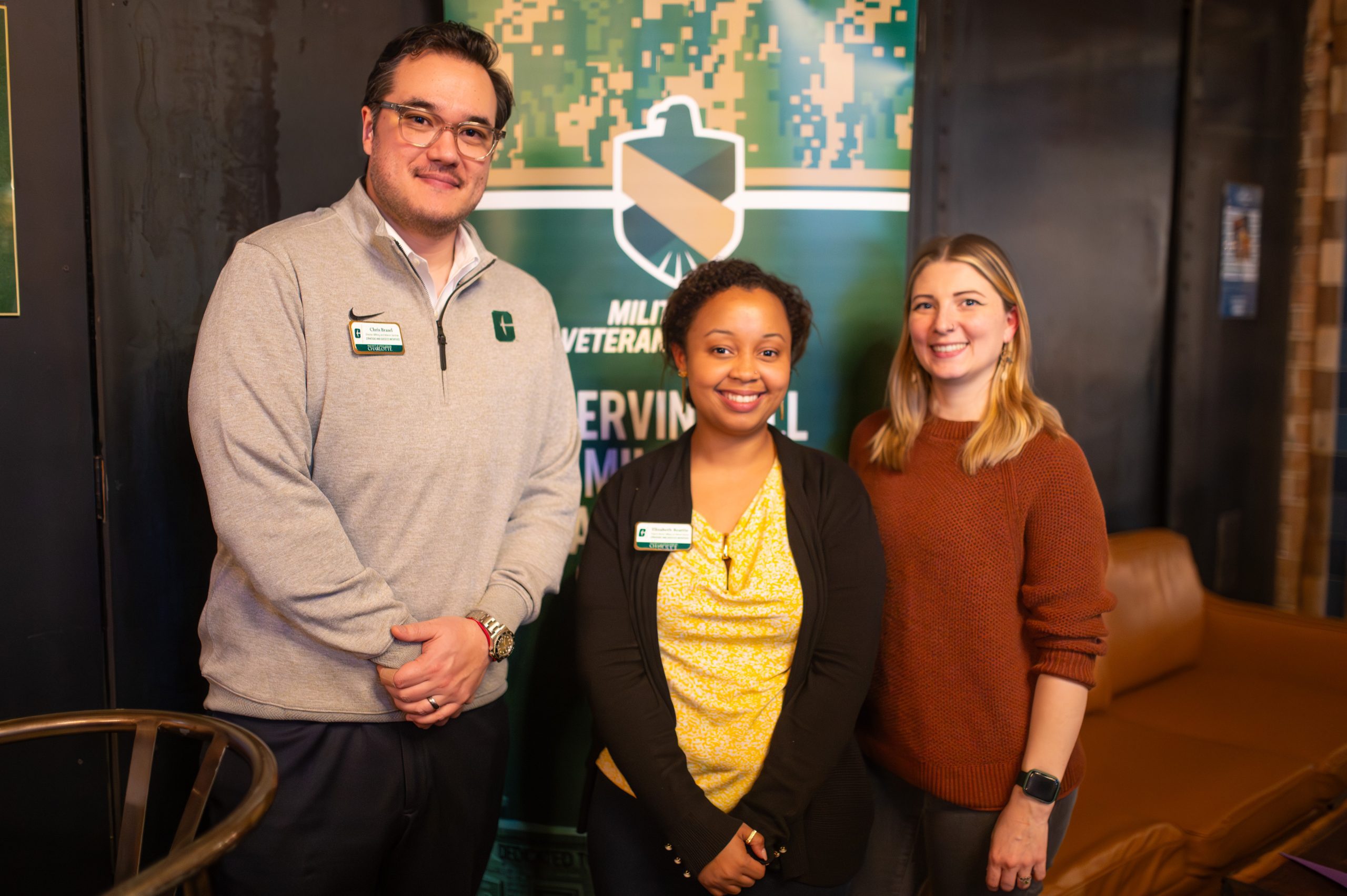
Three Charlotte alumni who serve veterans at MVS: Chris Brasel ’18, Elizabeth Beattie ’20 and Kat Denson ’25.
A Pfafftown, North Carolina, native, Beattie began college at the University of Alabama, but an unofficial tour of UNC Charlotte before her sophomore year inspired her to transfer and major in history. A lifelong dancer, she joined the Range of Motion dance ensemble and added a dance minor.
“Even though it’s such a big campus, it’s so niche,” she said. “I found my people in the history department, and even in big classes, I felt seen.”
After graduating, Beattie fell into admissions and discovered a passion for recruiting nontraditional students. Before joining MVS, she recruited military‑affiliated students in coastal North Carolina for Grand Canyon University while living in Jacksonville, a military‑heavy community.
When the opportunity arose to return to Charlotte and continue serving the military community, she went all in.
“I DM’d [Brasel] on LinkedIn — I’ve never done that before. I wrote a cover letter, the full nine yards,” she said. “I wanted this job so bad, and I did not think I was going to get it.”
Despite the high number of applicants, Beattie kept rising to the top. Brasel joked that her resume’s floral design would usually warrant an automatic rejection, but her experience made her the perfect fit for a developing role.
“I told her we’re building the plane while we’re flying it,” Brasel said. “Her experience doing it previously was huge, and her personality took it over the edge.”
Throughout the interview process, Brasel never asked about her military ties. Given her previous role and proximity to Camp Lejeune, he assumed she had some connection. Looking back, he appreciates her outsider perspective.
“Because of our military training and background, we think very rigidly a lot of times,” he said. “Elizabeth comes up with ideas that are outside the box — good and fresh for us.”
Meeting students where they are
One of Beattie’s core motivations is opening doors for a community that often feels separated from higher education. She frequently meets people who say they joined the military because they weren’t "good at school" — a belief that can be even harder to overcome for veterans returning in their mid‑20s and beyond.
“What I enjoy about my job is making college a reality for people who didn’t think it could happen for them,” she said. “I want to help them find a pathway and support them every step of the way.”
“My approach to recruitment is different because I make it all about them. I ask them what their goals are; where they see themselves in five years. Sometimes I’m the first person to ask them that.”