First-of-its-kind Partnership and Research Project to Improve Runways Across the Nation
Real-time pavement data informs future of aviation infrastructure through innovative research
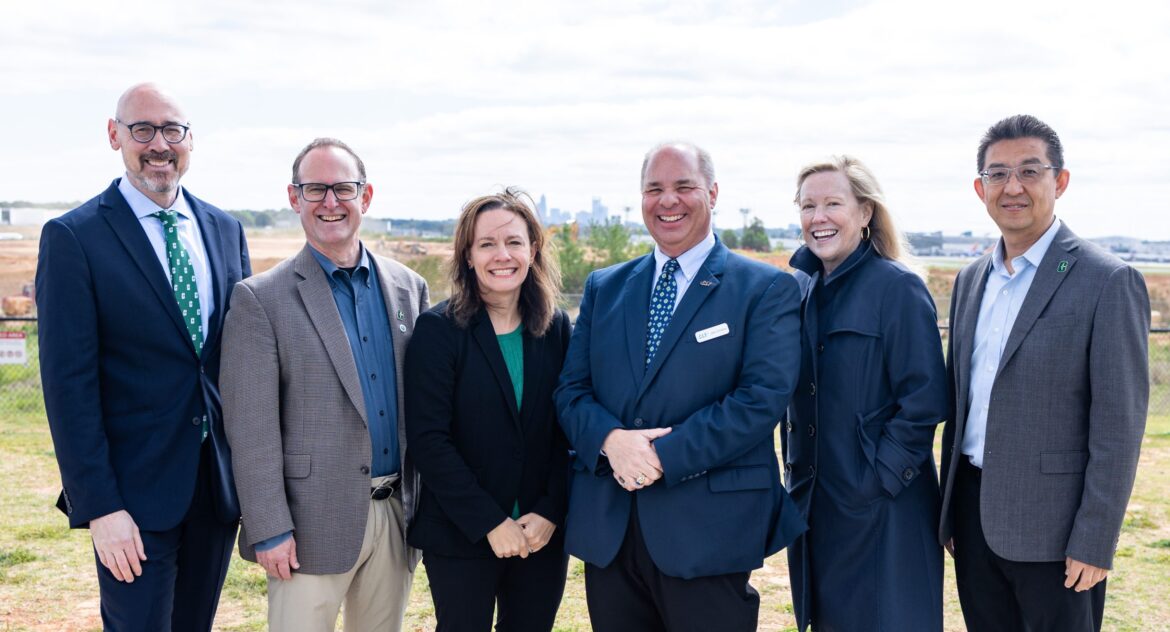
Tara Cavalline and Jack Christine (center) with Vice Chancellor John Daniels, W.S. Lee College of Engineering Dean Rob Keynton, Chancellor Sharon Gaber and Albert School of Construction Executive Director Lingguang Song.
CHARLOTTE, N.C. – Charlotte Douglas International Airport and UNC Charlotte’s Aviation and Innovation Research Institute are steering the future of airport runways. Tara Cavalline, director of the Charlotte AIR Institute and professor in the William States Lee College of Engineering, leads the joint research program between the airport and the university.
In the only project of its kind in the nation, the teams will study aviation infrastructure from the inside of the runway itself.
The study focuses on a runway currently under construction at CLT between and parallel to runways 2 and 3. High-sensitivity instruments, or sensors, will be embedded into the concrete as it is poured. The data feed from those sensors will reveal how the material behaves in real time and over the long term. Stakeholders will gain insight into pavement responses to environmental stressors and aircraft movements.
The airport will use the data for day-to-day operational analysis and maintenance needs, such as de-icing decisions.
“It costs quite a bit to de-ice a runway,” Cavalline said. “Currently, the decision relies on people walking outside to visually and physically assess the status. With the insights from this project, we will have data about moisture, temperature and ice to more accurately inform decisions. This will increase safety and decrease inefficiencies for the airport and travelers.”
Advanced modeling, such as digital twinning, will be a primary benefit for the stakeholders of the project. A digital twin — a virtual replica of the runway — enables dynamic testing capabilities, advanced knowledge of changes in the concrete, insight to the ground beneath the pavement and more.
The instrumentation and modeling of the runway is one of the airport’s most significant capital projects, said Jack Christine, chief infrastructure officer at CLT.
“This instrumentation and digital-twin project grew out of a strong partnership with UNC Charlotte, where the airport serves as a living laboratory for students,” said Christine. “By incorporating advanced technologies and innovative solutions, we’re enhancing how we design, build and operate our facilities. Safety is and will always be our top priority, and this collaboration supports our ongoing commitment to modernizing airport infrastructure. It reflects what can be achieved when working closely with Charlotte’s research university to turn innovation and research into real-world, cutting-edge results.”
John Daniels, the University’s vice chancellor for research and a fellow researcher on the project, said the partnership establishes Charlotte as a leader of airport infrastructure innovation.
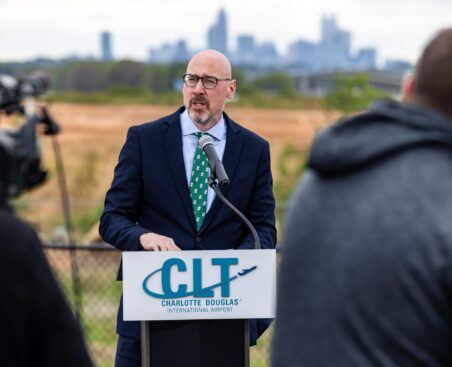
We are creating valuable data, models and insights that will inform the future of airfield design nationwide."
-John Daniels
“By embedding technology directly into the runway, we aren’t just building infrastructure,” said Daniels. “We are creating valuable data, models and insights that will inform the future of airfield design nationwide. Just as important, this work creates unparalleled, hands-on research opportunities for our students, who will be learning under the leadership of Dr. Cavalline.”
The approximately $6.5 million project is supported through a combination of grants, committed funding and in-kind contributions, including a $2 million grant from the FAA’s Airport Concrete Pavement Technology Program.
Ultimately, the project aims to transform traditional airfield management by creating a responsive system that supports more resilient runways and enhances the efficiency of airfield operations.

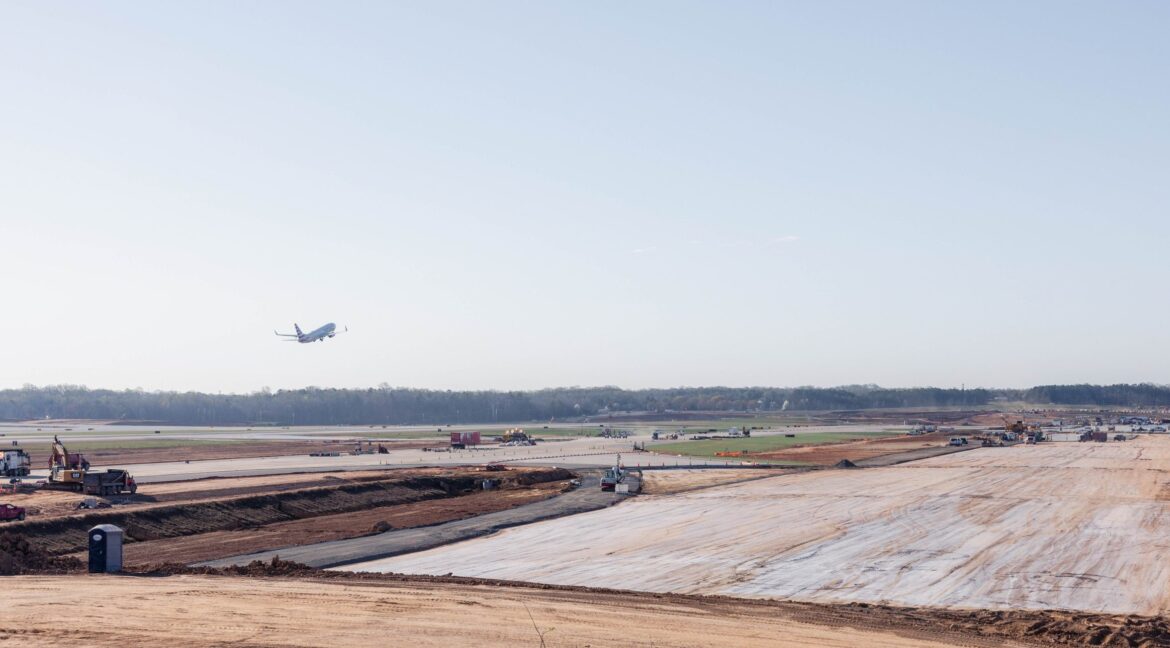
Fourth Parallel Runway Program Timeline
2016
- The Airport’s 2016 Master Plan Update identified the Fourth Parallel Runway Program as a solution that would meet growing demand for air service while maintaining efficient operations.
June 2023
- CLT held the groundbreaking for the 10,000-foot by 150-foot Fourth Parallel Runway
Oct 2023
- CLT established a first-of-its-kind partnership with UNC Charlotte’s William States Lee College of Engineering to launch Charlotte AIR Institute. Other key partners in the Institute are the Sullenberger Aviation Museum and Talbert, Bright and Ellington, a leading consulting firm for the aviation industry.
Sept 2025
- CLT and UNC Charlotte, through the Charlotte AIR Institute, entered a Memorandum of Understanding with the goal to collaborate on research initiatives aimed at advancing the aviation industry with a specific focus on enhancing airport operations
2025
- CLT’s three runways recorded 574,193 aircraft operations, the seventh-most in the world.
April 2026
- Approval and announcement of the instrumentation of the Fourth Parallel Runway
April-May 2026
- Work includes concrete placement, installation of erosion and sediment control measures and drainage structures. Airfield electrical systems are installed at multiple points along the runway.
Summer 2026
- Planned installation of sensor instruments below, in and above the runway concrete
Fall 2027
- Planned opening and commissioning of the Fourth Parallel Runway
Connect
Follow @CLTairport on Facebook, X, Instagram, Threads, YouTube and LinkedIn. Download the free, all-in-one CLT Airport app at the App Store or on Google Play. Get the latest Airport news at cltairport.com/news or sign up to receive CLT's electronic newsletters at cltairport.com/newsletters. Multimedia galleries featuring images and videos are available with credit attributable to Charlotte Douglas International Airport.
Follow @UNCCharlotte on Facebook, Instagram, YouTube and LinkedIn. Visit Inside.Charlotte.edu for the latest university news.
About Charlotte Douglas International Airport
Charlotte Douglas International Airport, a City of Charlotte department, is ranked the world’s seventh-busiest airport. In 2025, CLT welcomed 53.6 million passengers and handled nearly 574,193 arrivals and departures. CLT is served by seven major carriers, 15 regional carriers and four foreign flag carriers with nonstop service to 194 destinations, including 44 international locations and three U.S. territories. CLT averages 1,600 daily arrivals and departures and 4 million passengers traveling to, from and through CLT a month. An enterprise fund, the Airport is self-sustaining and does not collect tax dollars. Airport revenue funds all capital and operating costs.
(*Numbers reflect CLT’s Monthly Activity Report and data from Airport Council International.)
About the University of North Carolina at Charlotte
More than 32,000 students choose to call North Carolina’s urban research university home. As Charlotte’s only R1 institution, UNC Charlotte drives innovation and discovery in one of the fastest-growing regions in the United States. The University has an award-winning focus on student success, internationally recognized research and creative activity, and a deep commitment to community engagement and cultural vibrancy that makes it one of U.S. News & World Report’s Top 75 Public Universities. The Difference is Charlotte.