
Cultivating Community
Gambrell Faculty Fellowship brings the University and a local farm together to sow seeds for a good life.
By Meg Whalen
Photos by Kat Lawrence, Kyle Spence and Meg Whalen
The day the ribbon was cut on the “Roots of Change” project at Deep Roots CPS Farm, it was easy to imagine a good life.
The sun shone out of a bright blue sky. A golden Palomino horse grazed lazily on the lawn, its blonde mane ruffled by the
breeze. Nearby, James Beard Award-nominated chef Greg Collier served up a hearty chicken stew alongside tart pickles and crisp lettuces – all produced from the farm’s grounds.
A community of neighbors, UNC Charlotte students and faculty, and farm advocates chatted and munched as they admired the EcoDome, a vertical farming structure developed, built and installed by a collection of 45 architecture and urban design students under the direction of Assistant Professor of Architecture Kyle Spence.
Some 18 months in the making, the “Roots of Change” project was funded by a Gambrell Faculty Fellowship awarded to Spence through the UNC Charlotte Urban Institute.
“The Gambrell Faculty Fellowship was established in 2019, and since that time, the fellowship has funded more than 50 faculty on more than 30 projects from across different disciplines", said Liz Morrell, director of public policy research at the UNC Charlotte Urban Institute. “The faculty fellowship is part of the larger Gambrell Foundation, and the purpose of the Gambrell Foundation is really just to encourage social mobility and economic mobility, and more recently, to ask this broader question of what does it mean to live a good life?”
A truly collaborative, community-engaged project, “Roots of Change” offers some answers. Here’s how it came together.
Deep Roots CPS Farm
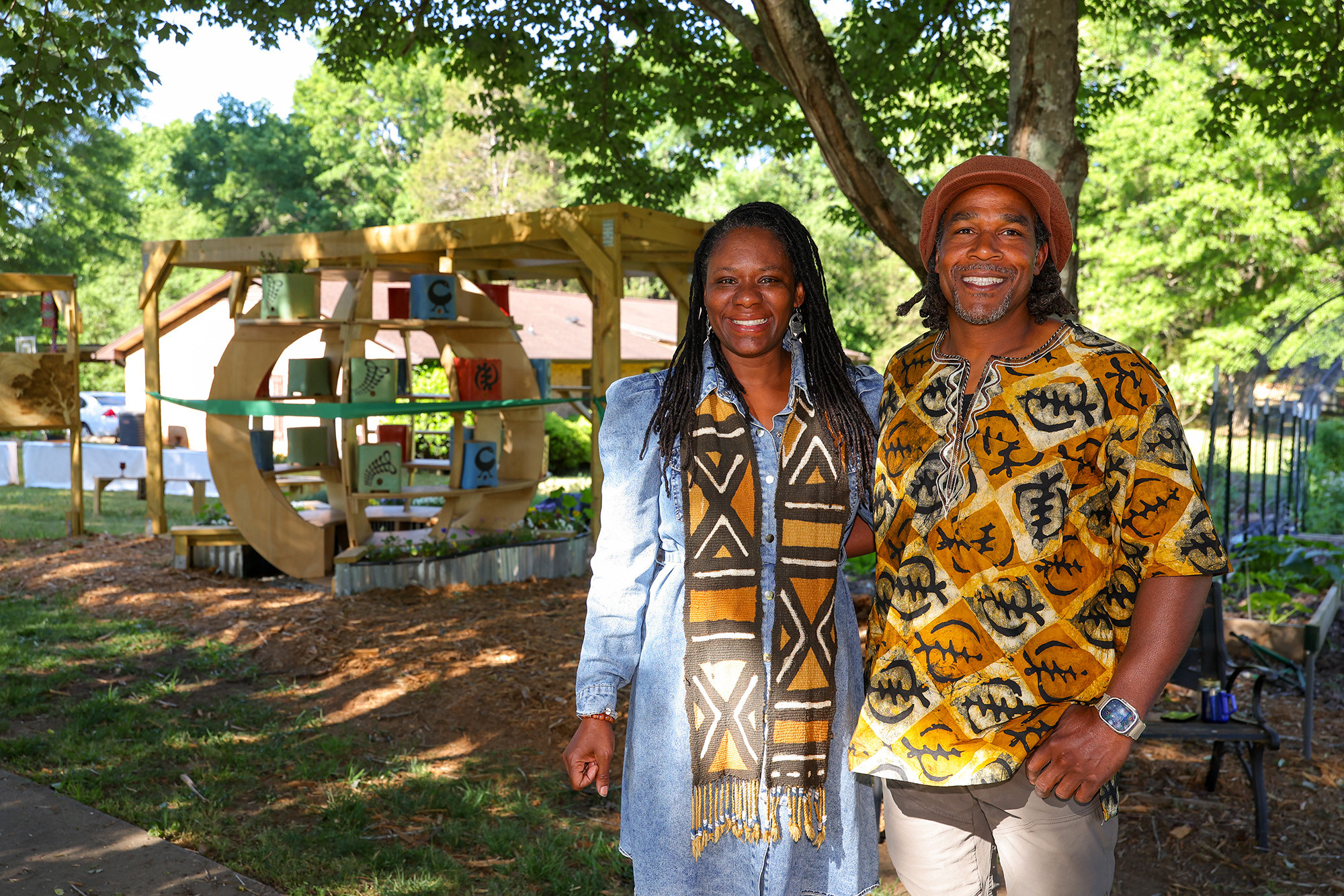
Founded by Wisdom and Cherie Jzar, Deep Roots CPS Farm is a seven-acre urban regenerative farm in west Charlotte. Although the Jzars began farming as a way to provide fresh, nutritious food for their family, their mission soon expanded: CPS stands for Community Planning Solutions.
“Nationally, farming is on a steady decline – food production in particular,” said Wisdom Jzar. “Vegetable and fruit production in this country is shrinking.”
The urbanization of Mecklenburg County provides a stark example. In 1910, at the height of local agricultural production, there were well over 4,000 farms in Mecklenburg. In 2022, there were 165, with under 8,000 acres of active farmland, according to the Agricultural Census.
“If you zero in even further to the Black farmer, now you're looking at not just a steady decline, but almost an extinction event,” said Wisdom. “And so we felt like it was our purpose to really get out and be a part of reversing that.”
Spence met the Jzars at the Uptown Farmer's Market, where they sell produce year-round.
“I had just moved to Charlotte from my previous institution, and as a vegan, it's always a big deal for me to go to local farmers markets. One Saturday I saw their stand, and it was really exciting to connect with them and hear about their operation.”
In addition to the market on Davidson Street, the Jzars sell vegetables, mushrooms, herbs, eggs and poultry directly from their farm through online sales or, in summer months, at their onsite farm stand. Customers can purchase occasionally or become a member through the Community Supported Agriculture program.
Deep Roots is also a place of education and community building, hosting farm-to-table dinners, a summer camp for youth and classes and workshops in gardening, composting, herbal remedies and other topics related to urban agriculture.
Soon Spence visited the farm. “I had some images with me of the EcoDome prototype, and it immediately piqued their interest because they saw the value of how a piece like that could add to what it is that they're currently doing.”
The Design Review
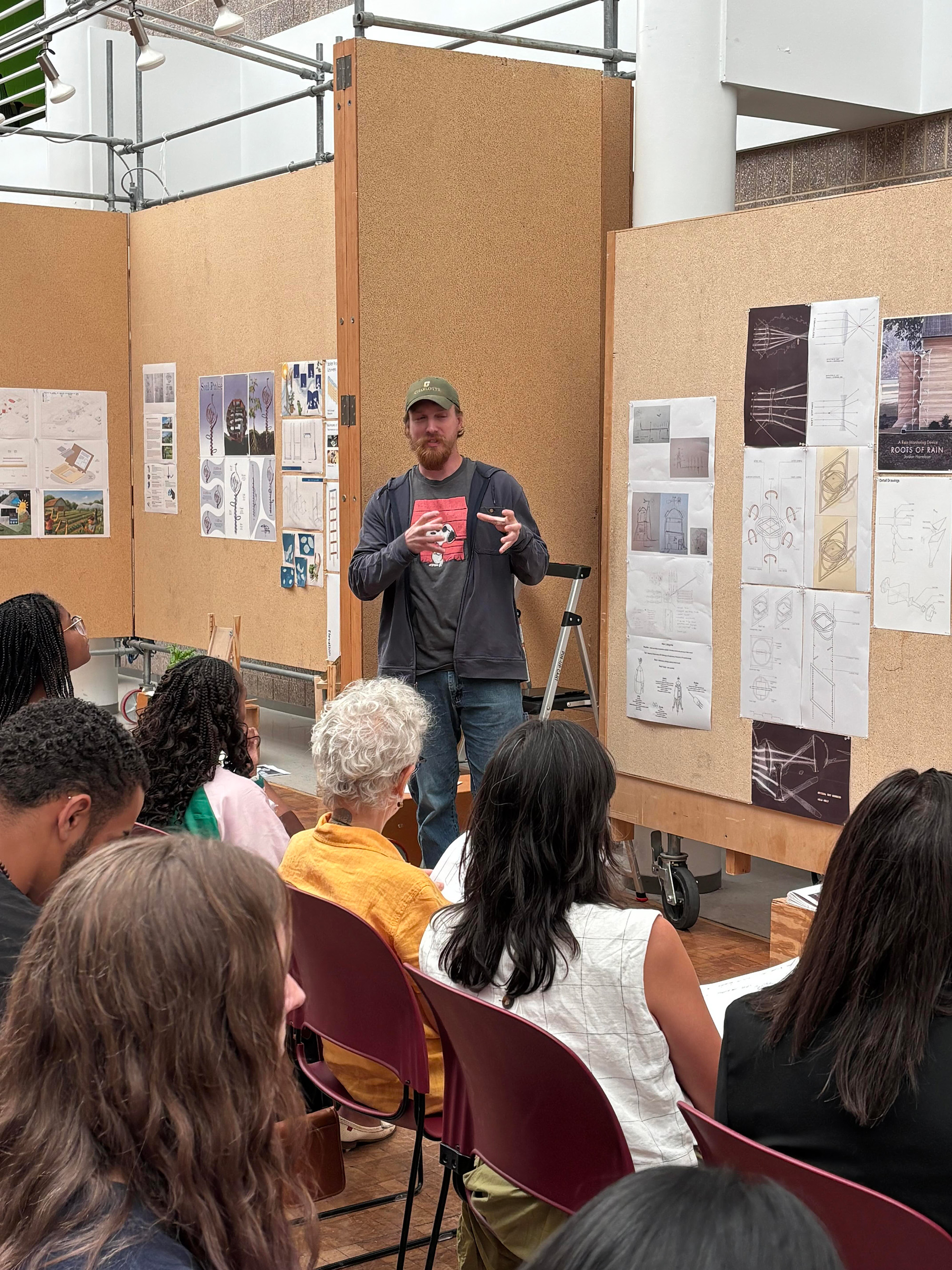
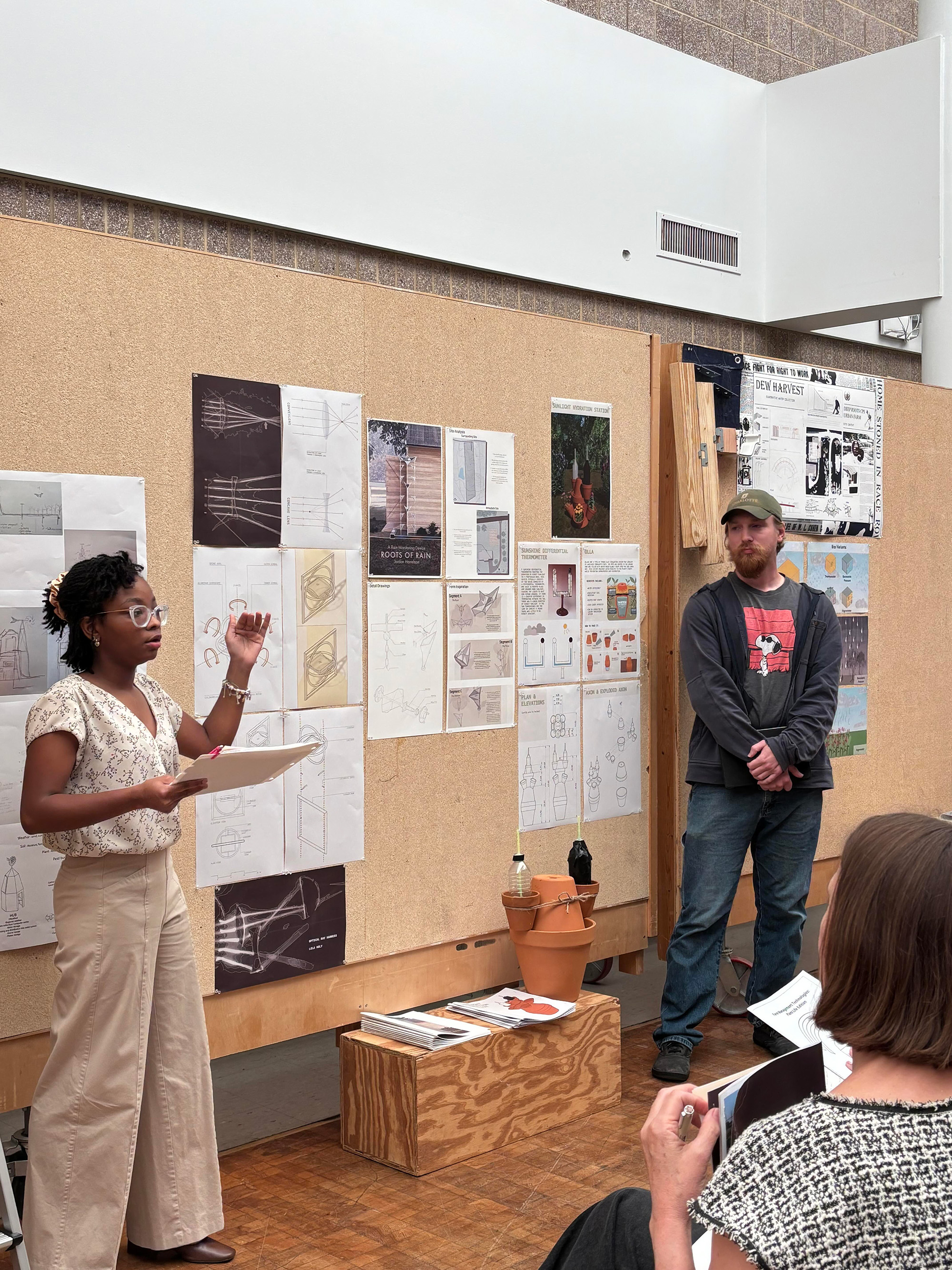
Three cohorts of students worked over three semesters to develop and refine concepts and designs for “Roots of Change.” The Jzars were partners throughout the process.
“I was inspired by seeing how the students responded to listening to the partners, Cherie and Wisdom,” said Morrell, who participated in design reviews. “They were there, giving direct feedback to the students, and I could see the students just light up.”
“It was really fun to hear their ideas,” said architecture student David Peterson, pictured above. “And when we presented ideas, they were very responsive to things and just loved what we were doing with it.”
The Build
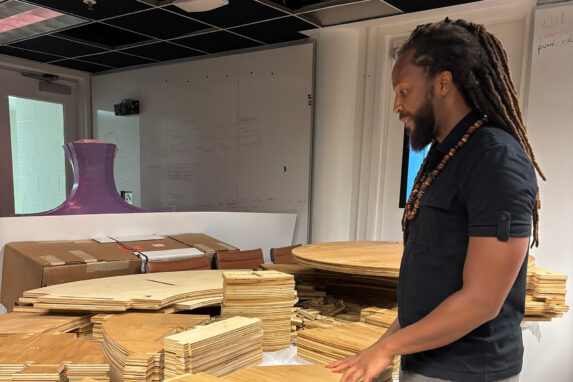
“EcoDome was actually one of the first larger scale pavilion spaces that I conceived with digital fabrication as the tool. When I moved from Florida to Charlotte, I brought all of the pieces of the EcoDome with me, with the mindset that at some point I would use that to initiate what would become the future collaboration of some kind of agricultural landscape project. I didn't exactly know what it would look like or how it would spatialize, but ultimately there was a vision for what would become what we now see on Deep Roots Farm.”
Assistant Professor Kyle Spence
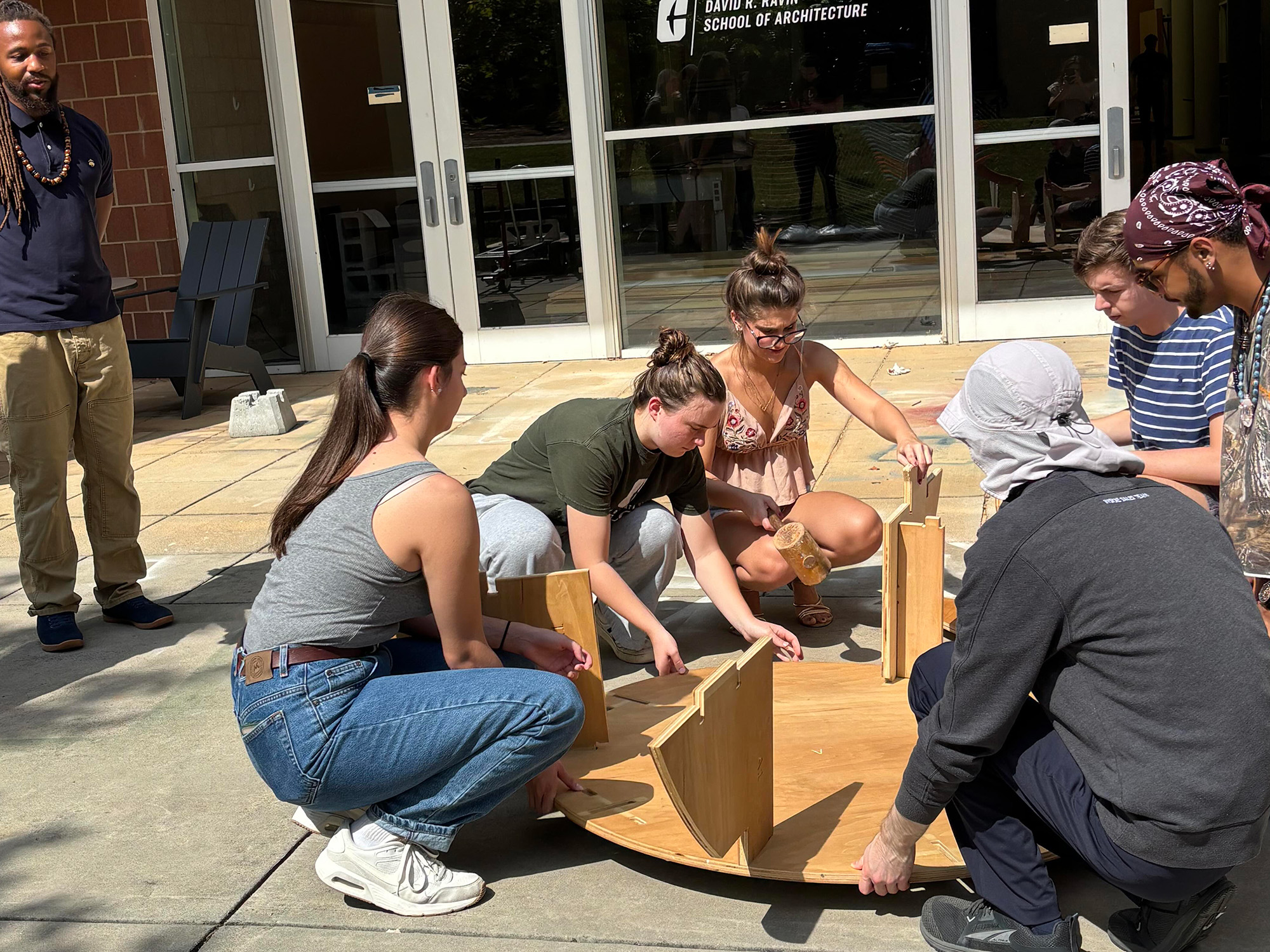
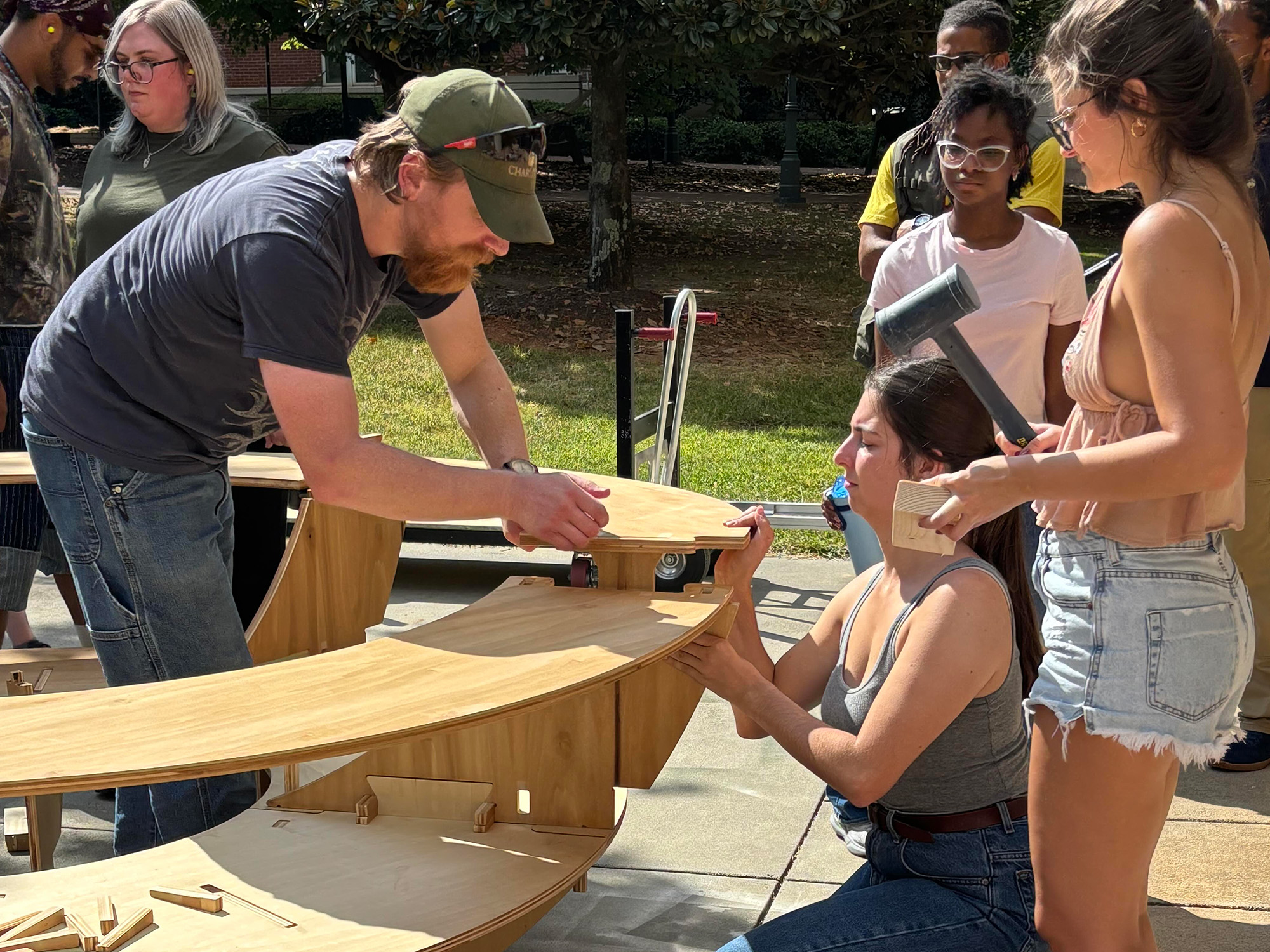
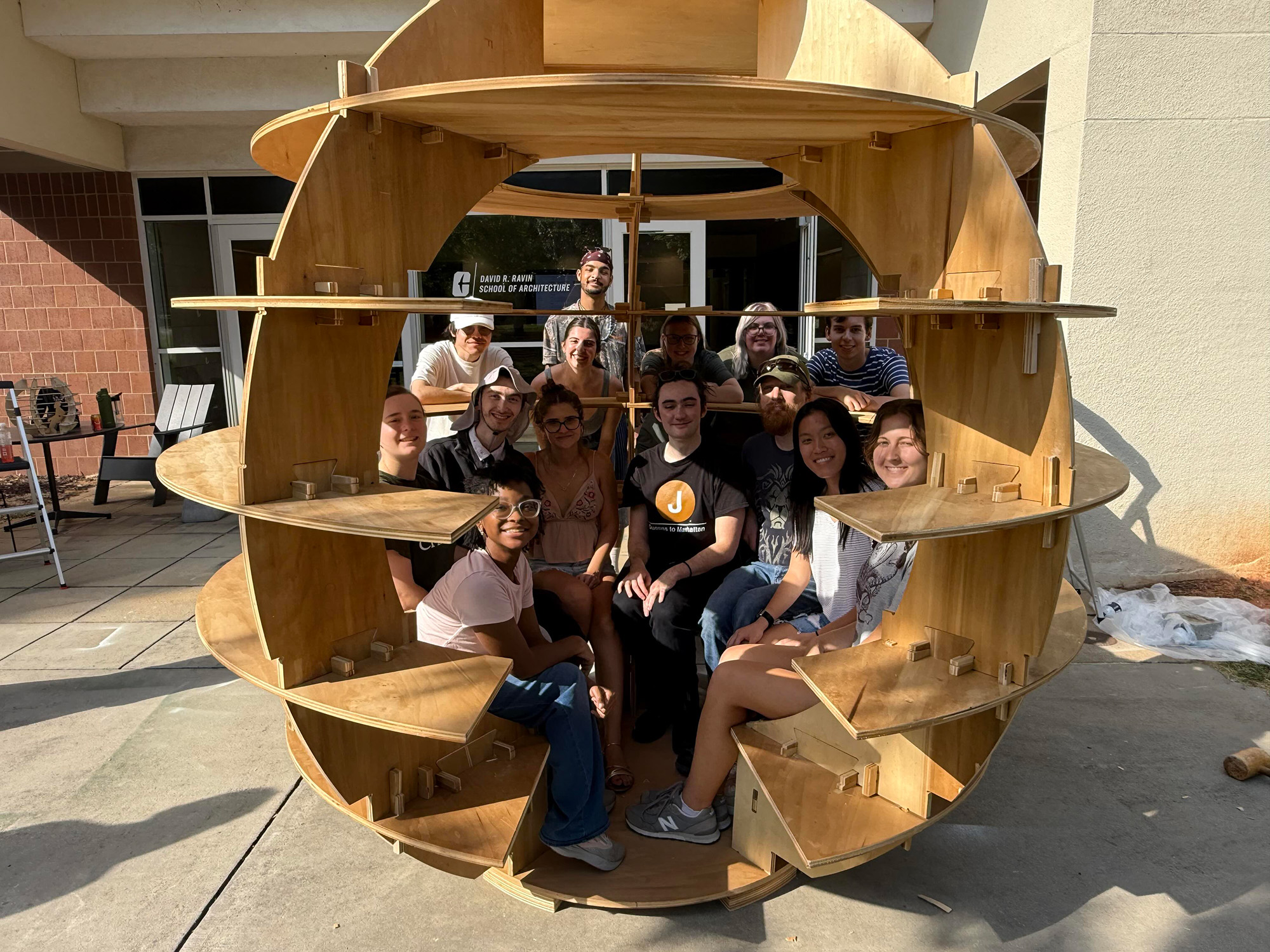
One hot afternoon in September, Spence and some students assembled the EcoDome prototype outside the Storrs building on campus. While it came together beautifully, they realized the need to make major adjustments before installing it at the farm.
“The original design was not very structurally sound after we put it together,” said Peterson, particularly for a long-term outdoor installation.
He and other students took the digital file and re-engineered the structure.
“We removed pieces, added pieces, and then built it a second time. And then we disassembled it again and then reassembled it at the Deep Roots Farm.”
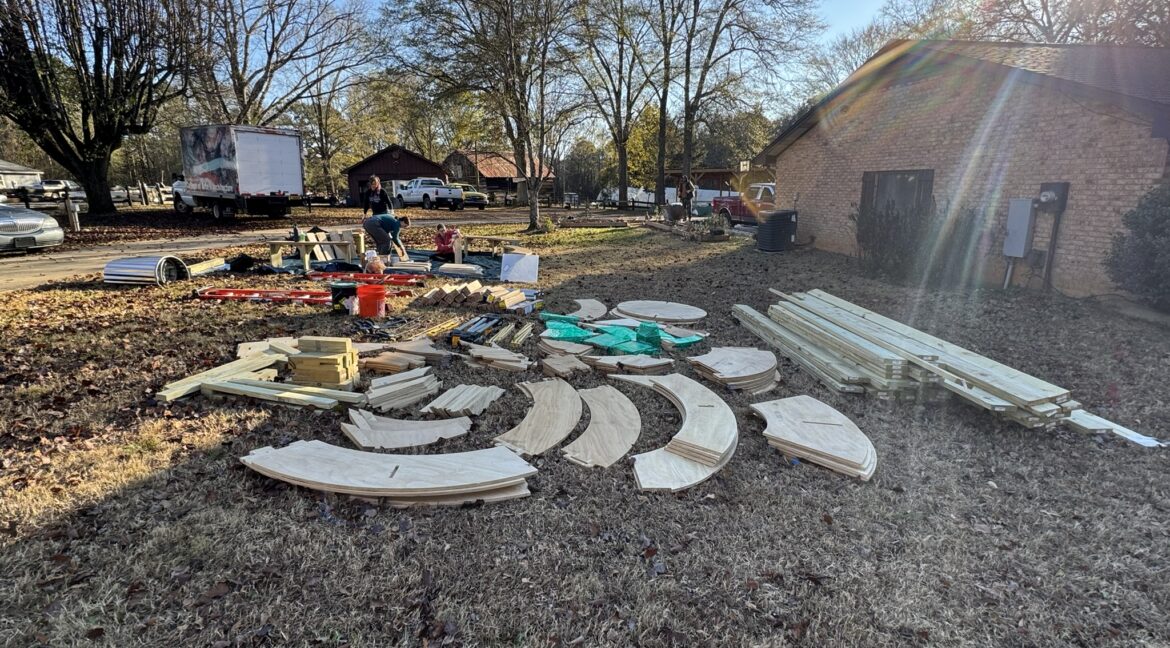
“Understanding your material, understanding the environment that it's going to be in, accounting for the different weather conditions, trying to calculate for all of that and then also just being willing to go back and look at the different pieces, seeing how you can improve it” – those are the challenges, said Peterson, who served as the project foreman.
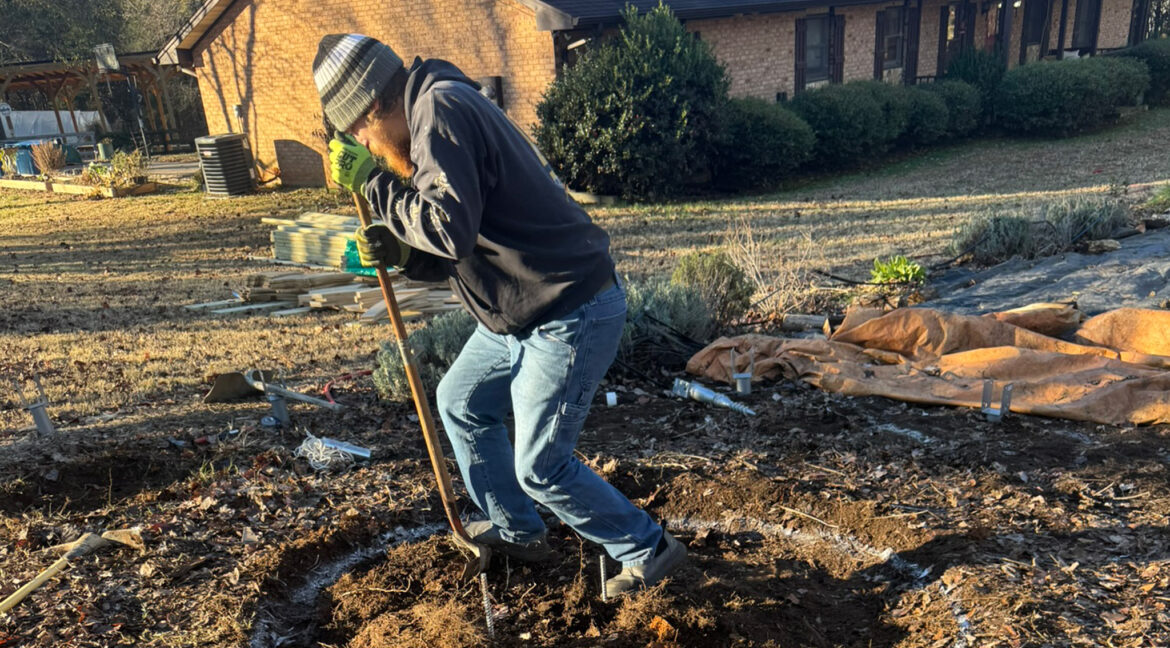
“When we went to the site, we dug into the ground, and we thought it was just soil, but we ended up running into clay a lot quicker than we thought,” said Peterson. “Digging out the foundation for it ended up being one of the biggest time-consuming parts of the project.”
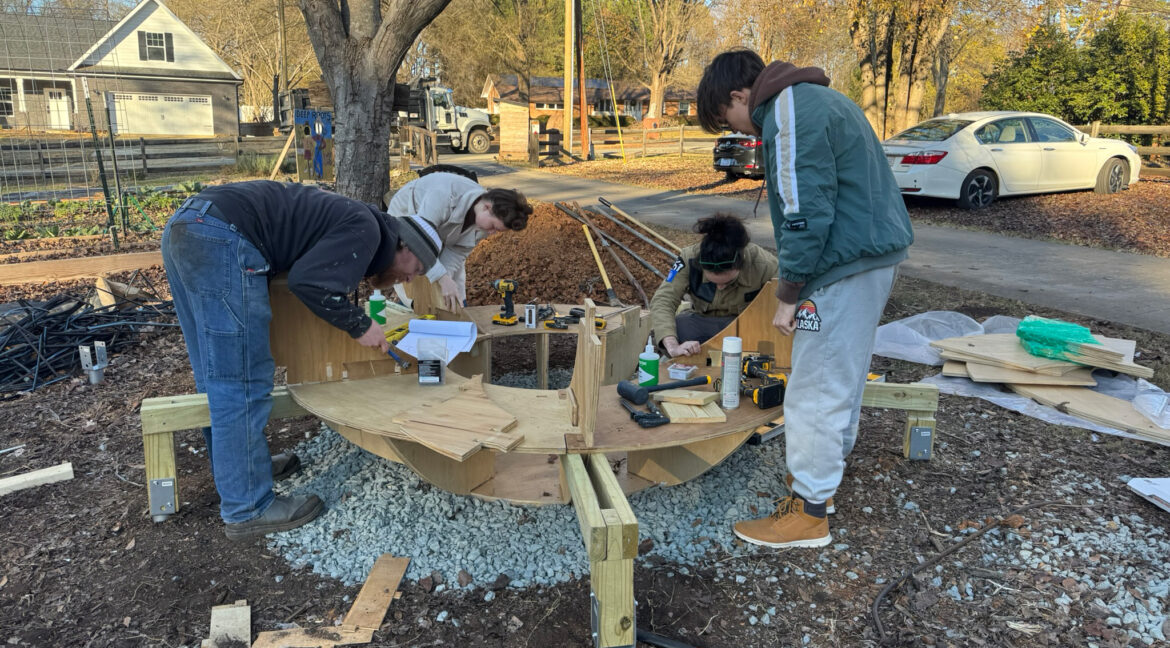
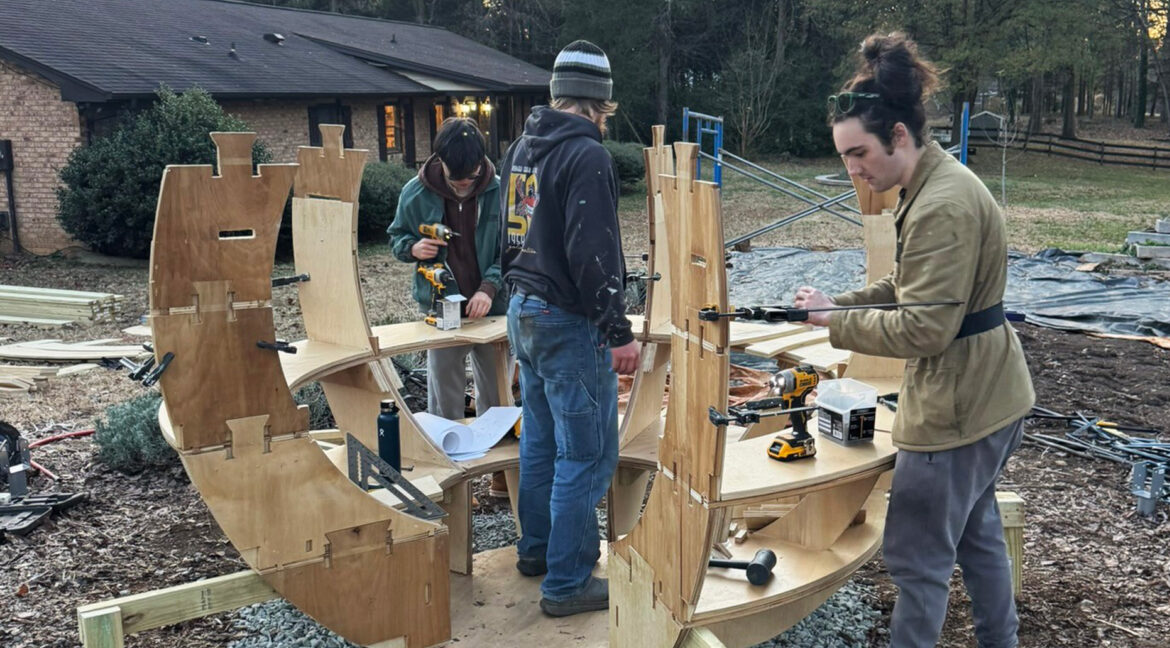
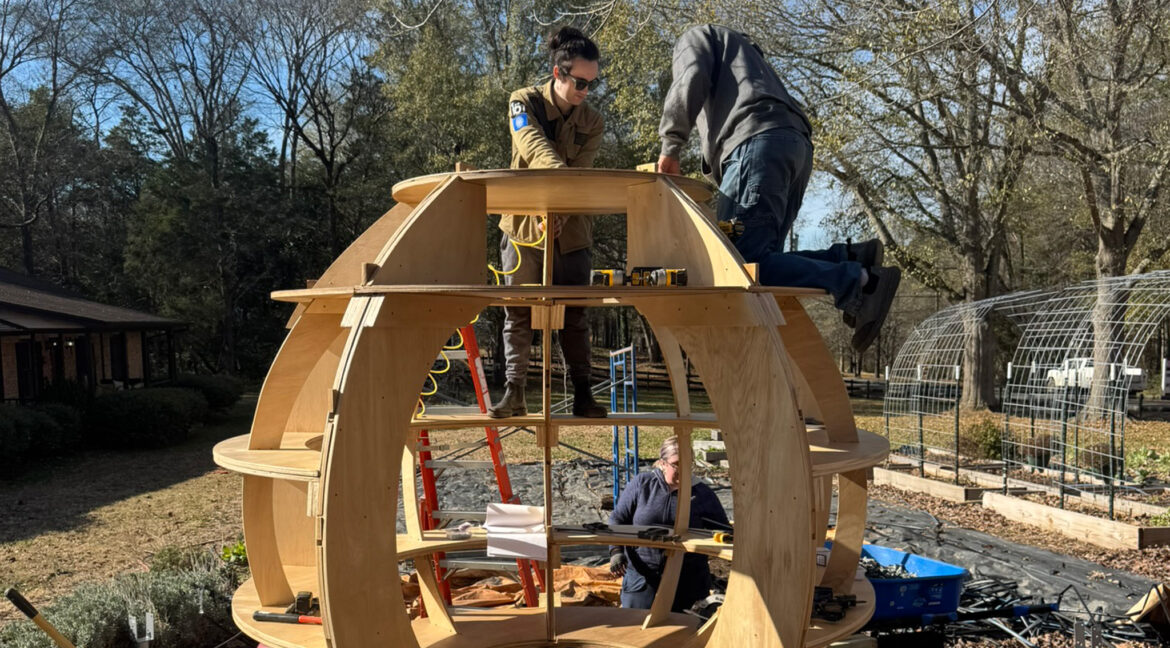
“December was when we built the EcoDome on the farm,” said Spence. “It was a seven-day process, and it was very cold.” The Jzars built a fire and served hot hibiscus tea.
"A lot of times you come into a fantasy world from the digital, where everything is perfect, said Peterson. “It lines up perfectly; screw holes are magically straight. And then in real life, you're taking a hammer and whacking and ratcheting and getting these pieces to stick together.”
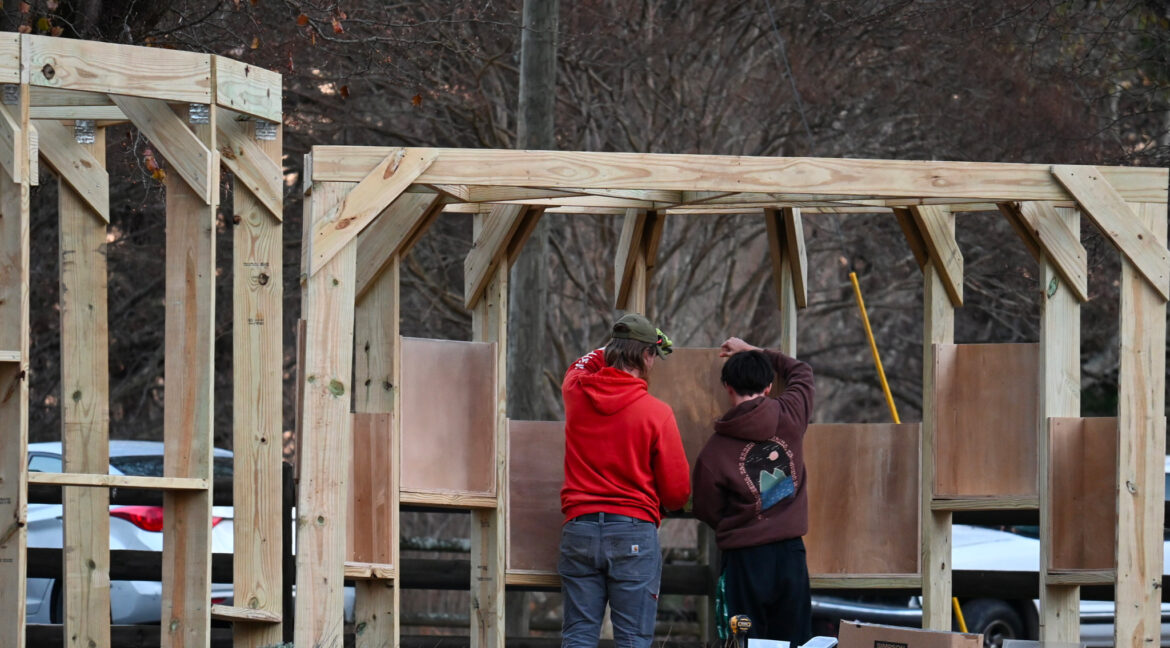
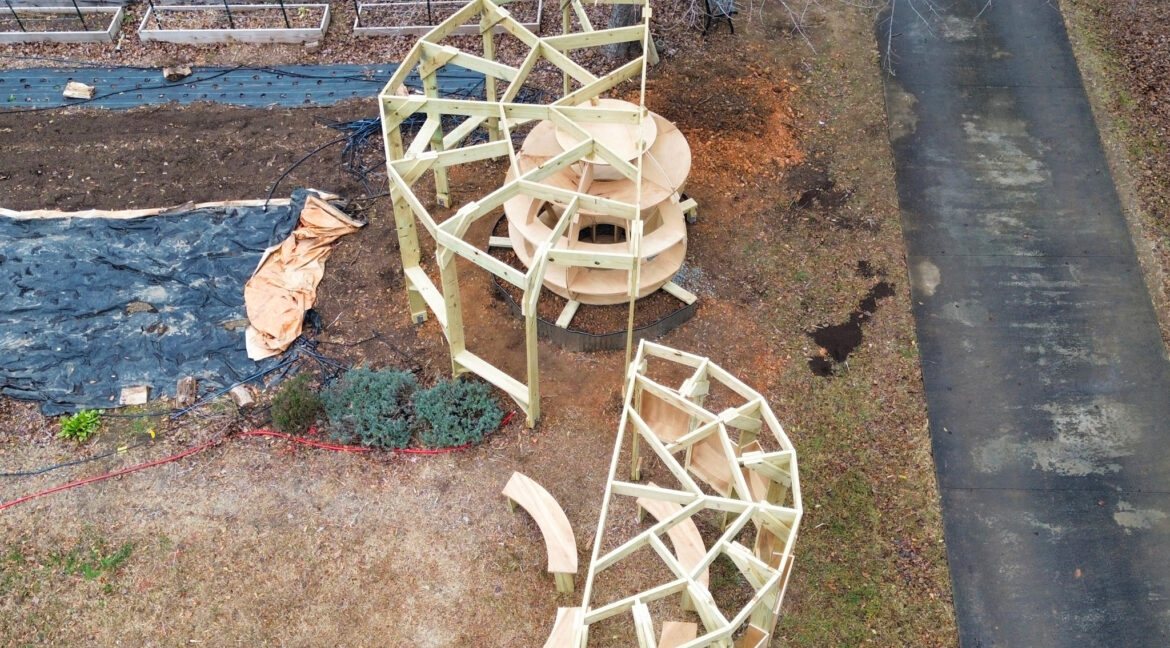
“There's a trellis that's around the EcoDome itself,” said Spence. “And then there's another trellis that is open to the landscape. Within the smaller of the two trellis structures, there are the vertical elements that are structural that are holding the trellis together.”
The Planter Boxes
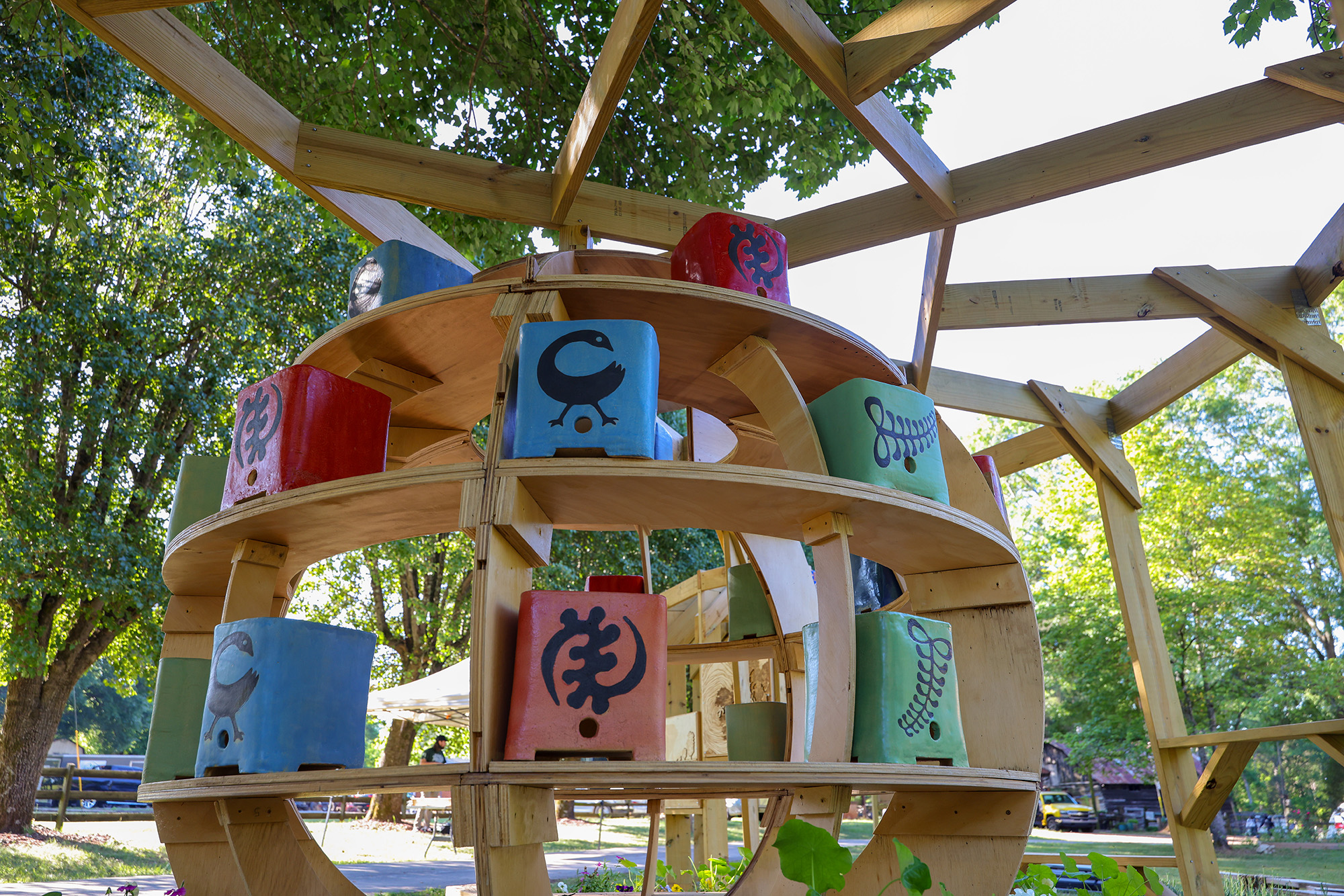
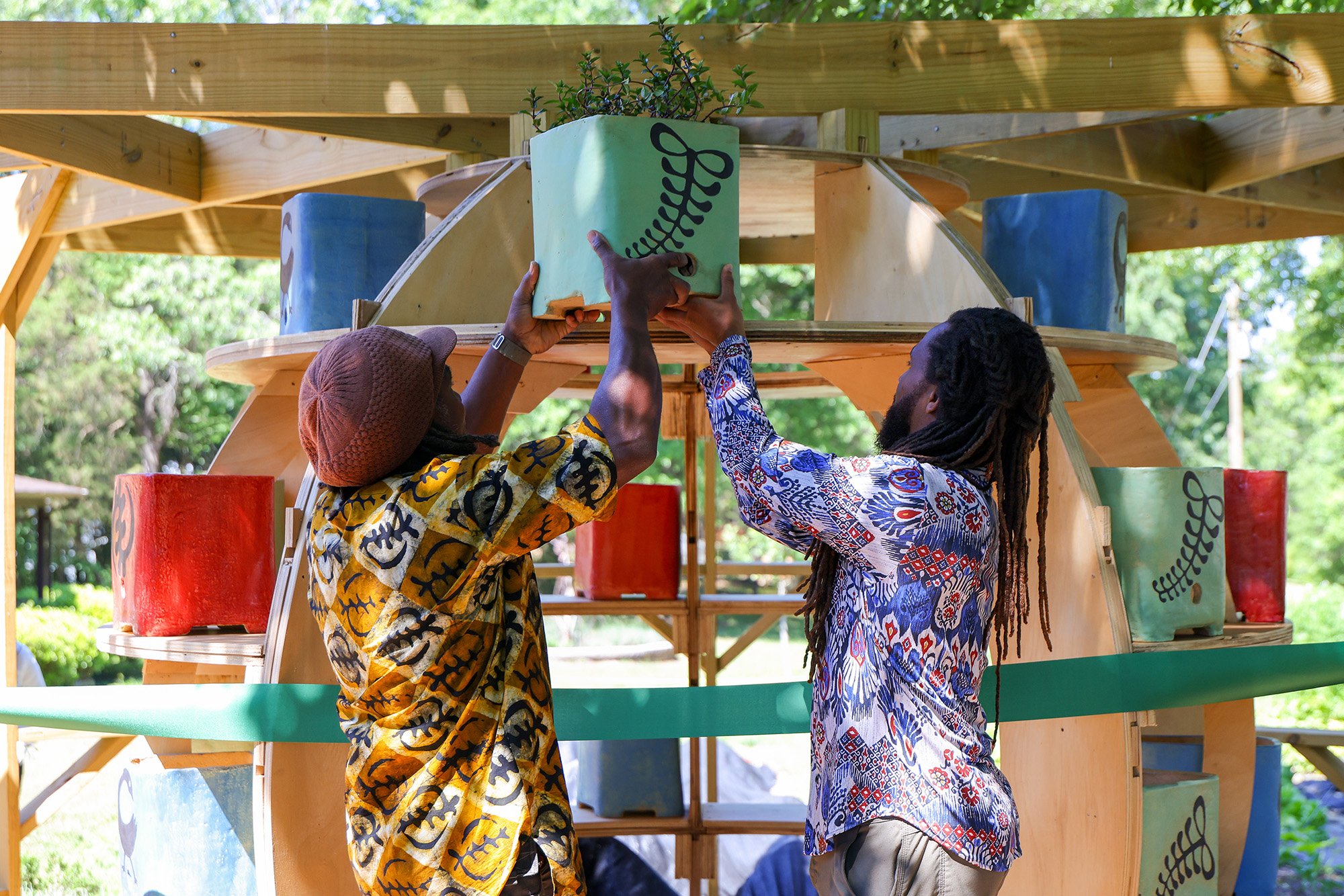
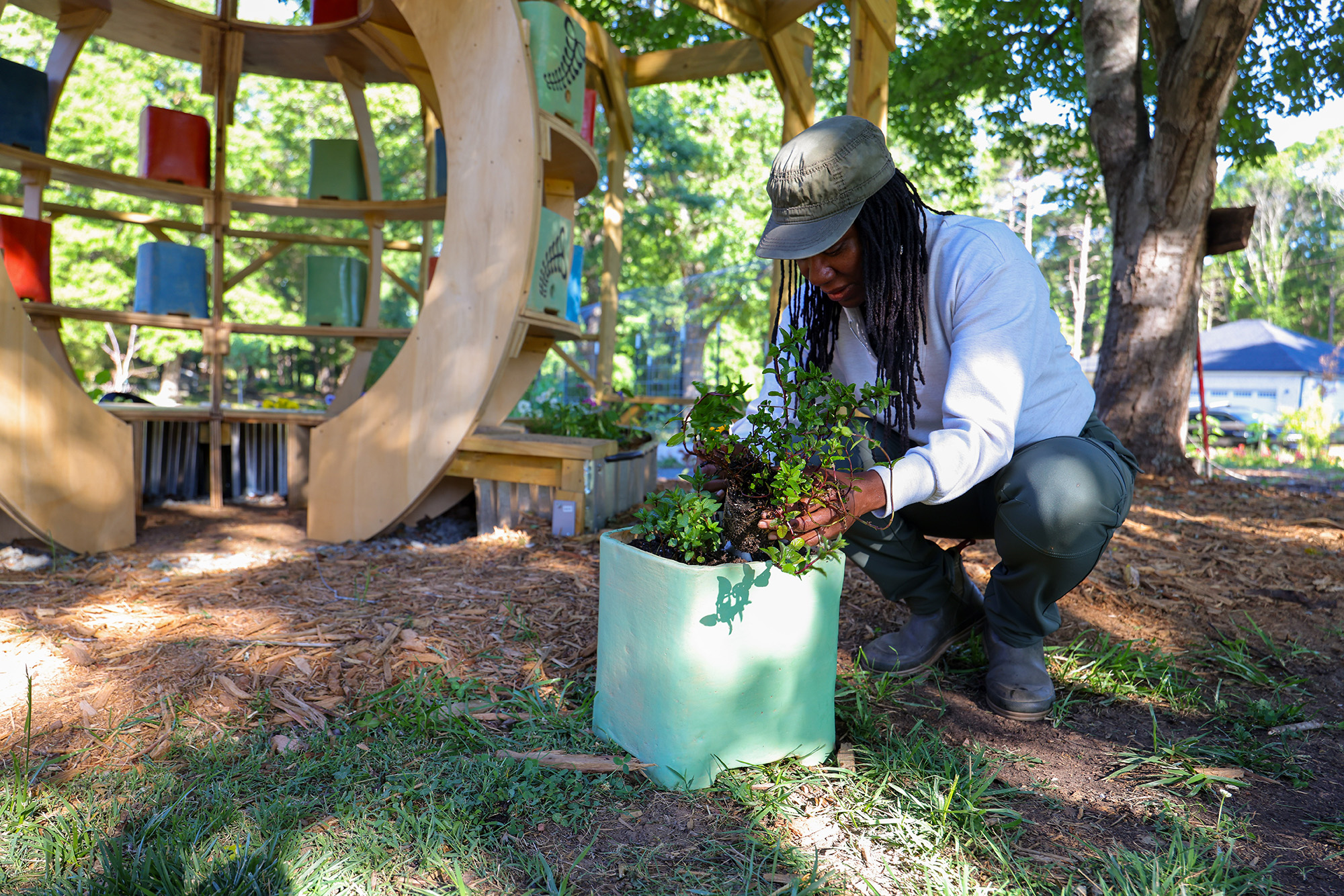
EcoDome is a vertical farming structure with custom planter boxes for cultivating herbs.
“We thought of a lot of different materials that we could use for the planter boxes,” said Spence. “Since we're so accustomed to working and fabricating with wood and metal, we thought that would be the ideal scenario, to make either wood or metal planter boxes. But it was not quite what Wisdom or Cherie wanted. They were interested in something that could withstand the heat, the temperature, sometimes the cold.”
They chose ceramic.
“I already had this very close relationship with Professor Lydia Thompson, who's within the College of Arts + Architecture, and I pitched the idea that she could talk to her ceramics students about the possibility of making some of these planter boxes for the EcoDome shelves,” said Spence.
Thompson, professor of ceramics, assigned the project to a class of 20 students. See here how they turned lumps of clay into beautiful planters.
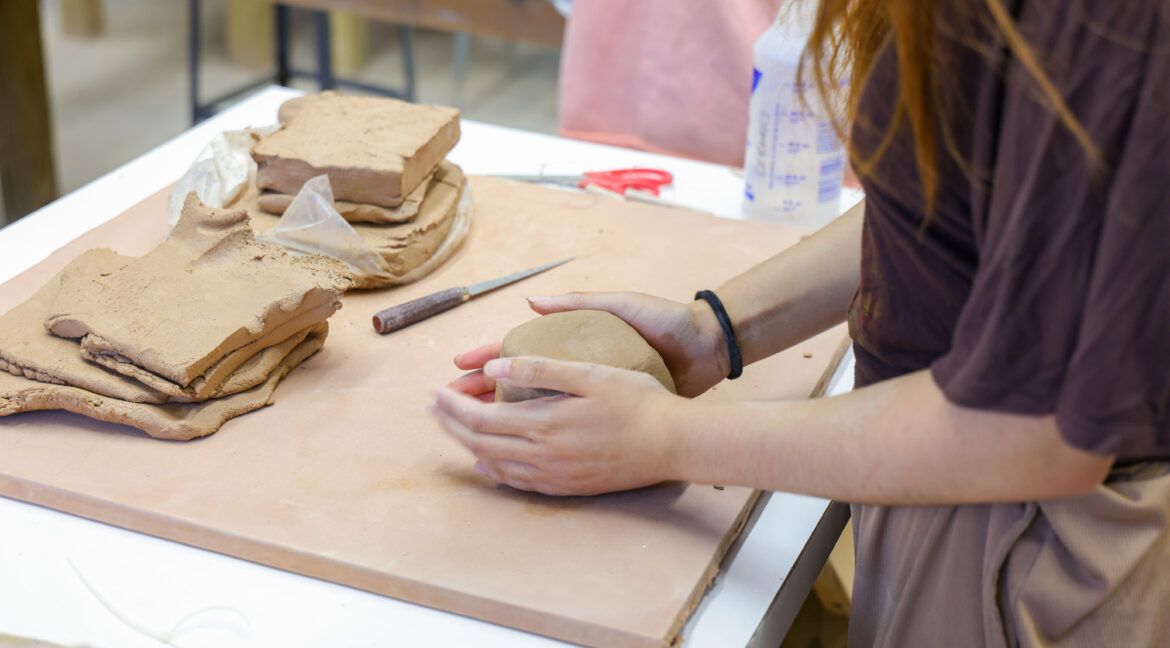
Each planter is made of sculpture clay, a formulated clay hybrid of commercial-mined clay, grog and wild North Carolina clay. It was produced by the Starworks arts center in Star, North Carolina.
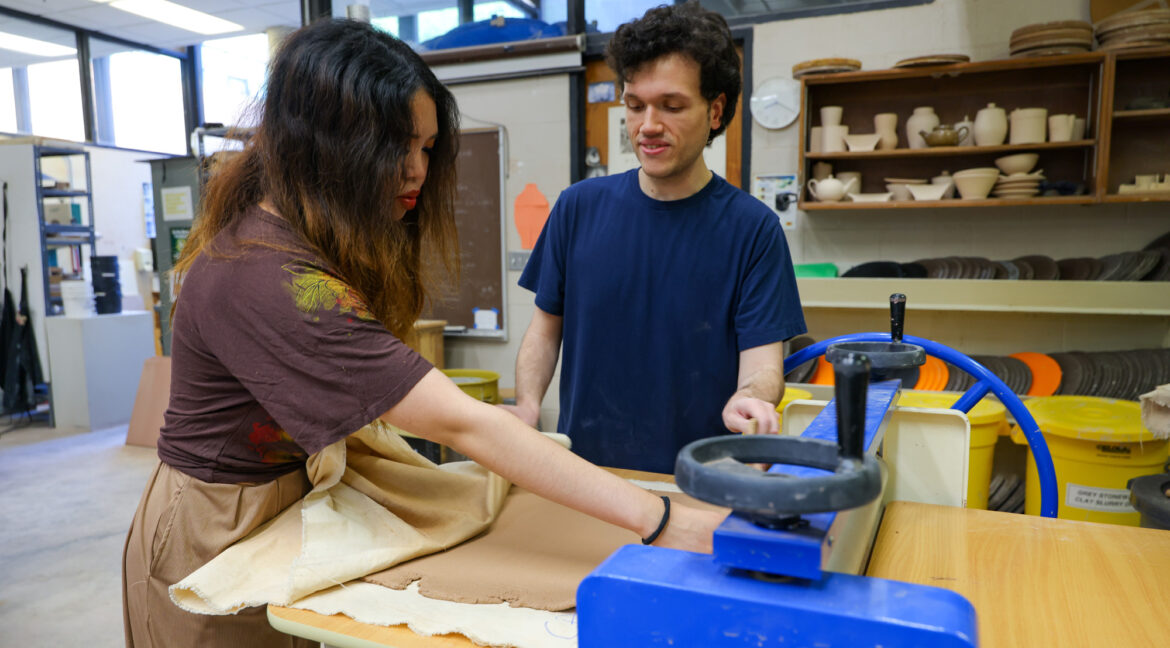
Each planter uses approximately 30 pounds of clay. Using a slab roller, students rolled out the clay to form half-inch thick sheets. Slabs must dry for 24 to 48 hours.
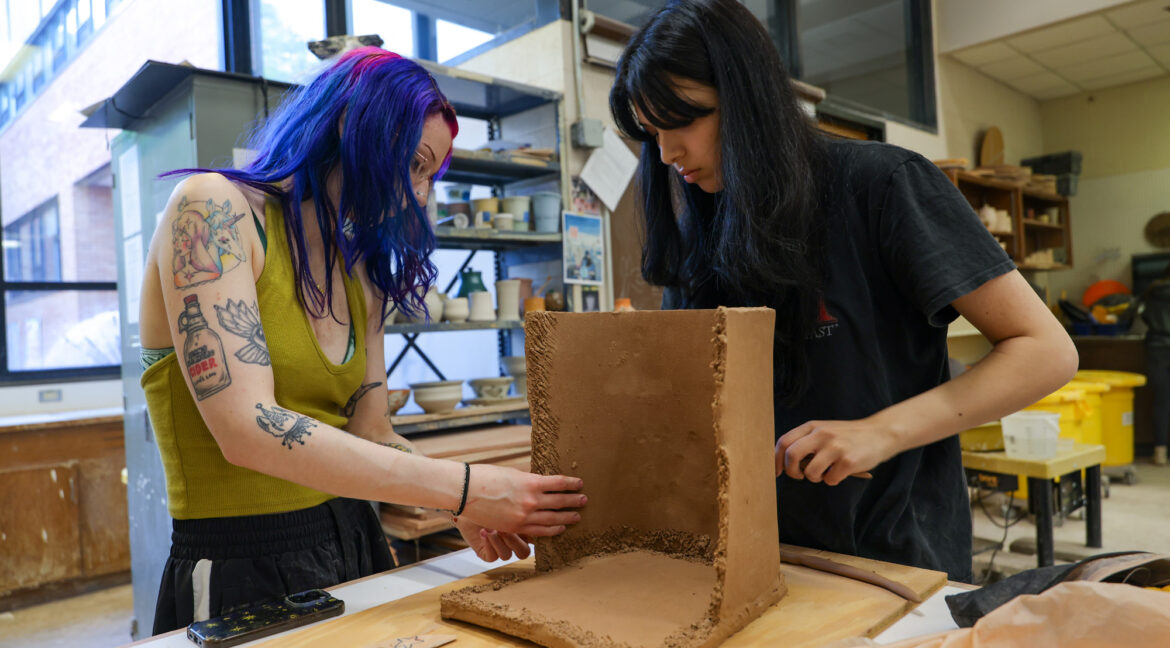
The students partnered up to attach the clay walls, using templates to ensure precision. Additional coils of clay were applied to the seams where two slabs meet to ensure that the walls would not pull apart.
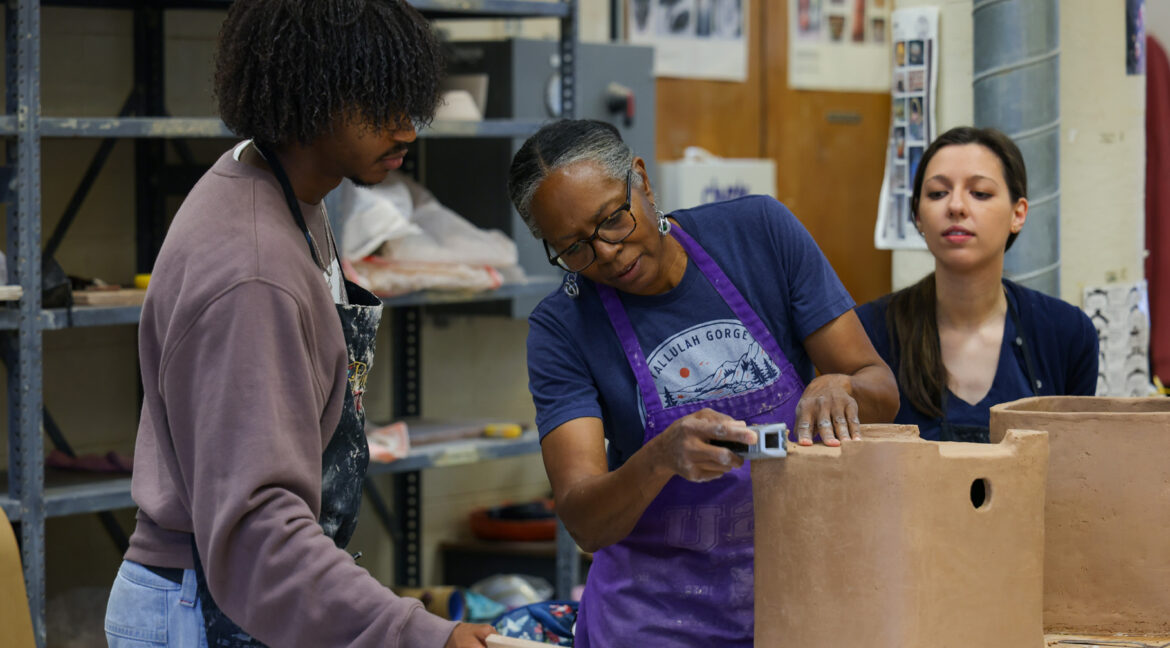
Once the form was leather hard, the planter was rotated upside down, and four feet were attached to the bottom of each planter.
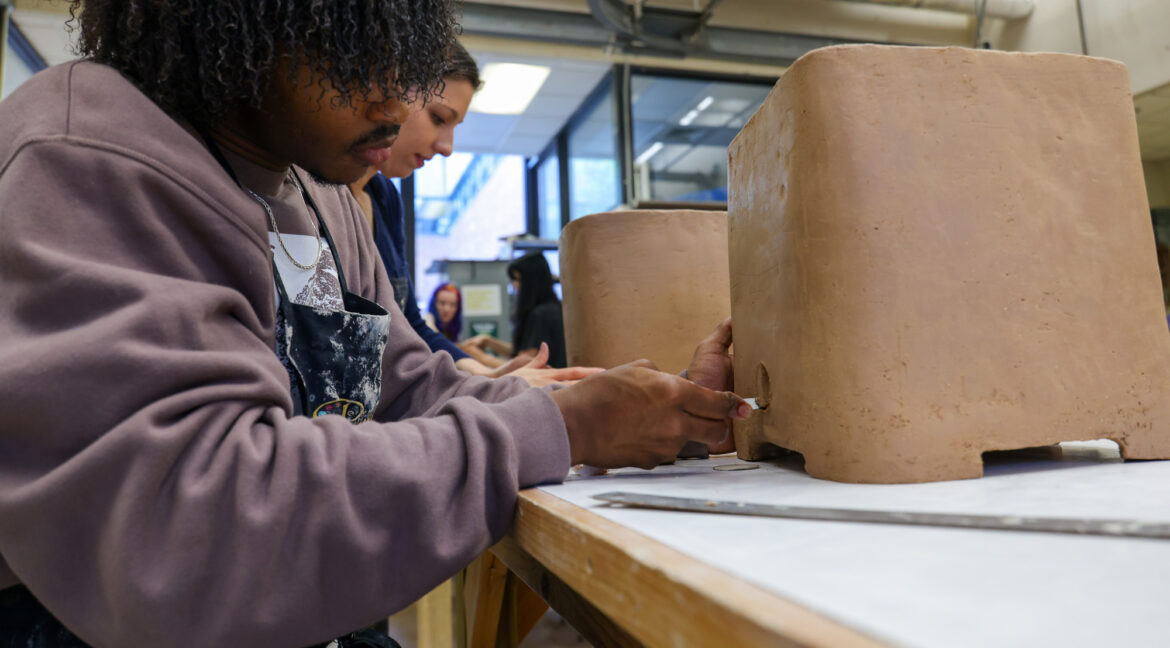
The planter was then turned upright, and the water drainage hole cut into the bottom front.
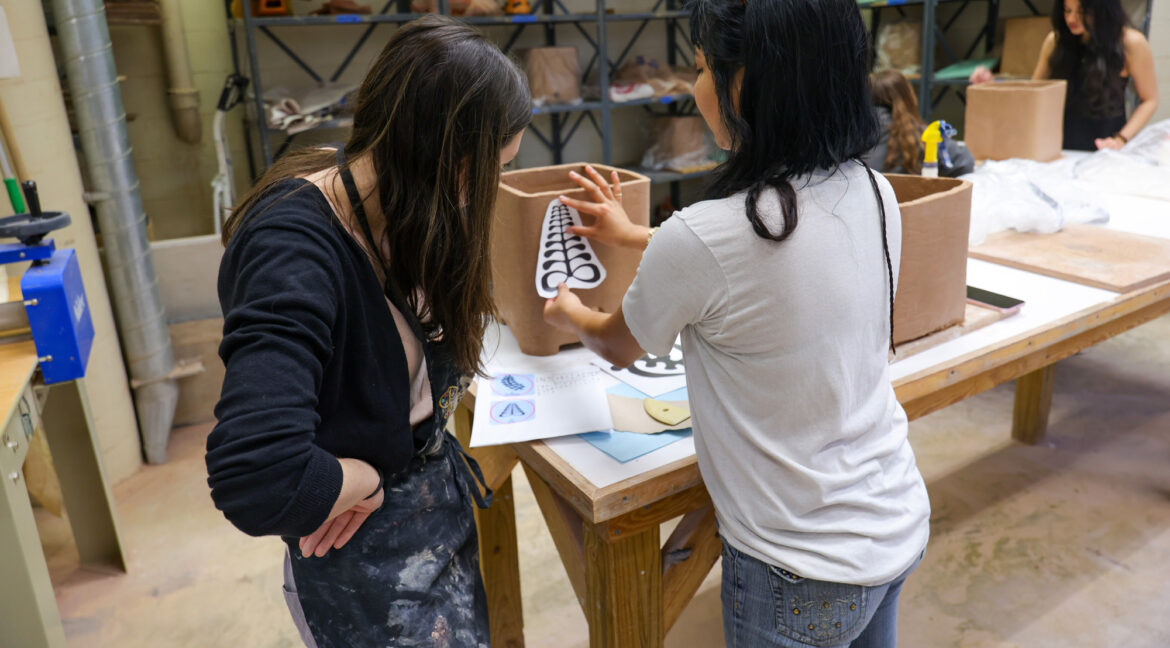
The Jzars chose three Adinkra symbols from Ghanaian culture to adorn the planters. The students used Adobe Illustrator to create files to cut templates, using a laser cutter. Students used the templates to trace the image onto the planter and then painted the images using black underglaze.
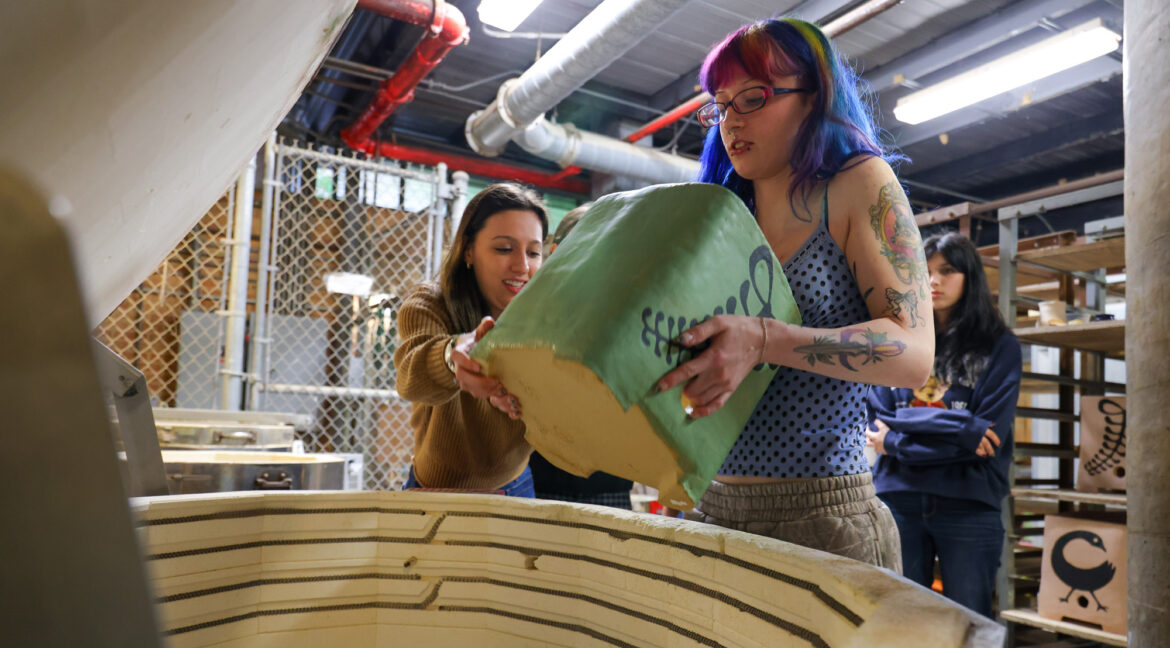
Once the planters were bone dry, they were loaded into the kiln for bisque firing: 15 to 20 hours, reaching 1,860 degrees Fahrenheit. Once the kiln cooled, the planters were unloaded, and three to five coats of glaze were applied. The planters were fired again to a temperature of 2,251 degrees Fahrenheit, which vitrifies the clay body.
The Story Boxes
Melissa Nemec, managing director of the Gambrell Foundation, says that living a “good life” includes beauty and belonging.
“I think if we can infuse awe and wonder and cultural significance and historical significance into solutions and new innovative ideas, we're on to something so great.”
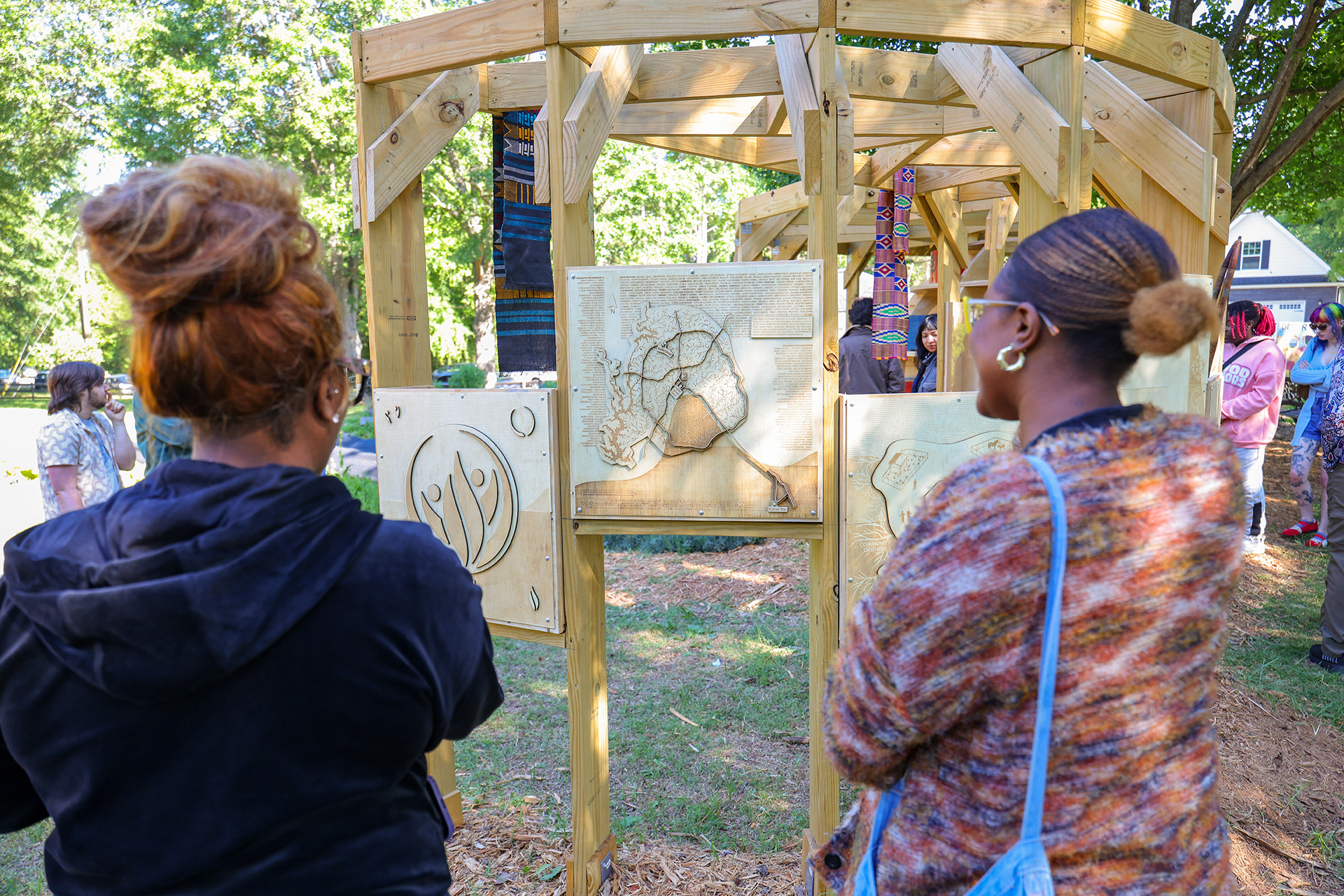
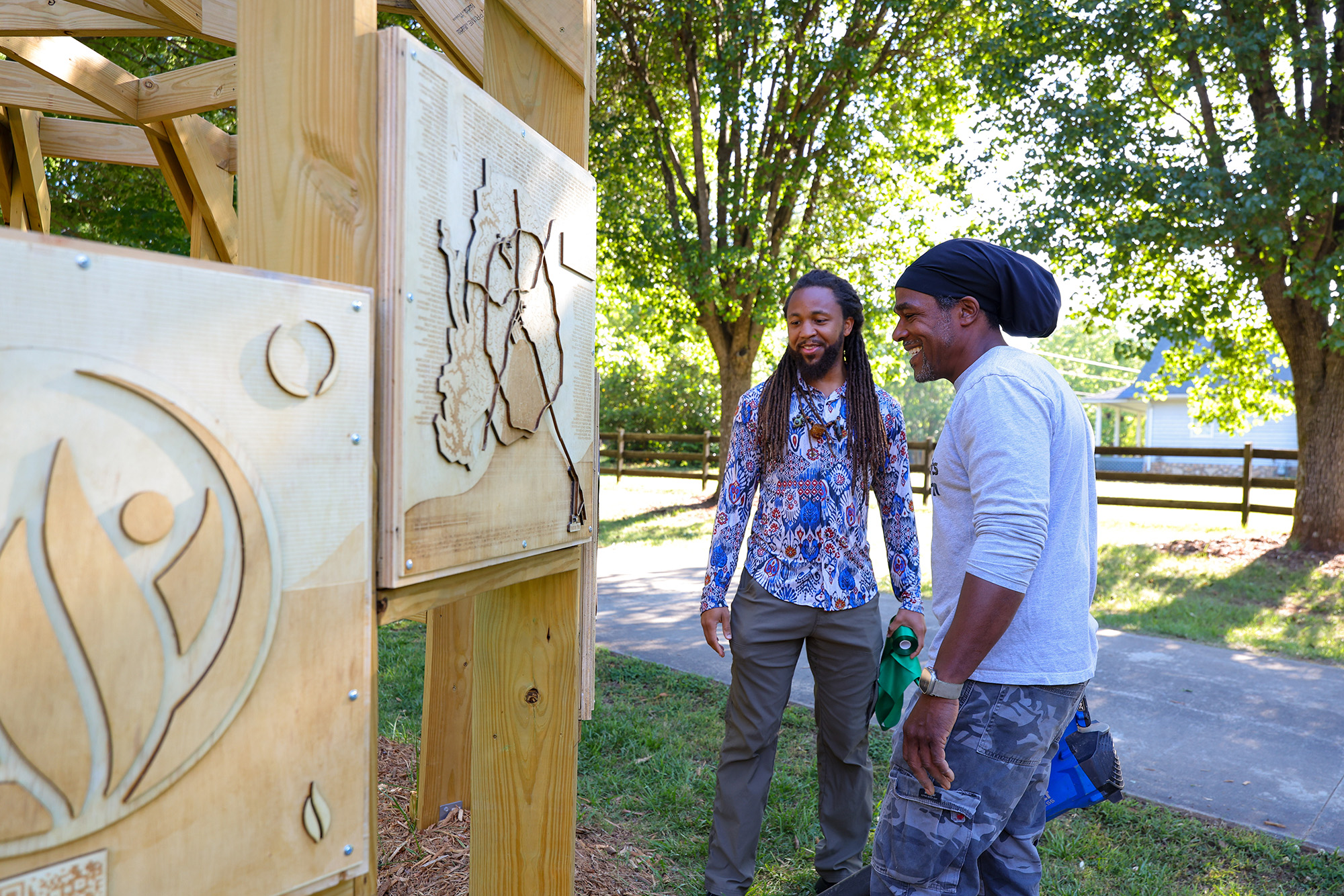
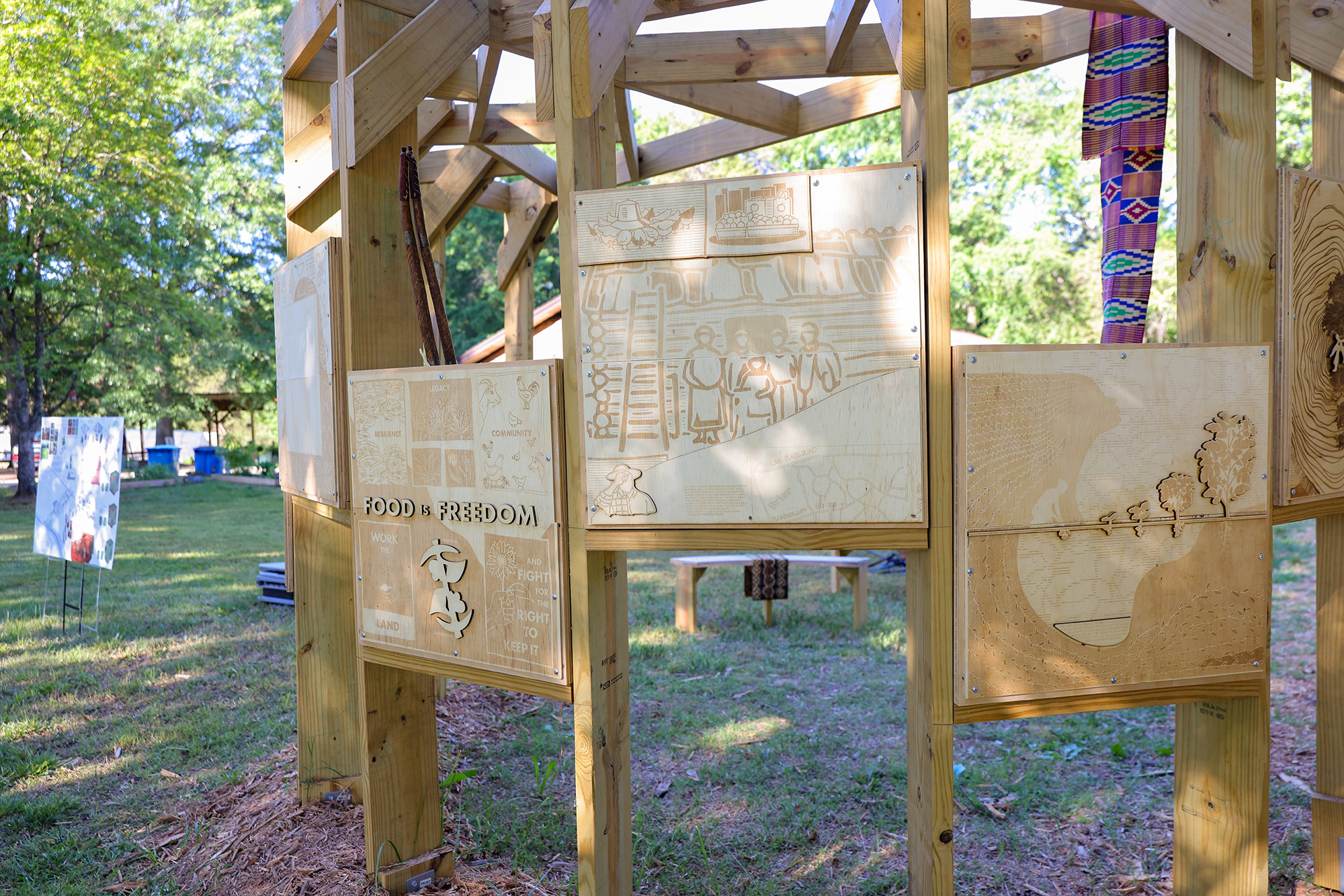
With laser cut custom panels conceived and designed by students in Spence’s Community Planning Workshop, the “Roots of Change” story boxes contribute to that vision.
“Some of them are about the family tree of Deep Roots,” said Spence. “Some of them are about the history of farming in Mecklenburg County and within the city of Charlotte. Some of them are about the Catawba River Basin and how Deep Roots fits into this larger landscape. So the story boxes are really sort of the living archive.”
The Ribbon Cutting
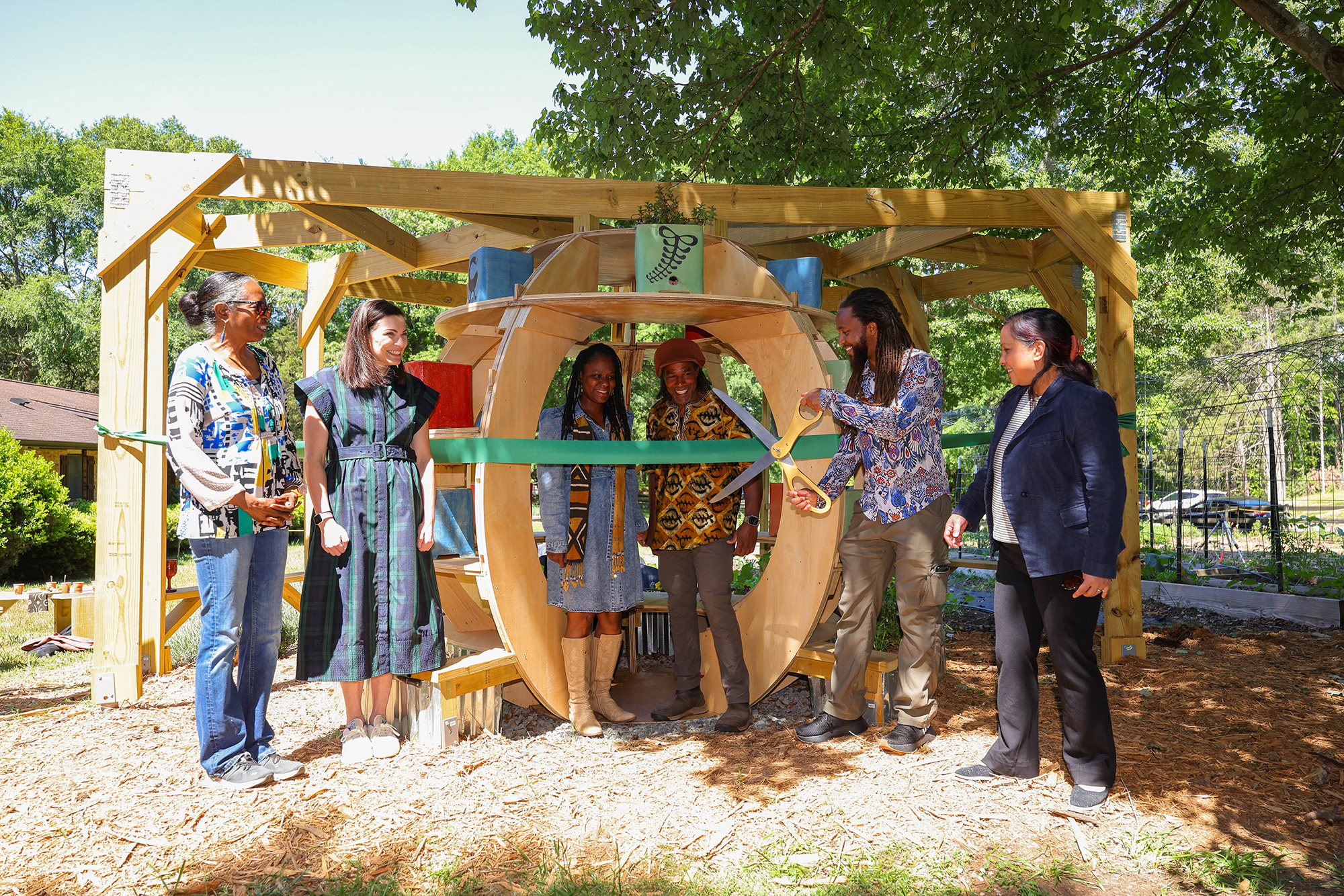
Lydia Thompson, Liz Morrell, Cherie and Wisdom Jzar, Kyle Spence and Cathy Morrison ’06, CEO of Neighboring Concepts, which served as a professional adviser for the project.
“I think for a really long time, philanthropy has viewed its work as focusing on these core elements: housing, food insecurity, education, access to internet,” said Nemec. “But I think there's a bigger way of thinking about it. And the work we do at the Gambrell Foundation is trying to get to the root of a lot of these things and infuse awe and wonder and a sense of belonging into our investments.”
Morrell says that “Roots of Change” exemplifies this holistic approach.
“Discussions about food deserts and the need for fresh and healthy and accessible and affordable food – it addresses that component. And then it also, with the design aspect and the incorporation of the community input and all of the students who did work on the project, really gets at this question of belonging, relationships and wonder.”
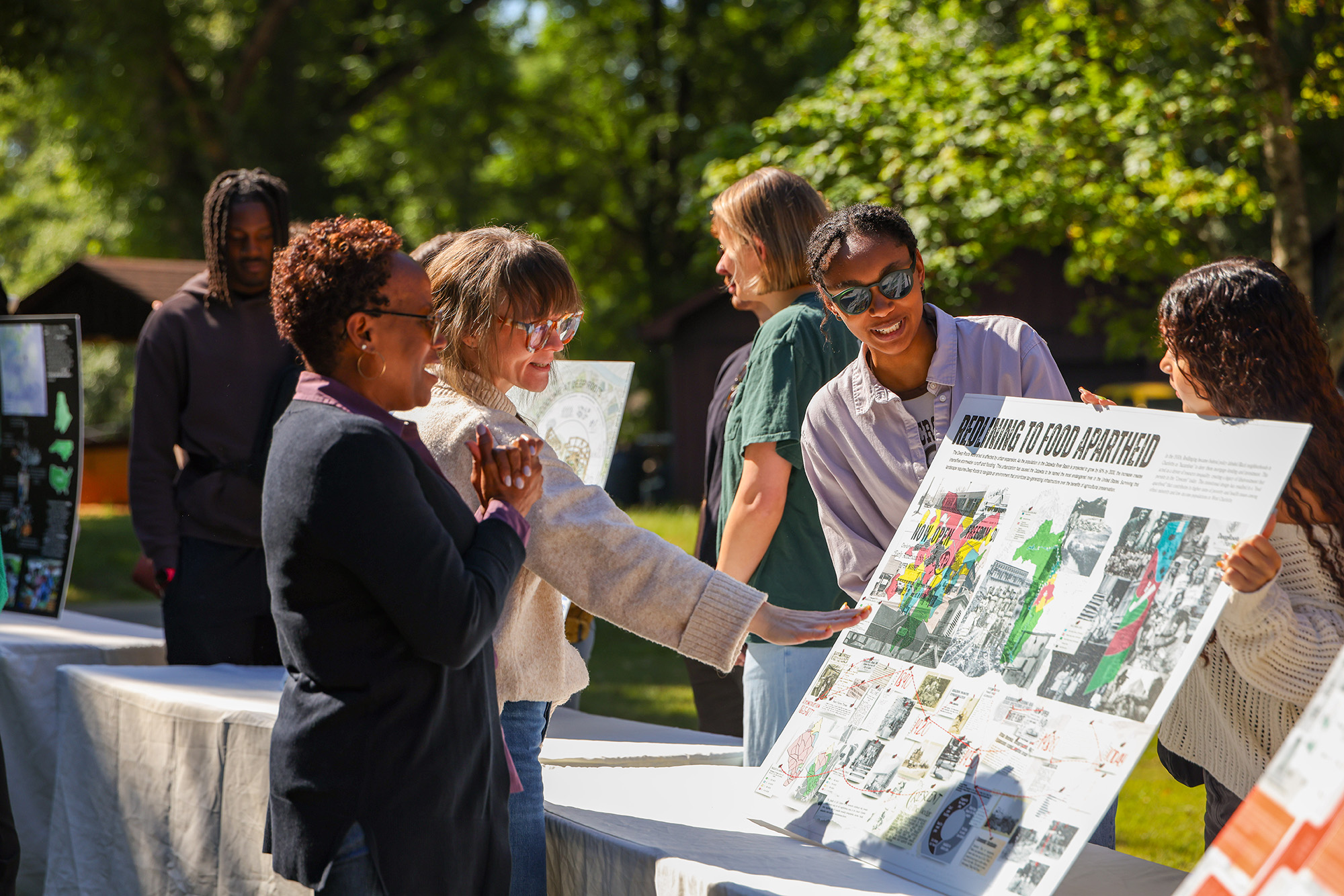
At the ribbon cutting event, students presented research posters investigating issues of urbanization, agricultural decline and food access.
With 20 ceramic vessels and a planting area at its base, the EcoDome provides space for growing herbs and edible flowers. But it serves other purposes, too.
“EcoDome meets you and greets you when you first get onto their property,” said Spence. “So it operates as signage.”
It also operates as a meeting place, he added, noting the seating built into the dome and the freestanding benches set around its perimeter. And the Adinkra symbols and story panels inspire reflection and conversation.
The Jzars have recently purchased a 44-acre farm in Union County, and they hope to continue the university partnership.
“It was very enlightening and exciting to work with Professor Spence and the students at UNC Charlotte,” said Cherie Jzar. “To engage and share our vision for our farm, share our vision for our connection to the community with the students, and then to have them help us imagine this space that we’re now going to implement on our farm as a space of learning, as a space of connecting, as a space of telling the story about Deep Roots – it was a wonderful journey.”