
Joe Posnanski on UNC Charlotte beginnings and the essence of fandom
Story by Alex Reynolds, video by Harrison Hieb and Alex Reynolds, photos by Alex Reynolds and contributed the Posnanski family
Joe Posnanski, an accomplished sports writer and bestselling author, is living the dream that began at UNC Charlotte in 1984. During his decades-long career, however, that dream has changed, again and again.
Posnanski gained the confidence to write in a Charlotte classroom and earned his first national byline in the Sporting News by profiling 49ers basketball star Bryon Dinkins ’95. He began as a freelancer, writing to pay the bills, and worked his way to newspaper columnist, first in Augusta, Georgia, then Cincinnati, and Kansas City, Missouri. Posnanski was hired by Sports Illustrated, the iconic magazine home to some of the greatest American sportswriters, where he was named the 2011 National Sportswriter of the Year. Posnanski says had he arrived at SI 20 years earlier, he happily would have retired there. But the shifting media ecosystem meant this was just the start.
The dream has to keep changing, because the world keeps changing.”
Joe Posnanski
Posnanski would branch into television, beginning at NBC. He has appeared in numerous sports documentaries, including CNN’s “Decades in Sports,” which premiered Sunday, Aug. 2. He’s authored critically acclaimed books, including “The Soul of Baseball: A Road Trip Through Buck O'Neil's America,” “The Baseball 100” and “Why We Love Football: A History in 100 Moments.”
His career has brought him to the grandest stages in sports — including 25 World Series, 25 Super Bowls and eight Olympic Games — and introduced him to celebrities and presidents. In his latest book, “Big Fan,” Posnanski and his good friend Mike Schur, creator of “The Good Place,” among other television series, ventured to the far edges of sports and entertainment in search of what it means to be a fan.
Posnanski grabbed the opportunity to start his career before graduating. He returned to Niner Nation in 2024 to witness his daughter, Liz ’24, and her future husband, Elijah Hensley ’24, cross the graduation stage. In the following Q&A, Posnanski reflects on his time at Charlotte, shares advice for aspiring sports writers and more.
UNC Charlotte connection
Was there a moment at UNC Charlotte that shaped your career in an unexpected way?
Growing up I was never told I had a talent for writing, so I assumed I did not. When I lucked into a couple of sports writing opportunities, I was petrified. I loved doing it so much, but I did not feel I had the talent to do it.
I remember the single moment from my time at Charlotte that shaped everything I do. I was in an English class and the assignment was to be a fly on the wall for a conversation between the protagonists of the two books we were reading. I’m fairly certain I had never heard that expression before, so I went home and wrote a paper as a literal fly on the wall. I wrote, “I am sitting here on the window shade and I don't really care what these two guys are talking about, because I see a hot dog right across the way.”
I did not get an A on the paper, nor should I have, but in the margin, the professor wrote, “Now I teach you in my class; someday, I’ll teach you to my class.”
I think about that all the time. I think about what it would have been like had that not happened. The confidence it gave me to go on in my career was very special.
Do you have any standout memories from your time as a student sports writer?
One vivid memory I have from Charlotte was my first national publication. It was a dream of mine to be published in the Sporting News but I didn't have any idea how. So I went to Mark Colone ’83, then sports information director for men’s basketball, and head coach Jeff Mullins and said, “I’d like to write a story about Byron Dinkins, for the Sporting News.” They told me to just go ahead and write the story, send it to the magazine and see what happens. So I did.
I didn’t hear anything for two months before I got a call from a friend, who said, “Oh, my gosh, you're in The Sporting News.” They just ran the story, they didn't tell me. I think they paid me at some point, but that was my first big national story.
Did you ever think UNC Charlotte would have an FBS college football program?
When I was at Charlotte, I remember writing a column about getting football. I mean it was such a pipe dream that I think I might have just written it as a joke. I was so pumped when Charlotte finally got football.
Everything about Charlotte itself has surprised me. When we toured with my oldest daughter, Liz, I didn't recognize a single thing. I didn't know how to get around. It was a completely different school. So, no, I could not have imagined in the 80s that there’d be football. Now that I'm much more familiar with the campus, of course Charlotte has football; that's just part of the experience.
What emotions did you feel as Liz crossed the stage as a UNC Charlotte graduate?
Any time your oldest graduates it’s gonna be an incredibly emotional moment. For me, it was emotional on multiple levels. First, there was the emotion of knowing what she went through: COVID her senior year of high school, transferring after her first year in college and trying to figure out what she wanted to do in her life.
Seeing her thrive and be happy. Seeing her graduate with a theatre degree, which was the last thing in the world that she would have imagined in high school. Seeing how it brought her to life. Seeing all those things was beautiful.
Then, from a personal perspective, I didn't graduate from Charlotte. I had to support myself so I left to go work for the newspaper. Watching her graduate from the school I attended made me so happy. It felt like part of me was graduating, too.
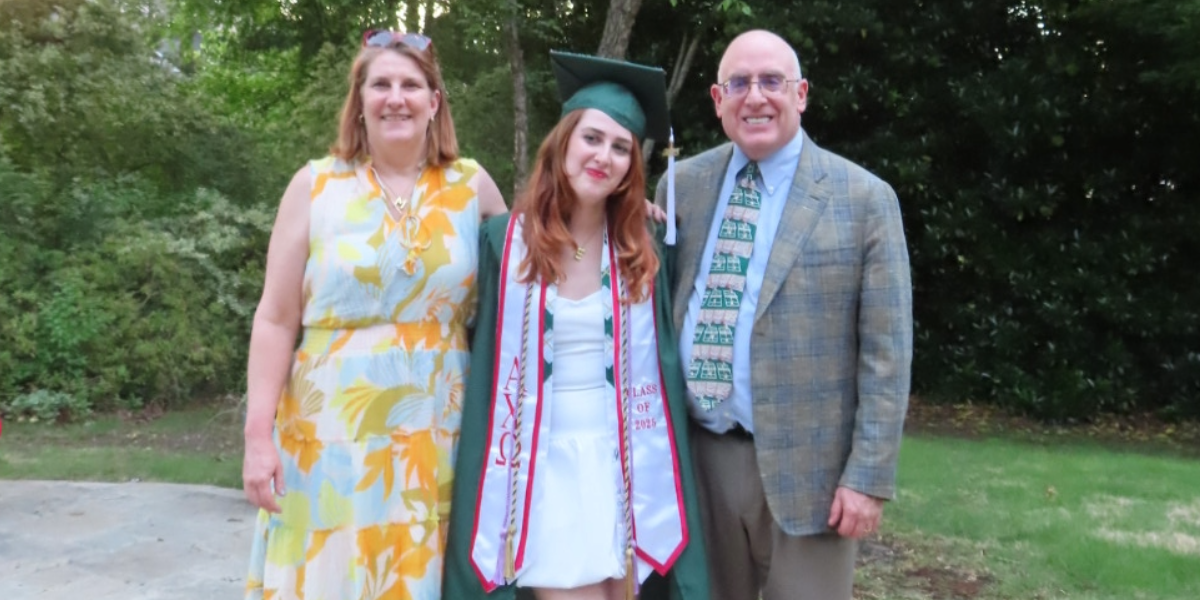
Joe Posnanski with his wife, Margo, and their daughter, Liz, at Spring Commencement in 2024.
Career progression and advice to Niners
What advice would you give to an aspiring sports writer at Charlotte?
I would start by saying your path is going to be different from mine because we’re in a very different time. But the importance of writing – and writing all the time – hasn’t changed. That’s how it happened for me. I was writing constantly.
There are disadvantages now. There isn’t a clear ladder any more — that’s gone. But there are more opportunities to write than ever before because you are your own publisher. You can start a newsletter, you can start a blog, you can create movies and social media channels. There are so many different ways to tell stories and you don’t need this big structure behind you.
Finally, you have to be bold. There is no way I know to make it without failing repeatedly. There’s no way to become a writer where you don't write something that humiliates you. It’s about having a belief in yourself that even if this doesn’t work, you’ll try again. Just keep doing it and take chances to find out who you are.
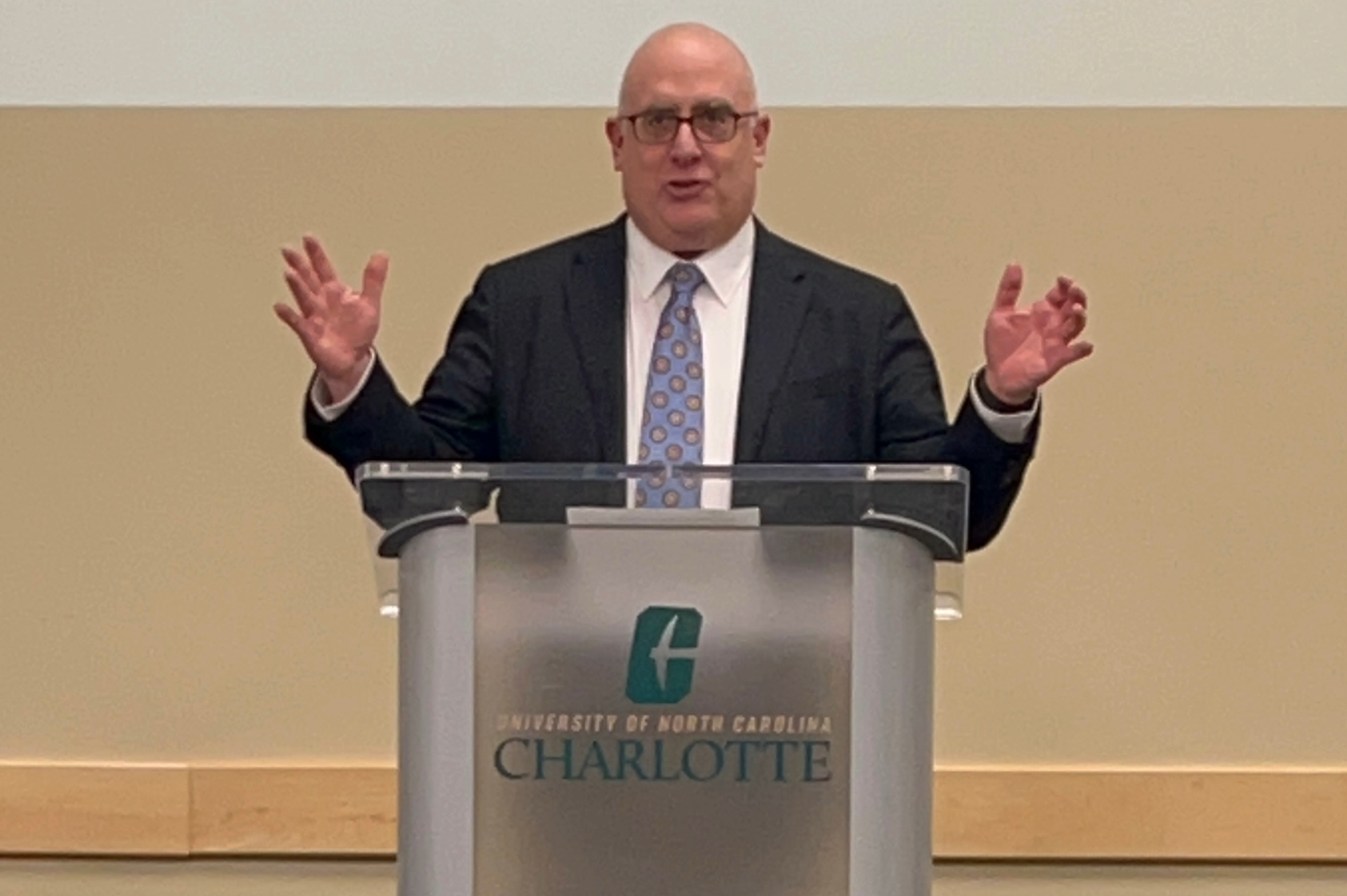
Posnanski speaks to a room of Niner Media students, alumni and fans following the release of his 2019 biography, “The Life and Afterlife of Harry Houdini.” Photo courtesy of Niner Media.
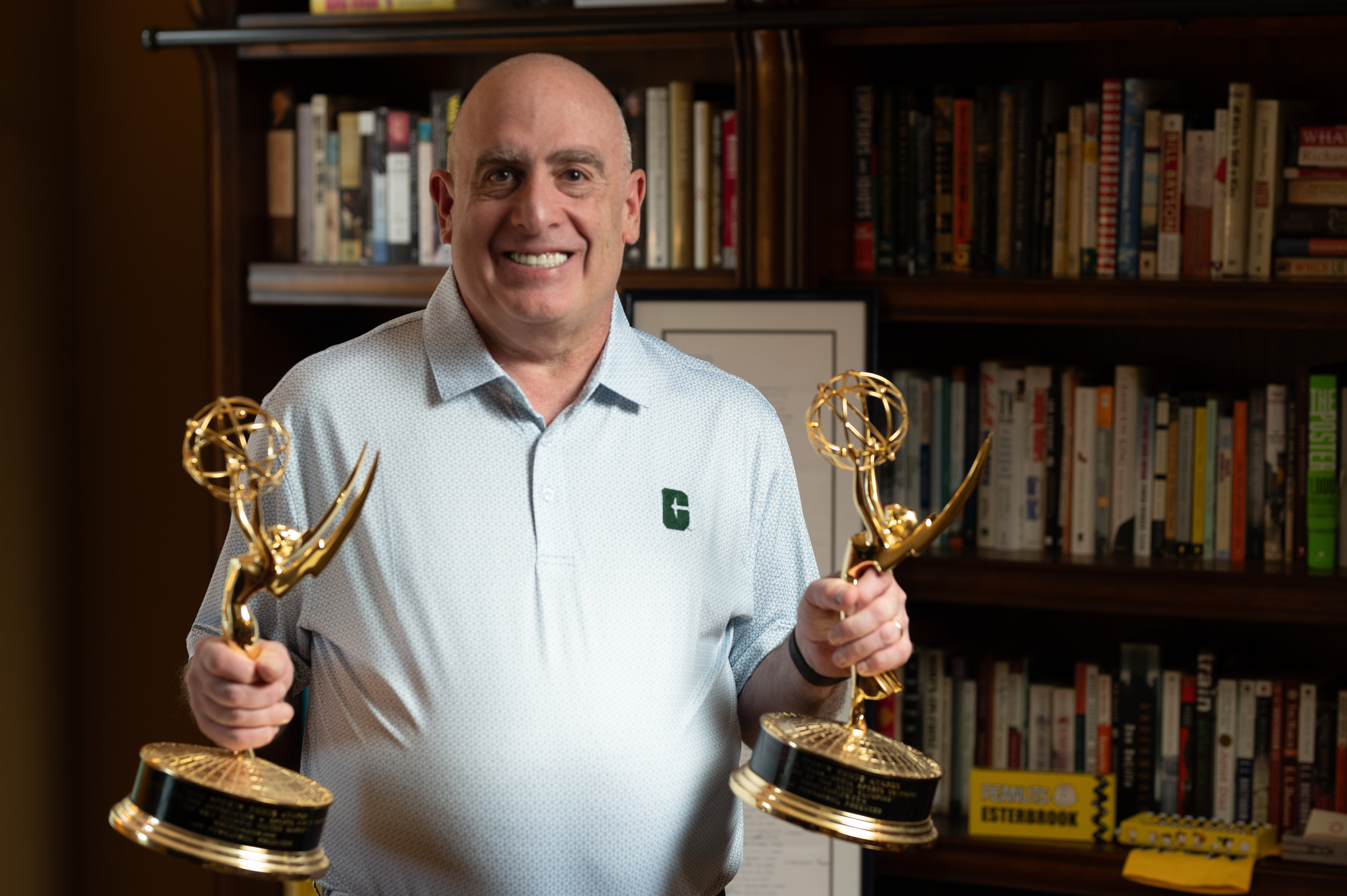
Posnanski holds his two Emmy awards at his home in Charlotte, North Carolina.
Is there a moment in your career that would absolutely shock your college‑aged self?
I don’t think my college self would believe any of this has happened.
When I became a sports columnist for the first time, in Augusta, Georgia, I was 24 years old, and I thought “Wow, this is the dream.” Maybe not in Augusta, but this is the dream.
Then I became a columnist in Cincinnati, a Major League Baseball town. That’s the dream. Then I became a columnist in Kansas City, Missouri, which probably had the best sports section in the entire country at the time. That’s the dream.
I got hired to write at Sports Illustrated and I’m writing where Rick Riley lived. That’s the premier job in all of sports writing. That’s the dream.
What’s been strange for me and everybody my age is that the dream has to keep changing, because the world keeps changing.
I feel incredibly lucky. Part of me wishes it were like the old days. I was more than happy to stay in one place for 50 years and have them name something after me or whatever.
But then there’s another part of me that thinks I came along at exactly the right time, because of the opportunities that I've had and the people I've met. The chances to cover sports all around the world, and then come home and write books. I don't know that those opportunities would have been there if I came along at another time.
Big Fan and what makes sports special
During your appearance on “Late Night with Seth Meyers,” your friend Mike Schur, with whom you co-wrote “Big Fan,” posed this theory about fandom: “Life is lonely, chaotic and boring — sports give us community, structure and excitement.” How did this book shape the way you think about your relationship with sports?
Mike Schur called me saying he wanted to do a book with me after seeing a video of the World Darts Championship. This was the most bananas event I've ever seen: people dressed up in costumes screaming and singing and drinking — a lot of drinking — and losing their minds.
Mike said, “I’m looking at these people freaking out, and I’m thinking, they’re us.” And so the whole concept behind “Big Fan” was to go out and talk to fans and kind of understand what fandom is all about.
There were a million little discoveries along the way. But I think the thing we took away most is that this is something that connects us, at a time where we're told that nothing connects us. We’re told how divided we are, but we're not. No matter where we went, we recognized ourselves in the fans.
Tom Hanks wrote the introduction for this book. Tell us about your relationship with him.
I was in Los Angeles, and Margo called me and said, ”You got a letter and I’m opening it.” I replied, “I'm pretty sure that's a federal offense.” She opened the letter and out comes this four-foot-long, typewritten scroll from Tom Hanks. It was after my book, “The Baseball 100,” had come out, and it was a fan letter telling me how much he loved it and how he was a fan of mine. Talk about moments that I never would have been able to understand as a college student.
I have a typewriter, so I typed a letter back. He and I became pen pals, which was such a strange thing. I told him in one letter that I was writing a book about the fan experience, and he wrote me this beautiful letter about his own fan experience. He wrote about what it was like being a sports dad taking his kids to hockey. He wrote about becoming a fan of Aston Villa F.C.
I shared it with Mike, who said, “This would be an amazing foreword for our book.” I thought, that’s a great idea but I didn’t have a way to get Tom Hanks’ approval. I've never met him, we’ve never talked; I just keep sending letters and standing by the mailbox every day hoping for a letter like an 18th-century debutante.
Eventually, we did connect with him. He was thrilled to contribute the foreword for the book, which was absolutely perfect. Now, we actually text each other. We’ve come to the 21st century.
You covered the biggest sporting events across multiple continents for decades. What about sports still feels magical to you?
What makes sports so magical is no matter how many times you write about it, no matter how many times you see it, no matter how many places you see it, there’s always something that surprises you. You never see the same thing twice.
This is especially true in football. Every play, something can happen that you’ve never seen before. Games can turn around in a second. No sport has it quite like that.
We talked before about things that connect us. Football is that thing that connects America. I mean 96 of the top 100 most watched telecasts in 2025 were football games. This is all that matters to us as a nation. And I think we all crave things that connect us.