UNC Charlotte research explores the power and potential of spider silk
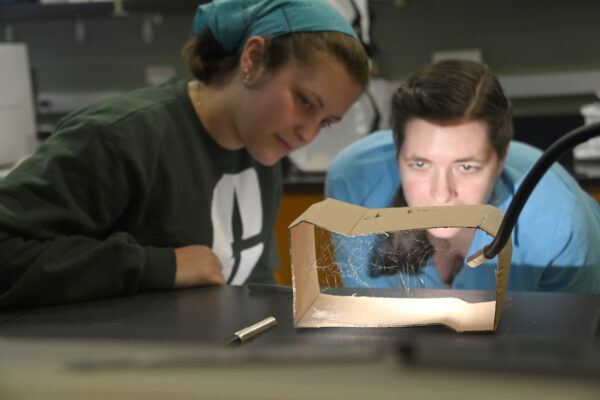
As Halloween approaches, spiders, bats and other “spooky” creatures are creeping into the spotlight. In the Stellwagen Lab at UNC Charlotte, though, spiders are the main focus of ongoing research throughout the year.
Sarah Stellwagen, assistant professor in the Department of Biological Sciences, is specifically interested in spider silk. She answered questions about the uniqueness of spider silk, potential applications of her research and what the general public should know about spiders.
How did you become interested in spider silk?
I’ve been interested in spiders since I was a kid, but it wasn’t until I joined Brent Opell’s silk lab at Virginia Tech for my Ph.D that I was exposed to silk research. After working with it for a while, I became passionate about continuing silk research. But honestly, who doesn’t think spider silk is cool? We have an entire comic book enterprise built around spider silk.
What is the focus of your research at UNC Charlotte?
I study silk from arthropods — things like insects and arachnids — at both the materials and genetics levels. We physically test silks by stretching them and measuring their material properties, and also try to understand the genes that encode for the silk proteins.
Why is spider silk unique?
It has amazing physical properties. Spider dragline silk has a tensile strength of about 1 to 1.5 GPa, which is comparable to high-grade steel but it is far stronger than steel for its weight. There are also all different kinds that function in unique ways — some are extremely stretchy; others work underwater. Some aren’t fibrous at all, but form a liquid glue that sticks to prey.
How does spider silk compare to regular household glue?
The gluey silks are unique because they are wet adhesives, so they wouldn’t be used in the same scenarios as household glue, where the goal is for the glue to dry. It has potential applications in the medical field as wet bandages or in areas where there is high humidity.
What are the potential benefits and other applications of your research on spider silk?
The challenge for making synthetic silk is turning liquid silk protein into an actual fiber. Researchers have made plenty of protein soup, as a spider does, but unlike spiders, they haven’t been able to spin that protein into solid threads at a scale that is relevant for the public. Once they do, the next question will be, “What kind of silk do you need?” We are trying to understand what makes different types of silk function the way they do, so we can then modify future synthetics to match applications. Those can range from fabrics, ropes and pest control, depending on the silk type.
Spiders seem to get more attention around Halloween — what do you think people should know about spiders that makes them special year around?
I always say Halloween is special because it acts as permission for everyone to love spiders when the rest of the year social culture dictates that we be afraid of them. The same people that jump on the table when they see a spider are the same ones that decorate their houses in giant spiders and webs. I want the public to know that they can love and appreciate spiders all year. They are incredibly important insect predators and they are far less dangerous than the media portrays them.
Learn more about Sarah Stellwagen’s spider research:
Written by Sarah Stellwagen and Andrew James