Team from UNC Charlotte shares AI literacy for STEM education expertise at Malmö University, Sweden

Seven members of the Network for AI Literacy in STEM Education from UNC Charlotte traveled to Malmö University, Malmö, Sweden, for “Network for AI Literacy in STEM Education: Opportunities and Challenges,” Sept. 28-Oct. 2. Through collaboration among the network’s three participating institutions, UNC Charlotte, Malmö University, Åbo Akademi University, Finland, and select others, attendees set out to bring together research surrounding AI literacy education for STEM from various cultural perspectives to frame an effective approach to teaching the topic in PK-12 settings.
Funded by a three-year grant from the Swedish Research Council, the Network for AI Literacy in STEM Education is working to examine ongoing research at each of the participating institutions to inform evidence-based recommendations for developing, designing for and teaching AI literacy that supports pre-service and in-service STEM teachers and their students.
Charlotte’s AI expert network members
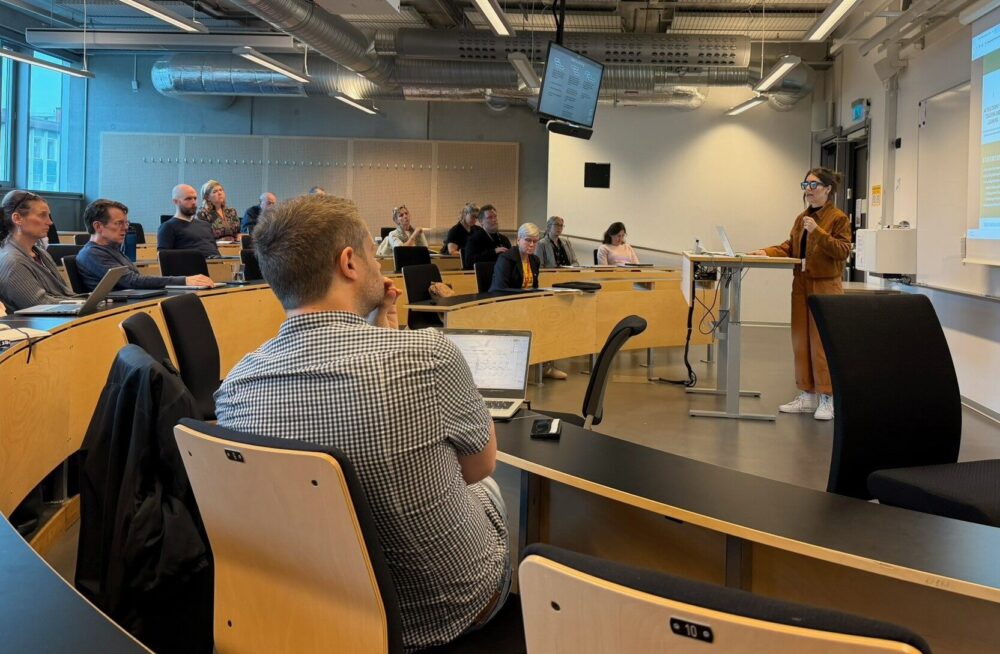
Gordon Hull, professor of philosophy, director of UNC Charlotte’s Center for Professional and Applied Ethics and co-director of its Center for Humane AI Studies, described the experience as “a rare opportunity to work face-to-face with an international group of collaborators and do our collective part to shape the development of AI literacy so that it actually benefits students and prepares them to make critically informed choices about AI.”
Hull was joined by Justin Cary, College of Humanities & Earth and Social Sciences; David Pugalee, Premukamar Pugalenthi (virtual) and Michelle Stephan, Cato College of Education; Jordan Register, Center for Teaching and Learning; and Yash Tadimalla, College of Computing and Informatics. In addition to faculty from the aforementioned network members were researchers from East Carolina University, Lenoir Rhyne University and Western Norway University of Applied Sciences. Prior to the conference, the group convened four virtual seminars to discuss established and developing research as it relates to the development of AI literacy in their respective spaces
Goals, takeaways and next steps
For the funded period, the Network for AI Literacy in STEM Education aims to:
- Facilitate collaboration through a forum for international scholars and teachers to share knowledge and experiences regarding AI literacy across cultural borders
- Enhance knowledge sharing through organized seminars, workshops and conferences to provide platforms for presenting research, discussing new ideas and sharing insights on AI literacy in STEM education
- Support research and publications by encouraging shared data collection and preparation of research applications that lead to the production of publications, research applications and dissemination of findings
- Engage the broader community by hosting hybrid conferences to showcase research results and discuss AI in STEM education
In Malmö, network activities prioritized international collaboration through a series of working sessions organized around themes that spanned ethical reasoning and AI, conceptualizing AI literacy in education, assessment and feedback through AI, designing teaching and learning for AI literacy and the role of mathematical modeling in AI literacy. While in Sweden, members visited a secondary AI classroom where students engaged in machine learning as part of the school’s AI program. They also presented as part of a full-day symposium with educational researchers and teachers from surrounding countries, universities and K-12 schools.
Key takeaways include identifying established and supportive research and gaps in literature, needed frameworks, priorities for future research, potential grant opportunities and avenues for developing empirically validated best practices for teaching and learning.
Virtual meetings will continue over the remaining two years of the network. The network plans to meet at UNC Charlotte in 2027 and return to Sweden in 2028.
Written by Susan Messina