Statewide symposium brings nearly 1,500 to UNC Charlotte for undergraduate research showcase
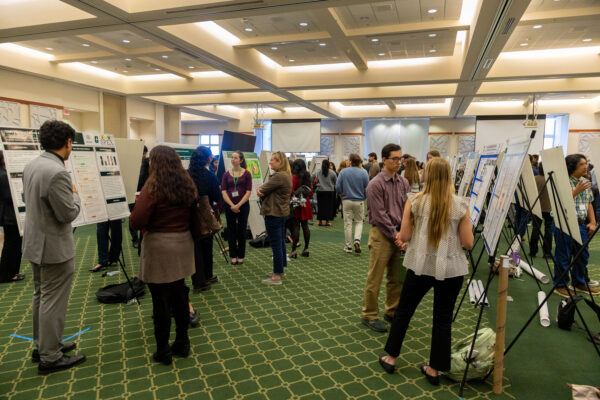
Nearly 1,500 students, faculty, staff and guests came to UNC Charlotte on Saturday, Nov. 7, for the 22nd State of North Carolina Undergraduate Research & Creativity Symposium (SNCURCS), a statewide gathering showcasing undergraduate research and creative scholarship.
Co-hosted by UNC Charlotte and Central Piedmont Community College, the symposium featured 620 presentations from 774 student researchers representing 49 institutions. Participants from 64 colleges, universities and high schools attended the event.
Students shared their research findings and creative work through poster presentations, oral presentations and exhibits or performances spanning a wide range of academic disciplines.
“UNC Charlotte has been rapidly growing internship opportunities, including undergraduate research, so to have the opportunity to showcase those investments was exciting,” said Lance Barton, director of the Office of Undergraduate Research. “To collaborate with so many offices and across institutions to bring an event of this magnitude with the mix of presentation and professional development opportunities to Charlotte was tremendous. It was a big win for our campuses, our programs, but also for the region to have so many folks visit Charlotte and recognize that we are leading in this area.”
Building skills and connections beyond the classroom
Beyond sharing their research, students connected with peers, faculty mentors and representatives from graduate programs and other organizations through networking activities, professional development workshops and the symposium’s Future Fair.
The fair allowed students to explore graduate education, research opportunities, internships, scholarships and potential career paths while building relationships with institutions and organizations from across the state.
“Undergraduate research builds skills, confidence and competence in areas that build career readiness,” Barton said. “Building those communication skills by presenting research is important for student researchers.”
Yazi Bulluck, a UNC Charlotte student majoring in biology and psychology, shared her research on mental healthcare in the Western Cape of South Africa.
Her poster presentation examined how the legacies of apartheid, the history of involuntary institutionalization and differences between public and private health coverage affect access to mental healthcare.
Bulluck developed her interest in the topic through her experience working with the University’s Collective Wellness Lab. A study abroad experience in South Africa over the summer led her to explore how those challenges translate across different cultures and historical contexts.
While presenting her research at SNCURCS, Bulluck spoke with a psychologist from Fayetteville State University who noticed the word “Ubuntu” — an African philosophy emphasizing community, interconnectedness and shared responsibility — highlighted on her poster.
He shared his experience as a Kenyan psychologist with Bulluck. They talked about the importance of culturally competent care frameworks and the need to train and educate trusted members within these communities to make care more accessible for those struggling with mental illness.
“This interaction was very meaningful as it showed me that this research, although focused on South African mental health care, is relevant for other countries and cultures,” Bulluck said.
Bulluck, who is expected to graduates in 2028, hopes to continue her education by pursuing a doctorate in clinical health psychology.
“Being involved in research has truly been a critical part of my undergraduate career,” she said. “These experiences, both participating in a formal lab setting and in a study abroad program, have given me a broad perspective on how research can be done in any discipline.”
Research experiences with lasting impact
The symposium’s keynote address was delivered by Karen Resendes, president of the Council on Undergraduate Research, a national organization that supports undergraduate research, scholarship and creative inquiry.
Her address emphasized the lasting influence of undergraduate research on students’ academic and professional careers and their communities.
For Barton, the symposium demonstrated how institutions across North Carolina are preparing students for the future while advancing research and innovation.
“A lot of attention has been focused on how higher education prepares students for post-graduation success and I think SNCURCS is a perfect example to show how North Carolina is successfully doing that,” he said. “From high schools to community colleges to small colleges to large research universities, SNCURCS showcases how we’re all invested in student success and driving innovation in our state, across the nation and internationally.”
Written by: Bernie Petit
Photo by: Menelik Clark