Growing up in a household where lively debates were everyday occurrences helped foster Sina Gholami’s sense of exploration.
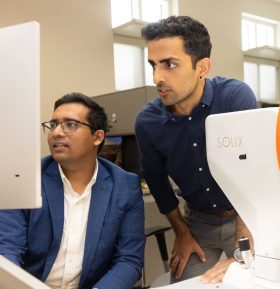
A doctoral student in the William States Lee College of Engineering, Gholami is working closely with Minhaj Nur Alam, assistant professor of electrical and computer engineering, to develop federated learning frameworks to aid optometrists’ treatment of patients.
Gholami’s decision to join Alam’s Quantitative Imaging and AI Laboratory began with a LinkedIn post he came across while finishing a master’s degree at the University of Pisa.
“Dr. Alam was seeking Ph.D.s to apply deep-learning models to address health care issues. I phoned him immediately, and by the end of the call, I was certain UNC Charlotte was the place to help me transform the theories I’ve studied into something tangible,” said Gholami.
Visualizing Computer Code
A native of Shiraz, Iran, Gholami was introduced to computer programming by his father’s cousin, Shahrokh Rastegar, known affectionately as “Mr. Engineer.”
Like many middle-schoolers, Gholami enjoyed video games. But one day, Mr. Engineer asked a question that changed the youngster’s life. “Instead of playing video games, why not build your own?”
Together, they constructed a head-to-head air hockey game. Then, a few days later, Rastegar challenged his younger relative to write a bot that could defeat him in the game.
“The moment I saw my self-written AI paddle return my shots I knew I wanted to become an engineer,” Gholami said.
Immersion in computer programming throughout high school led him to develop algorithms for a number of projects
“Even before I begin writing a program, I can visualize in my mind precisely how to create it, defining it step-by-step,” explained Gholami.
Seeking Academic Inquiry
Leaving Iran for Italy freed Gholami from the insularity of his native environment. He completed an undergraduate degree through the Baha’i Institute for Higher Education, a distance education program created because members of the Baha'i faith are barred from Iranian public universities.
Dual motivations to acquire greater theoretical training in artificial intelligence and to experience an academic culture rooted in open inquiry led Gholami to the University of Pisa. “Living in Italy promised day-to-day immersion in a new language and viewpoint, plus, Galileo once taught there, which appealed to the part of me that always asks, ‘Why?’”
During his three years at the University of Pisa, Gholami took advantage of exploring Europe. His favorite sightseeing destination was Prague, capital of the Czech Republic, “a beautiful city with great history and a really cool atmosphere.”
Bringing Theory to Life
UNC Charlotte’s commitment to first-generation and international students, combined with Professor Alam’s mentorship, is enabling Gholami to chart a course in doctoral studies and research with a bright future in both academia and the private sector. A bonus is the Queen City’s expanding medical-technology sector.
Just three months into his residency, Gholami presented at the 2023 annual meeting of the Association for Research in Vision and Ophthalmology in New Orleans.
“Dr. Alam really encouraged my attendance to better understand the potential impact of my work,” said Gholami. “I met several clinicians and ophthalmologists who were interested in collaborating on our use of AI to develop assistive technology solutions.”
Beyond conference presentations, Gholami has co-authored more than 10 scholarly articles for various academic journals, including “Distributed training of foundation models for ophthalmic diagnosis” published in Communications Engineering.
According to the article, vision impairment affects more than two billion individuals globally. Reliable AI-assisted detection methods for conditions like diabetic retinopathy and age-related macular degeneration could aid intervention methods.
Gholami and Alam are developing an AI-assistant to analyze retinal scans. Eye clinics use an optical coherence tomography scanner, which is akin to an ultrasound with light. An OCT, in less than a second, captures a stack of paper-thin 3-D sections of a retina resulting in hundreds of grayscale images. It’s virtually impossible to review them all pixel by pixel. But, an AI assistant can browse through millions of scans to identify even the slightest variation in biochemical signals.
While he is a year from completing a Ph.D. in electrical and computer engineering, Gholami is confident in his decisions thus far. “The University of Pisa provided me with the theoretical compass; Charlotte is giving me the equipment, field site and map to complete my journey.”