Building a greener future: How Fushcia-Ann Hoover is reshaping environmental education
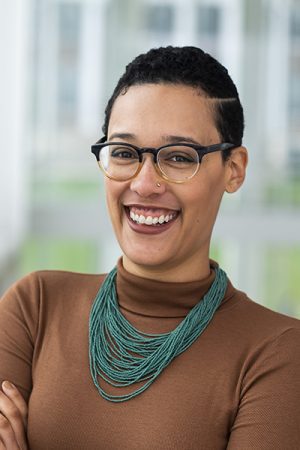
Fushcia Ann-Hoover, assistant professor in the Department of Earth, Environmental and Geographical Sciences, spends a lot of time thinking about humans’ relationship to the planet.
A former postdoctoral fellow at the National Socio-Environmental Synthesis Center, Hoover also served as a Harvard-Salata Climate Justice Fellow. For five years at UNC Charlotte, she has encouraged students to think critically about the environment beyond the classroom. That included being a role model, training to be a sustainability ambassador and helping her department earn a Green Workplace badge.
As Earth Month approaches Hoover believes now is a great time for reflection.
“It’s a time to reflect on habits and behaviors so that it’s not just us that gets to enjoy the planet — it’s so those seven generations ahead of us are able to enjoy this space and create community within it,” Hoover said.
Connecting with nature
Hoover grew up in St. Paul, Minnesota, a walkable city with public access to the Mississippi River and many lakes. Her mother’s rural upbringing and lifelong gardening further instilled in Hoover an appreciation for the natural world.
When Hoover left for graduate school, she learned quickly that not all U.S. cities are designed with nature in mind. This fueled her interest in studying the intersection of sustainability and urban planning.
Hoover practices sustainability in her own life in Charlotte by limiting her use of petroleum and plastics, pushing herself to walk for short trips and subscribing to Crown Town Compost. She also recommends the simple act of sitting outside to build a relationship with the environment.
“Especially with how fast-paced our world is, and the declining attention spans, sometimes it’s good to just go sit outside and be bored,” Hoover said.
Campus connections to sustainability
UNC Charlotte facilities offer students a look at sustainable systems in practice. Since 2024, Hoover has collaborated with the Office of Sustainability for a waste audit in one of her entry-level classes. In fall 2025, students collected a week’s worth of trash (excluding food and medical products) to be sorted; the resulting report found the class diverted 53% of its waste from the landfill.
“I think this audit gave students a greater awareness of what they are doing out of convenience versus what they’re doing out of thoughtfulness,” Hoover said.
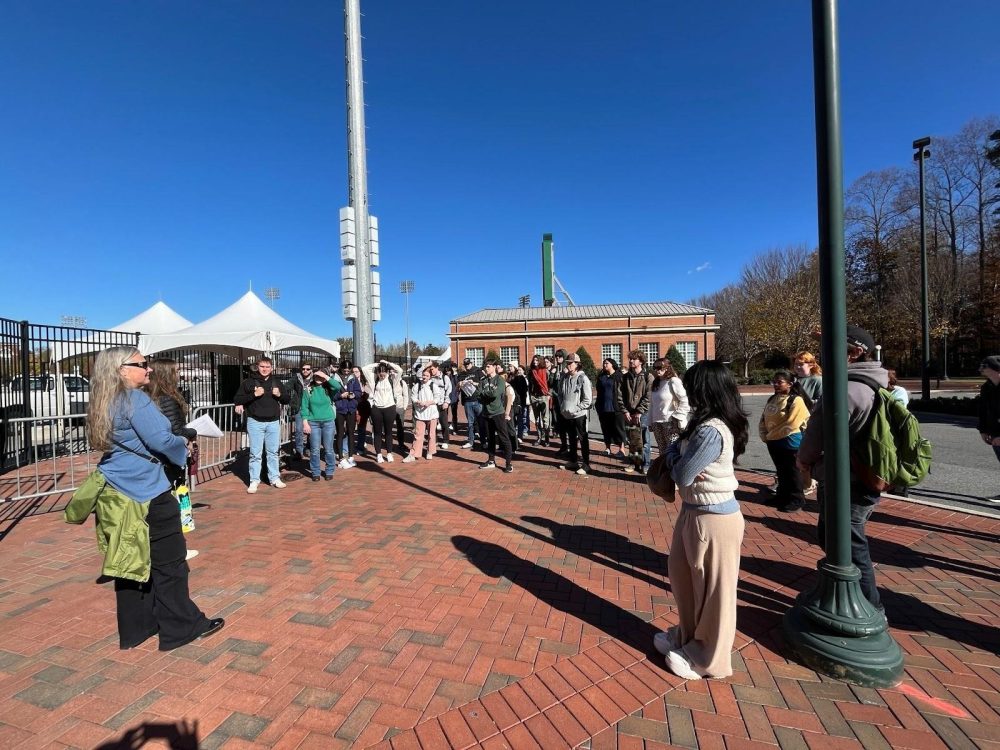
Keeping with the waste diversion theme, Hoover’s class toured Charlotte’s zero-waste football stadium operations and participated in a post-game trash sorting. Hoover’s graduate students explored Charlotte’s stormwater management systems to see how “best management practices” are intentionally planned to manage water quality.
Broadening perspectives through a sustainability minor
Hoover is the director of a new sustainability minor launching in fall 2026. This program aims to allow students from various disciplines to learn more about sustainability and how it impacts their respective fields. Hoover believes that giving students the opportunity to connect their career interests to sustainability will give them a valuable “tool in their toolkit” to take into the workforce.
“When you take a class that you’re not familiar with, and that’s outside of your major, it gives you a new way of thinking,” Hoover said. “It pushes your brain to develop different neural pathways and think more critically about how to approach a problem.”
As a first-generation student, Hoover feels called to make STEM disciplines, particularly environmental science, accessible to more students. Establishing a minor in sustainability allows for more students from various backgrounds to engage with the topic — bringing forth new perspectives. Hoover noted that many developments in widespread sustainability have come on the backs of youth movements.
“I really enjoy teaching because it allows me to break things down for students in a way that is tangible, relevant and helps identify them as the solution,” Hoover said. “Yes, there are a lot of complex problems, but [students] are the ones that are bringing that fresh perspective, and new ideas to help us find solutions.”