Student Success Summit focuses on Charlotte Model and first-time-in-college students entering with 30+ credits
Not all first-time-in-college students come to campus as freshmen.
First-time-in-college non-freshman students are those who arrive at UNC Charlotte with 30 or more earned credits, typically through Advanced Placement, early college or dual enrollment pathways.
In fall 2021, only 688 first-time-in-college students arrived at the University with 30+ credit hours. By fall 2025, that number skyrocketed to 1,259, meaning that — as a portion of the total incoming class — these high-credit students grew from 16% in 2021 to more than 25% in 2025.
UNC Charlotte faculty and staff shined a light on these students on March 31 during the University’s Student Success Summit, a campuswide effort to strengthen student success through the Charlotte Model.
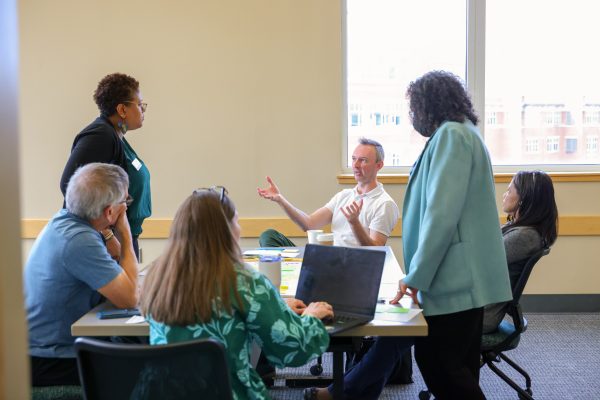
The summit, held in the Popp Martin Student Union theater, brought together campus leaders and practitioners from across advising, coaching, enrollment, academic, business and student affairs, student success programs and OneIT to examine how students experience the University — and how that experience can be improved through greater coordination and alignment.
“Students experience Charlotte as one institution — one journey — and it is our responsibility to ensure that journey is clear, cohesive and supportive at every stage,” said Jennifer Troyer, provost and vice chancellor for academic affairs.
The Charlotte Model is UNC Charlotte’s institution-wide framework for understanding, designing and improving the student experience across the full college lifecycle, from pre-admission through alumni engagement. It provides a shared structure and common language to help align campus efforts around how students actually experience the University.
By aligning efforts across the University, the Charlotte Model ensures all students — from first-generation to transfers and from undergraduates to graduate students — can design and achieve their unique path to success.
The summit focused on first-time-in-college students who enter college as non-freshmen because, while these students often progress quickly through academic requirements, they may encounter gaps in access to information, engagement, skill building experiences and opportunities traditionally designed for first-year students.
During the summit, participants explored the student experience through four interconnected lenses: academic experience, skills and experience, campus engagement and “College 101,” or how students navigate the University’s systems, resources and expectations.
Sessions included a review of student engagement and retention data, highlighting the connection between involvement and student success.
Students entering with 30 or more credits were found to be less engaged overall than their peers, but retention increased at every level of engagement, with the most significant gains occurring when students moved from no engagement to even modest involvement.
Participants then worked in cross-functional groups to map the student journey across key transition points, from recruitment through graduation and alumni engagement. The goal was to identify strengths, gaps and opportunities to better align institutional systems, policies and practices.
“The Charlotte Model helps us organize the many efforts already happening across the University and better understand how they come together to shape the student experience,” said Karen Shaffer, associate vice chancellor for student affairs.
The summit builds on ongoing collaboration across Academic Affairs, Student Affairs, Business Affairs and OneIT to create a more coordinated and intentional approach to student success.
Work will continue through the summer as campus partners translate insights from the summit into strategies to strengthen the student experience and support student success.