UNC Charlotte projects named in first cohort of U.S. Department of Energy Genesis Mission
The U.S. Department of Energy has selected two UNC Charlotte projects for the first cohort of the Genesis Mission. The projects led by Stephanie Schuckers, Bank of America Distinguished Professor in Computing & Informatics, and Jinzhen Wang, assistant professor of computer science, were among the projects highlighted at the Genesis Mission Summit in Washington, D.C. on July 22, 2026.
The Genesis Mission is a historic national initiative led by the U.S. Department of Energy, which is building the world’s most powerful integrated science discovery platform. By uniting government, industry, academia and philanthropy, it is accelerating breakthroughs in energy, scientific discovery and national security through a new platform that combines AI, supercomputing, quantum systems and advanced scientific instruments.
“We thank the Department of Energy for partnering with UNC Charlotte researchers for the inaugural Genesis Mission,” said Bojan Cukic, professor and dean of the College of Computing and Informatics. “Having two projects chosen for this national initiative demonstrates our position at the forefront of applied AI research. Our faculty are working to make next-generation supercomputing both secure and trustworthy. We’re grateful that the DOE is empowering us to solve these massive, real-world problems and accelerate critical breakthroughs in energy, science and national security.”
The goal of the Phase I RFA awards is to identify promising pathways toward transformative scientific capabilities and establish a foundation for future investment and scale. Project teams will design and demonstrate research workflows that integrate AI with scientific investigation, while rigorously evaluating whether those approaches can accelerate discovery, improve predictive capabilities, enhance experimentation or generate new scientific insights.
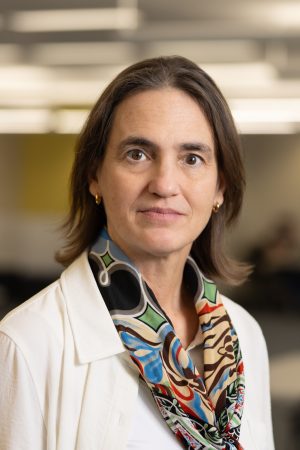
For Schuckers’ project GATEKEEPER: AI-Mediated Cybersecure Air-Gapped Enclaves for High-Throughput Science, her research team will partner with Oak Ridge National Laboratory scientists to develop an AI-driven framework that enables secure, controlled and auditable data sharing between highly-protected research environments and external data sources.
“Traditionally, keeping the most sensitive research secure meant completely disconnecting supercomputers from the outside world. The data was protected, but collaboration was significantly slowed down,” Schuckers said. “GATEKEEPER aims to bridge that gap. By deploying AI as an intelligent security checkpoint, we believe we can safely allow data to flow in and out of isolated environments in real time, giving scientists the speed they need to innovate without compromising data security.”
Wang’s project, CASCADE: Composable Assurance for AI-enabled Scientific Computing with Agentic Error Governance, aims to provide DOE AI models with a layer of functionality to better work with “lossy” scientific data — data that is compressed to be usable at scale, but necessarily loses some amount of detail in the process. The goal is to create software that automatically gives detailed, auditable explanations when AI models use this type of data, along with precise confidence levels to make sure scientists can fully trust the models’ outputs.
“To accelerate research, DOE supercomputers have to compress massive datasets, but losing the wrong detail can ruin entire experiments,” said Wang. “We’re building CASCADE to automatically verify when this simplified data is safe to use, giving scientists a transparent receipt for every AI decision so they can confidently speed up their breakthroughs without second-guessing the data.”
Written by: Schaefer Edwards and Andrew James