Prompts to Poems: Meet the ‘instant poets’ ahead of Valentine’s Day-themed Fundraiser
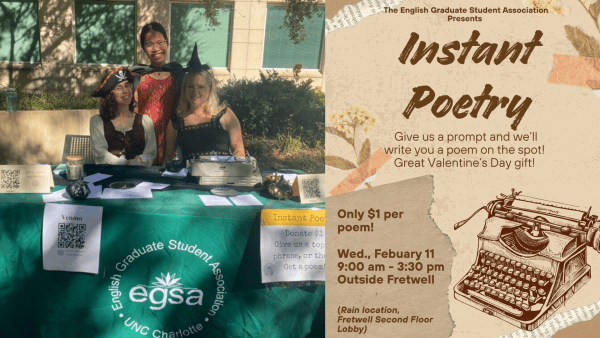
If you were walking by the Fretwell Building on Oct. 15, you may have seen something peculiar — a pirate, a witch and a mage sitting at a table behind a typewriter. That was English graduate students Izzy Cross, Anna Robinson and Haley McCall and they were doing an ultimate test of creative writing — instant poetry.
The three took prompts from passing students, which could be anything from a single word to a love poem written by a knight who likes spaghetti. Then, on the spot, they turned the prompt into a poem, written on a typewriter, which the students walked away with. No drafts; no redos.
“Instant poetry is such an incredible exercise in turning off that editorial brain and just looking for what comes instinctively,” McCall said.
The English Graduate Student Association’s Instant Poetry Fundraiser returns from 9 a.m. to 3 p.m., Wednesday, Feb. 11. Cross, McCall and Robinson will be in front of the Fretwell Building again, turning prompts to poems, in an event that makes for a cute Valentine’s Day present.
“If someone is drawn to the idea of giving their partner a love poem but aren’t sure how to go about creating it themselves, they can just come up to us and we’ll give them a poem that’s personalized for their partner,” Robinson said.
Cross, McCall and Robinson share the experience of writing poetry on the spot and the key to a good love poem in this Q&A.
What was the experience of the first Instant Poetry Fundraiser like? Was there a lot of pressure to produce a poem on the spot?
Robinson: I feel like we shared the pressure really well amongst ourselves. There were moments when it was hard to put things into words on the spot — but everyone was so warm. It was intimidating at first but the sense of community around it made it less so.
Cross: A lot of people would stand there after and read the poem so I think being able to see the positive reception to your poem immediately was really great. The communal creative spirit was just really contagious. It was just really awesome to get to see the impact of your words.
McCall: I was really scared for my first poem out in public. It was a gratifying way to push back against the idea that the English department is insulated and that we are the only ones that care intensely about the things that we care about. It was reassuring to have people from all kinds of majors and backgrounds be so curious and receptive to what we were doing.
What is your approach to writing instant poetry?
Cross: If I’m writing poetry for myself, I usually begin with either an emotion or an image. But with instant poetry, once I feel like I’ve got a good understanding of what they want from the poem, I just kind of go with the first thing that I’ve got in my head. In a sense, that critical part of your brain gets turned off.
Robinson: As a writing teacher, I make students free write all the time. One of my favorite things is to force people to just keep writing and you will eventually get to something good. For better or worse, that’s how I approach instant poetry. I will make a list of words, phrases and cliches associated with whatever the topic is until hopefully we get to something more poetic.
Were there any stand-out prompts from the first Instant Poetry Fundraiser?
McCall: I remember one that was very strange, but it came out really well. One person was describing their Dungeons and Dragons character, which was a werewolf pirate. It was a silly, lighthearted conversation, but ended up being very serious and emotional. Once I gave them the poem, they were like, ‘I have to tell my game master. I need to integrate this into my lore.’
What is the goal of Instant Poetry?
Cross: We’re putting on the event to raise money for our English Graduate Symposium in April. But we’re also just interested in connecting with people outside of our department and reaching people who aren’t typically interested in words, writing and language, and showing them what fun and what magic it can be.
McCall: I also found that a lot of people brought personal prompts, wanting to talk about relationships with other people or their pets. A lot of them ended up feeling a little bit therapeutic or fortune teller-esque, where they would read the poem and then realize that they hadn’t thought about their situation the way that we as outsiders present it back to them. I think that’s kind of the beauty of literature in general and the English department in general is using language to examine the world. So that’s a really fun outcome.
What is the key to a good love poem or story?
Robinson: Anytime I’m trying to write something for another person, whether it’s a birthday card, a love poem, what have you, it’s specificity. For me, the greatest measure of a love poem is this can only be for one person.
Cross: Even in reading love poems, if I can tell that it was written for a specific person, I think that’s a lot more impactful than something that is trying to talk about love generally, because the reality is that love looks different for everyone.
Written by: Alex Reynolds