Inside BMW’s production floor: A Charlotte student’s hands-on co-op experience
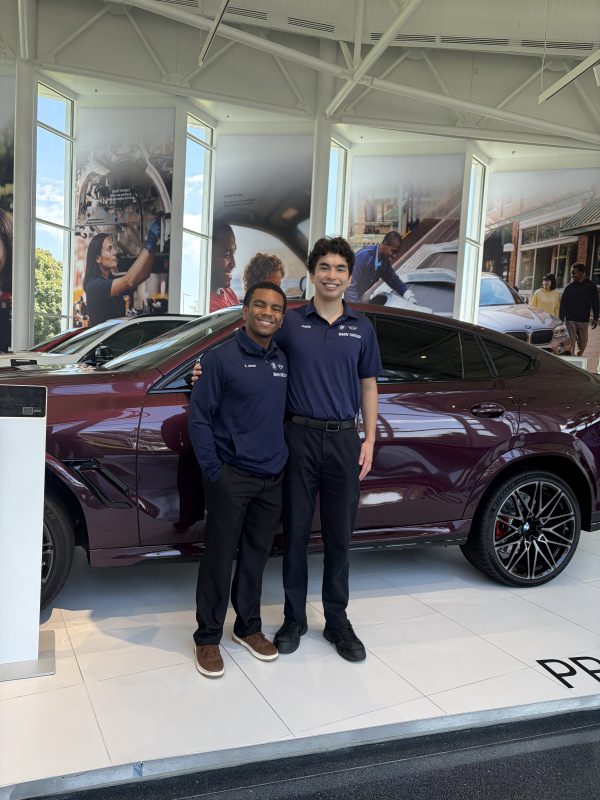
For senior computer science student Austin Lee, a cooperative education experience with BMW USA’s Spartanburg plant has done more than provide professional experience, as it has shown him firsthand how classroom skills translate into real-world projects.
Lee is pursuing a bachelor’s degree in computer science with a concentration in software engineering, and he plans to pursue a career in software or AI engineering. His path to BMW began with undergraduate research at the University, where he gained hands-on experience with AI systems. That work strengthened his skills and gave him concrete examples to discuss with employers throughout the interview process. It also reinforced a quality that BMW looks for in its interns and employees: the ability to solve problems.
“Technical skills are important, but they are only part of what companies are looking for,” Lee said. “Strong soft skills are what enable you to demonstrate what you know and apply that knowledge effectively.”
His role and different rotations
Lee’s co-op has given him experience across several rotations. His first assignment focused on controls engineering, which is the design and maintenance of automated systems that keep manufacturing equipment running. In that role, he supported controls engineers by building and repairing software and hardware for the body shop production floor.
In his second rotation this summer, Lee completed a predictive maintenance internship in BMW’s press shop, where parts for the body shop are produced. He develops Power Apps and other tools to track and prevent defects, and he helps automate planning processes. The work was very hands-on, as he assembled control panels and quality-checked parts.
Connecting academics with experience
The co-op structure alternates full-time academic semesters with professional work rotations, which Lee called one of the most rewarding parts of the program. Lee says that returning to campus after a rotation has given him a clearer understanding of how classroom topics apply to industry.
The transition between the two settings was challenging at first. Coursework and exams dominate the classroom, while his rotations required collaborating with professional teams to solve real-world problems. Managing his time and learning to work effectively with others were essential to making that shift successfully.
His first rotation also reshaped how he approached academics once back at school. It helped him identify which skills and subjects mattered most to his career goals, and which mattered less than he expected.
“It helped me better understand which skills and subjects would be valuable in my future career, and which areas were less important than I originally thought,” Lee said. “As I continue with school, I am able to better prioritize my academics and make better use of my time before graduating.”
Growing professionally
Beyond technical rotations, Lee has taken advantage of BMW’s professional development offerings for interns, including workshops on presentation skills, resume critiques, and elevator-pitch practice. He said these opportunities have built his confidence as he prepares to enter the workforce.
Networking has played an equally important role. One-on-one coffee chats are a common part of BMW’s culture, Lee said, and they’ve allowed him to connect with professionals he might not otherwise meet.
“Inviting people to have a one-on-one meeting is a really great way to hear their career story and get good insight and advice that they may have for you,” Lee said. “One thing I’ve realized is that people want to see you succeed. Being able to network within my team and even externally has allowed me to grow my network of professionals who are actively helping me grow and are pushing me closer toward my career goals.”
Finding new career interests
Before starting the co-op, Lee hadn’t pictured himself in a manufacturing environment. That has changed. As he moves through his final rotation, he has grown increasingly interested in manufacturing, particularly the automotive industry, and the work involved in producing a vehicle.
Advice for students considering a co-op
Lee’s advice is simple: Take initiative. He encourages students to ask questions, look for ways to contribute to their teams, and build connections across the organization.
He also recommends the co-op model itself over a traditional internship, given the chance to work multiple rotations with the same company.
“If you are interested in potentially doing a co-op, I’d recommend it 100%,” Lee said. “Having the ability to work in a company or role for multiple rotations provides a lot more opportunities and growth compared to a traditional internship. Working through multiple rotations allows you to build up your knowledge on the specifics of the company and industry and creates an environment for you to work your way up to more complex and important projects and an increase in responsibility.”
The co-op program is available for Charlotte undergraduate students in architecture, computing and informatics, and engineering as well as for graduate students in architecture and health psychology. Students remain in full-time student status while on co-op assignment and are enrolled in a zero-credit class noted on their transcript.
Written by: The Career Center